Ajinkya Yeole’s RHCSA Achievement and Practical Next Steps
WebAsha's announcement reports Ajinkya Yeole's RHCSA achievement after Linux training. Congratulations to Ajinkya on this milestone. RHCSA recognizes assessed core administration skills, and it can provide a useful foundation for further Linux work. This article explains the credential's practical context, a service-permission exercise and ideas for continued learning.
Topic: Red Hat & RHEL in IT Infrastructure · Certification preparation
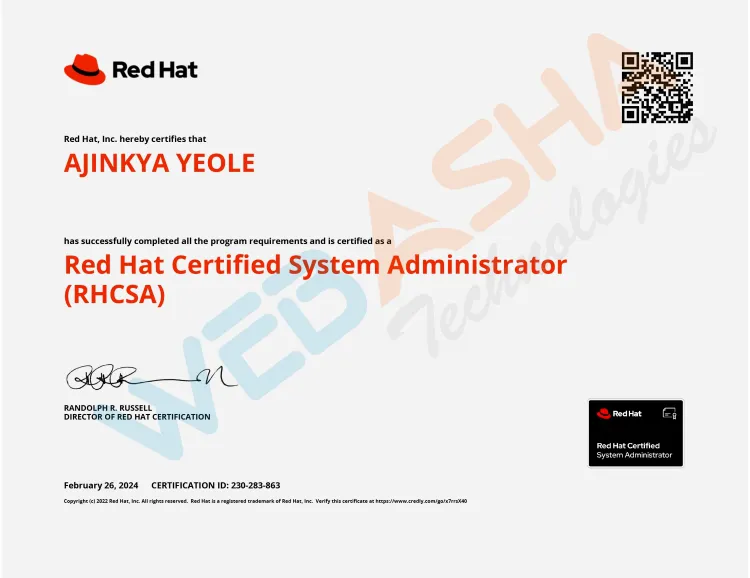
Quick answer: WebAsha's announcement reports Ajinkya Yeole's RHCSA achievement after Linux training. Congratulations to Ajinkya on this milestone. RHCSA recognizes assessed core administration skills, and it can provide a useful foundation for further Linux work. This article explains the credential's practical context, a service-permission exercise and ideas for continued learning. It also points to issuer verification and current objectives for readers planning their own assessment.
Key takeaways
- Recognize the reported achievement with clear attribution.
- Understand RHCSA as an assessed practical credential.
- Use current objectives for your own preparation.
- Let the holder control personal verification details.
- Build further evidence through small, well-explained projects.
Table of Contents
- What does Ajinkya Yeole’s RHCSA milestone recognize?
- What does RHCSA represent in practical terms?
- Which skills make this achievement relevant to Linux learners?
- How do practical Linux skills help explain a service failure?
- What can another learner take from this milestone?
- What would a useful next project look like?
- How should readers understand an issuer verification result?
- How can the achievement lead to continued development?
- References
What does Ajinkya Yeole’s RHCSA milestone recognize?
Congratulations to Ajinkya Yeole on this Linux-learning milestone. Preparing for a hands-on assessment involves more than recognizing command names: it calls for connecting a requirement to a working configuration and checking the result.
For fellow learners, this is a useful moment to look at the administration skills behind the credential and choose a practical next step. A small exercise that you can explain independently is a good way to keep those skills active after an examination.
Celebrate the achievement, share the credential wording accurately and let Ajinkya describe any personal learning story or future plans he chooses to make public.
What does RHCSA represent in practical terms?
The Red Hat RHCSA page describes a credential earned through EX200 and focused on core administration skills in Red Hat Enterprise Linux environments. It is a practical milestone rather than simply a record of attendance.
The assessed area includes working with system tools, storage, users, services and security. Those subjects connect because a useful system configuration must serve the intended operation under the appropriate identity and constraints.
A learner can take pride in completing a demanding assessment while continuing to develop depth. The credential's scope does not require a claim that the holder has already administered every production environment or mastered every related technology.
Which skills make this achievement relevant to Linux learners?
The current EX200 objectives provide a concrete view of the assessment. The page checked on 15 November 2026 describes RHEL 10 and asks candidates to complete tasks independently, with configurations persisting after reboot.
A strong learning habit is to connect configuration to verification. When creating an account, ask what the intended user can do. When configuring a service, distinguish its current state from startup behavior. When handling storage, check the exact filesystem and target.
The public objective list can change. Someone preparing now should use the designated exam version rather than assume the current list reconstructs the content of Ajinkya's earlier assessment.
| Skill area | Practical learning question |
|---|---|
| Files and permissions | Can the intended identity perform the required operation? |
| Services | Does the service have the required runtime and startup behavior? |
| Storage | Does the intended filesystem serve the correct persistent target? |
| Networking | Does the configured identity and path match the requirement? |
| Security | Is the needed operation permitted without unnecessarily weakening controls? |
How do practical Linux skills help explain a service failure?
Consider a fictional follow-up exercise. A reporting service runs as reportsvc. It can read its configuration, but the supplied failure record says it cannot create an output file in /srv/reports. The directory is owned by root:root with mode 0755; the service identity is neither the owner nor privileged. Assume the parent directories permit traversal and no additional ACL or security-policy restriction changes the supplied facts.
The mode permits this identity to search and read the directory, but does not grant it directory write permission. Reading a configuration file therefore does not establish permission to create a different file. The Linux pathname-resolution manual also explains why access through parent directories matters.
Review the intended ownership and access arrangement before proposing a correction. Grant the required operation narrowly and verify it as the service identity in an approved lab, rather than making the directory writable by everyone.
| Supplied fact | Reasoning |
|---|---|
| Service identity is reportsvc | Its access differs from a privileged administrator |
| Output directory is root:root, 0755 | The supplied identity lacks directory write permission |
| Configuration can be read | That is a different path and operation |
| Required outcome | The intended service creates output under an approved narrow access arrangement |
This is a permissions worksheet, not an executed Linux test. A real diagnosis must also consider ACLs, SELinux, read-only mounts and other relevant controls.
What can another learner take from this milestone?
Start with a learning plan that you can sustain. New administrators can compare their foundations with RH124, which introduces command-line and core administration work. Learners ready for additional storage, boot and security topics can review RH134.
Use a notebook to record requirements, observations, mistakes and corrections. Repeating a task from a clean lab state is useful because it exposes dependencies that may have been left behind by an earlier attempt.
Ask for feedback on the explanation as well as the final state. A clear account of why an operation worked is more transferable than a screenshot of a successful command. Ajinkya's achievement can be a prompt to build those habits, without assuming everyone needs the same schedule or training route.
What would a useful next project look like?
Choose a small, authorized administration project that deepens one assessed area. Write the intended behavior, the environment, the identity used and the acceptance checks before making changes.
For example, a personal lab project could document a service's required access to a working directory and the evidence used to verify that access. A second version could change the service identity, making the learner revisit the permissions rather than reuse the first result blindly.
Keep sensitive information and protected exam content out of a portfolio. Show the requirement, your contribution, meaningful checks and remaining limits. That gives a future technical conversation something concrete to discuss while keeping the credential and project evidence separate.
How should readers understand an issuer verification result?
Use Certification Central and the official verification service when the holder supplies an approved record. Match the person and credential carefully, and interpret the fields actually displayed.
Red Hat says its public service verifies certifications considered current and depends on the holder's mapped profile. An absent search result should therefore prompt a record or profile clarification, rather than an unsupported accusation about the learner.
For an achievement announcement, keep the verified status and the date of that check together if they are published. Do not silently convert a historic milestone into a statement that a credential remains current forever.
How can the achievement lead to continued development?
After celebrating, review the Red Hat Certification Program Guide and current learning paths before choosing another assessment. Select a direction because it matches a real gap or goal, not because every credential holder must follow one identical sequence.
Some learners deepen Linux operations; others apply their foundations to automation, containers or platform work. A new topic may require additional preparation even when the existing credential provides a useful base.
Ajinkya's RHCSA milestone deserves a clear, respectful announcement. The most useful continuation is practical: maintain the skills, record honest project work and choose the next learning objective with care.
Related reading: RHCSA preparation and persistent state; AWS DevOps Professional achievement.
References
Frequently Asked Questions
What's Your Reaction?
 Like
0
 Dislike
0
 Love
0
 Funny
0
 Wow
0
 Sad
0
 Angry
0

With a passion for staying on the cutting edge of technology trends, I am dedicated to delivering content that not only informs but also inspires. Whether you need in-depth analysis pieces, informative guides, or thought-provoking opinion pieces, I craft content that resonates with tech enthusiasts and professionals alike.