Top 12 Cybersecurity Books to Read in 2027 for Ethical Hacking & Certification Prep
Discover the best cybersecurity books to study in 2026 for beginners, ethical hackers, and professionals. Includes top picks for OSCP, CEH, CISSP, and blue/red team learning.
Topic: Ethical Hacking in Cybersecurity & Ethical Hacking · Certification preparation
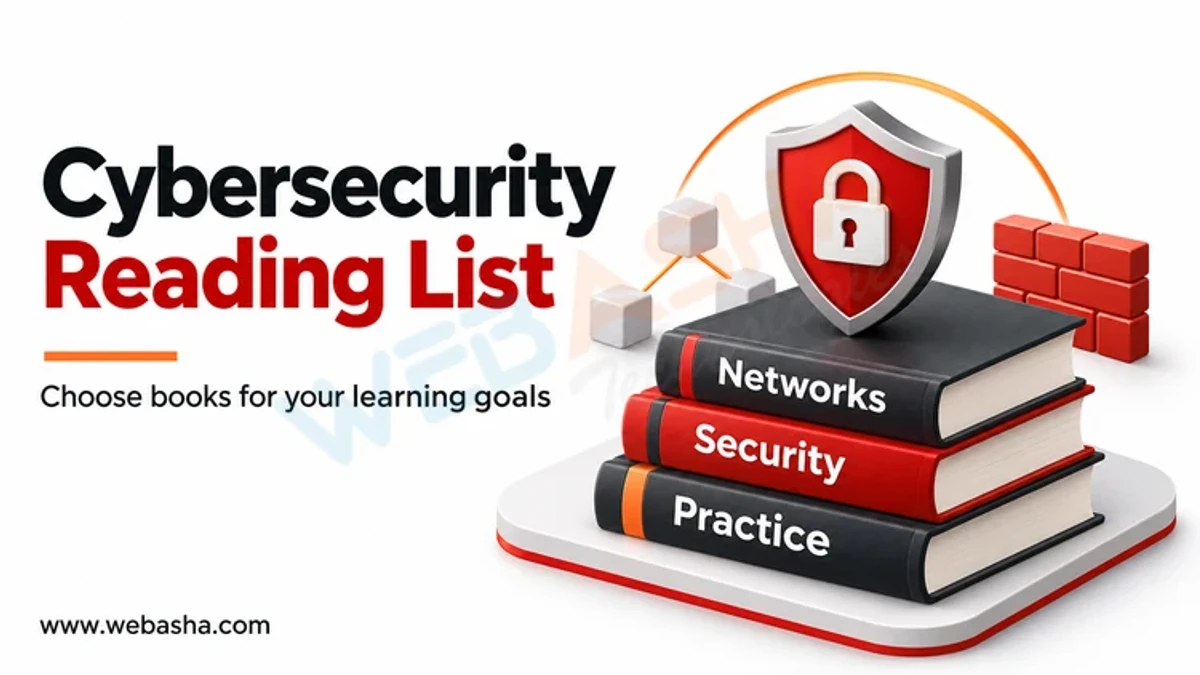
Quick answer: The best cybersecurity books to read in 2026 depend on your stage. Beginners should start with Linux Basics for Hackers (2nd edition) and Ethical Hacking by Daniel Graham. Penetration testers should add Metasploit (2nd edition, 2025) and Bug Bounty Bootcamp. Defenders should read Cybersecurity Blue Team Toolkit and the Blue Team Field Manual. For certifications, use these books alongside the official exam material, not instead of it.
Key takeaways
- Check the edition before buying: Linux Basics for Hackers should be the 2nd edition and Metasploit the 2025 2nd edition, not older copies.
- Older classics from 2008 to 2014 can still teach concepts, but treat their tool commands as dated and verify them in a current lab.
- Plan reading over about six months, pairing each book with hands-on practice, because a book alone will not prepare you for OSCP or CEH.
Many "best books" lists still recommend titles from 2008 to 2014 as if they were new. Some are still worth reading, some have been replaced. This list gives you 12 books, the edition to buy, who each one suits, and an honest note on what has aged.
The 12 best cybersecurity books for 2026 at a glance
| # | Book (edition) | Author(s) | Level | Best for |
|---|---|---|---|---|
| 1 | Linux Basics for Hackers (2nd ed.) | OccupyTheWeb | Beginner | Linux and Kali command line |
| 2 | Ethical Hacking: A Hands-on Introduction to Breaking In | Daniel G. Graham | Beginner | First structured hacking labs |
| 3 | Cybersecurity Blue Team Toolkit | Nadean H. Tanner | Beginner to intermediate | Defensive tools and habits |
| 4 | Metasploit: The Penetration Tester's Guide (2nd ed., 2025) | David Kennedy, Mati Aharoni, Devon Kearns, Jim O'Gorman, Daniel G. Graham | Intermediate | Exploitation framework skills |
| 5 | The Hacker Playbook 3 | Peter Kim | Intermediate | Red team workflow |
| 6 | Bug Bounty Bootcamp | Vickie Li | Beginner to intermediate | Modern web vulnerabilities |
| 7 | The Web Application Hacker's Handbook (2nd ed.) | Dafydd Stuttard, Marcus Pinto | Intermediate | Web testing methodology |
| 8 | Social Engineering: The Science of Human Hacking (2nd ed.) | Christopher Hadnagy | All levels | Human side of attacks |
| 9 | Hacking: The Art of Exploitation (2nd ed.) | Jon Erickson | Advanced | Memory, C and assembly |
| 10 | Practical Malware Analysis | Michael Sikorski, Andrew Honig | Advanced | Reverse engineering malware |
| 11 | Blue Team Field Manual (BTFM) | Alan White, Ben Clark | All levels | Incident response quick reference |
| 12 | Serious Cryptography (2nd ed., 2024) | Jean-Philippe Aumasson | Intermediate | Modern cryptography in practice |
Best cybersecurity books for beginners
1. Linux Basics for Hackers (2nd edition)
Start here if the Linux terminal still feels unfamiliar. It covers files, permissions, networking commands, scripting and services using Kali Linux, which is the base for nearly every hacking course and certification. Buy the second edition; the first dates from 2018. Pair it with our explainer on the Kali Linux file system hierarchy while you practise.
2. Ethical Hacking: A Hands-on Introduction to Breaking In
Daniel Graham's book walks you through building a lab and working through a sequence of attacks, from capturing traffic to exploiting web apps and escalating privileges. Its strength is structure: each chapter has hands-on exercises, so you learn by doing rather than by reading tool lists.
3. Cybersecurity Blue Team Toolkit
If you lean towards SOC or defensive work, this is a gentle start. It explains the everyday tools defenders use, such as packet capture, vulnerability scanning, logging and patch management, in plain language. It is from 2019, so treat product screenshots as examples and focus on the habits it teaches.
Best books for penetration testing and ethical hacking
4. Metasploit: The Penetration Tester's Guide (2nd edition, 2025)
The first edition was a classic but badly out of date. The 2025 second edition, published by No Starch Press, refreshes it for current Metasploit and adds topics such as Active Directory. Read it after you know Linux and basic networking. Remember that many exams, including OSCP, restrict how much Metasploit you may use, so learn the manual techniques too.
5. The Hacker Playbook 3
Peter Kim's book follows a red team engagement from setup to reporting. It teaches how professionals think about an assessment, which is more useful than any single tool. It was published in 2018, so some specific tools have changed; the workflow has not.
6. Bug Bounty Bootcamp
Vickie Li's book is one of the clearest modern introductions to web vulnerabilities such as XSS, IDOR, SSRF and insecure deserialisation, with a focus on finding and reporting them responsibly. It is a good bridge between a beginner book and real web testing.
7. The Web Application Hacker's Handbook (2nd edition)
This is still the best explanation of web testing methodology, but it dates from 2011. Its authors, the team behind Burp Suite, have said there will be no third edition. PortSwigger recommends its free Web Security Academy instead, because interactive labs stay current. Read the book for method and use the Academy for up-to-date practice.
8. Social Engineering: The Science of Human Hacking (2nd edition)
Most real breaches involve a human step: phishing, pretext calls or fake support. Hadnagy explains how these attacks are built and, just as importantly, how organisations train people to resist them. Useful for testers, awareness trainers and managers.
Best advanced and specialist books
9. Hacking: The Art of Exploitation (2nd edition)
This book teaches exploitation from the ground up: C, assembly, memory and the stack. It is from 2008 and its examples use 32-bit Linux without today's protections, but nothing explains the fundamentals as clearly. Read it once you can program, and treat it as theory for exploit development.
10. Practical Malware Analysis
Still the standard text for learning static and dynamic malware analysis, debugging and reverse engineering in a safe lab. It dates from 2012, so samples target older Windows versions; the analysis method transfers directly to modern work.
11. Blue Team Field Manual (BTFM)
A pocket reference of commands and checklists for incident response, organised around identify, protect, detect, respond and recover. It is not a book you read cover to cover; keep it on your desk during labs and exercises.
12. Serious Cryptography (2nd edition, 2024)
Older lists recommend Bruce Schneier's Applied Cryptography, whose main text dates from the 1990s. For 2026, Aumasson's Serious Cryptography is a better first choice: it explains modern encryption, hashing, TLS and common implementation mistakes, and the second edition adds newer topics such as post-quantum cryptography.
Older classics: still worth it, or skip?
- Penetration Testing by Georgia Weidman (2014): still a clear explanation of concepts, but its tool versions and lab setup are outdated. Choose Graham's Ethical Hacking as your first hands-on book instead.
- Applied Cryptography by Bruce Schneier: historically important, not a practical first crypto book in 2026.
- Cybersecurity and Cyberwar by P.W. Singer and Allan Friedman (2014): a readable policy primer for managers, but its threat examples predate ransomware's rise. Read it for concepts, not current events.
Which books help with OSCP, CEH, CISSP and Security+?
Books build understanding, but every major certification has official preparation material that matters more. Use this table to combine them:
| Certification | Start with the official material | Books that support it |
|---|---|---|
| OSCP (OffSec) | OffSec's PEN-200 course and labs | Linux Basics for Hackers, Ethical Hacking, Metasploit 2nd ed., The Hacker Playbook 3 |
| CEH (EC-Council) | EC-Council's official CEH courseware for the current version | Ethical Hacking, Bug Bounty Bootcamp, Social Engineering |
| CISSP (ISC2) | ISC2's official study guide and practice tests for the current exam outline | Serious Cryptography (domain 3), Social Engineering, Blue Team Toolkit |
| CompTIA Security+ | A study guide that matches the current exam code on CompTIA's website | Blue Team Toolkit, BTFM, Serious Cryptography |
Check the exam code before you buy any study guide. Security+ and CEH are revised every few years, and an old-version guide can cost you marks. For exam strategy, see our guides on passing the PEN-200 OSCP exam on the first attempt and passing CISSP on the first attempt.
How to choose the right cybersecurity book
- Be honest about your level. If you cannot yet navigate Linux or explain TCP/IP, an exploitation book will frustrate you. Start with books 1 and 2.
- Pick a direction. Offensive (books 4 to 9), defensive (3, 10 and 11) or cryptography and exams (book 12 plus official guides).
- Check the edition and year. Prefer the latest edition, and read older classics for concepts only.
- Only buy books you will practise with. A security book without a lab is half a book. Set up a home lab before you start.
- Buy legitimately. Free "PDF" copies on random sites are a common way to spread malware, which is an ironic way to start a security career.
A six-month reading plan
| Month | Focus | Read | Practise |
|---|---|---|---|
| 1 | Linux and networking | Linux Basics for Hackers | Daily terminal work in a Kali VM |
| 2 | Hacking fundamentals | Ethical Hacking (Graham) | Build the book's lab and complete every exercise |
| 3 | Web security | Bug Bounty Bootcamp, WAHH (method chapters) | PortSwigger Web Security Academy labs |
| 4 | Exploitation and tooling | Metasploit 2nd ed., The Hacker Playbook 3 | Intentionally vulnerable VMs you host yourself |
| 5 | Defence | Blue Team Toolkit, BTFM | Collect and read logs from your own lab attacks |
| 6 | Specialise and certify | One of: Art of Exploitation, Practical Malware Analysis, Serious Cryptography | Official material for your chosen certification |
Practise only on systems you own or are explicitly authorised to test. Unauthorised access is an offence under India's IT Act, even for "learning". For how these books fit into a full learning path, read our step-by-step ethical hacking roadmap for India.
Are books enough, or do you need training?
Books are enough to build understanding, and many good security professionals are largely self-taught. What books cannot give you is feedback: someone checking your methodology, a lab that resets cleanly, and exam-style practice under time pressure. If you need that structure, a trainer-led course such as CEH v13 AI training can sit alongside your reading rather than replace it.
Next step
Pick one book from the beginner section and one lab to go with it, and set a date to finish both. Reading two chapters a week with practice beats buying all twelve at once.
Related reading
Frequently Asked Questions
What's Your Reaction?
 Like
0
 Dislike
0
 Love
0
 Funny
0
 Wow
0
 Sad
0
 Angry
0

Vaishnavi is a skilled tech professional at the Ethical Hacking Training Institute in Pune, responsible for managing and optimizing the technical infrastructure that supports advanced cybersecurity education. With deep expertise in network security, backend operations, and system performance, she ensures that practical labs, online modules, and assessments run smoothly and securely. Her behind-the-scenes contributions play a vital role in delivering a seamless and secure learning experience for aspiring ethical hackers.