Online vs Classroom OSCP Training: Which Format Suits You?
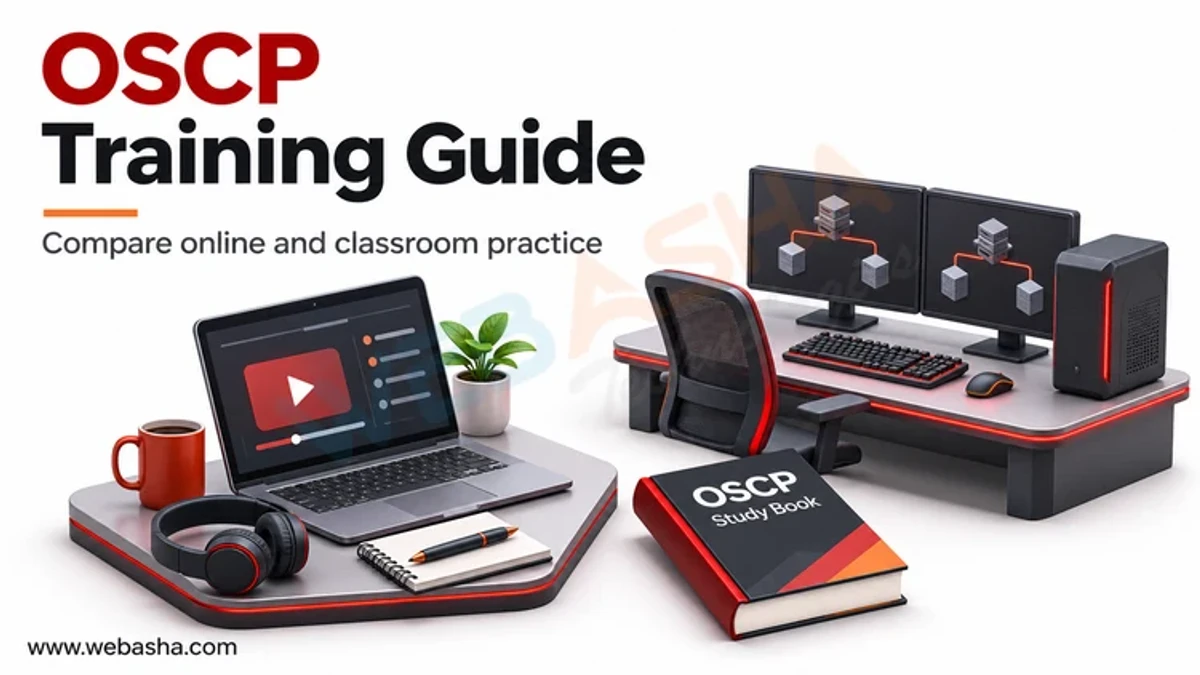
Online and classroom OSCP training cover the same OffSec material and lead to the same exam, so the choice is about how you learn best. Online training suits self-motivated learners who need flexible hours. Classroom training suits people who learn faster with a trainer in the room, fixed timings and peers to discuss problems with.
Topic: Penetration Testing in Cybersecurity & Ethical Hacking · Certification preparation
Quick answer: Online and classroom OSCP training cover the same OffSec material and lead to the same exam, so the choice is about how you learn best. Online training suits self-motivated learners who need flexible hours. Classroom training suits people who learn faster with a trainer in the room, fixed timings and peers to discuss problems with. In both cases the OffSec exam itself is taken remotely under proctoring, lasts 23 hours and 45 minutes, and needs a report within 24 hours. Judge any provider on lab time, trainer experience, feedback on your reports and how doubts are handled, not on the format label.
Key takeaways
- The syllabus, labs and exam do not change with the delivery format.
- Online gives flexibility; classroom gives structure and live interaction.
- Your own lab hours matter more than the format you choose.
- Ask every provider the same questions about labs, trainers and feedback.
- A hybrid plan, online study plus scheduled live sessions, works for many learners.
Table of Contents
- What Is the Difference Between Online and Classroom OSCP Training?
- What Stays the Same Whichever Format You Choose?
- How Do the Two Formats Compare?
- Who Does Online Training Suit?
- Who Does Classroom Training Suit?
- What Should You Ask a Provider Before Enrolling?
- Can You Combine Both Formats?
- References
What Is the Difference Between Online and Classroom OSCP Training?
OSCP is the certification you earn by passing the exam linked to OffSec's PEN-200: Penetration Testing with Kali Linux course. Some learners study the OffSec material alone. Others join a training provider that adds a trainer, a schedule and extra practice. That added layer can be delivered online, in live virtual sessions or recorded lessons, or in a physical classroom.
The difference is delivery, not content. A live online class and a classroom batch can follow the same plan; what changes is how you ask questions, how fixed your schedule is, and who you practise alongside.
What Stays the Same Whichever Format You Choose?
- Syllabus: PEN-200 covers enumeration, web and client-side attacks, password attacks, privilege escalation, pivoting and Active Directory.
- Labs: OffSec module labs and challenge labs are accessed online in every case.
- Exam: the OffSec exam guide sets 23 hours and 45 minutes of proctored hands-on work, then 24 hours to upload your report.
- Certification: passing gives OSCP, which does not expire, and OSCP+, which the OSCP+ page says must be renewed every three years.
How Do the Two Formats Compare?
| Factor | Online | Classroom |
|---|---|---|
| Schedule | Flexible, often evenings or weekends | Fixed batch timings |
| Doubt clearing | Chat, forums or live calls | Face to face, often immediate |
| Peer learning | Online groups, depends on effort | Natural, through the batch |
| Travel | None | Daily or weekly commute |
| Discipline needed | High, you set your own pace | Lower, the timetable sets it |
| Hardware | Your own laptop and stable internet | Your laptop or institute machines |
| Exam conditions | Close to the remote exam setting | Different from the exam setting |
Who Does Online Training Suit?
Online suits working professionals, people outside major cities, and learners who already have strong fundamentals. It also mirrors the exam, which you take alone at your own computer. The risk is drift: without a timetable, weeks can pass with little lab work. Set fixed weekly lab hours and track the machines you complete.
Who Does Classroom Training Suit?
Classroom suits learners who are newer to the field, who benefit from seeing a trainer work through a problem, or who study better away from home distractions. NIST's guidance on learning programmes, SP 800-50 Rev. 1, notes that different audiences need different delivery methods, which applies to individual learners too. The trade-off is less flexibility and travel time.
What Should You Ask a Provider Before Enrolling?
| Question | Why it matters |
|---|---|
| How many hours of guided lab work are included? | Hands-on practice drives exam readiness |
| What offensive security work has the trainer done? | Practical experience shapes useful feedback |
| Will someone review my practice reports? | The exam is graded on your written report |
| Is OffSec lab access included or separate? | Avoids surprises about what you are paying for |
| How are doubts handled between sessions? | Getting stuck for days wastes lab time |
| Are labs authorised and isolated? | Practice must stay legal and contained |
Any good course should stress that real testing needs written permission. NIST SP 800-115 describes scoping and rules of engagement, and in India unauthorised access can attract action under Sections 43 and 66 of the IT Act, 2000.
Can You Combine Both Formats?
Yes. A common plan is self-paced online study during the week with scheduled live sessions or classroom days for doubt clearing and mock exams. Add extra machines from OffSec Proving Grounds as practice. For more on choosing a course, see our OSCP course guide and online courses and bootcamps for penetration testers. To discuss which format fits your schedule, contact us about online or classroom OSCP training.
References
Frequently Asked Questions
What's Your Reaction?
 Like
0
 Dislike
0
 Love
0
 Funny
0
 Wow
0
 Sad
0
 Angry
0

Vaishnavi is a skilled tech professional at the Ethical Hacking Training Institute in Pune, responsible for managing and optimizing the technical infrastructure that supports advanced cybersecurity education. With deep expertise in network security, backend operations, and system performance, she ensures that practical labs, online modules, and assessments run smoothly and securely. Her behind-the-scenes contributions play a vital role in delivering a seamless and secure learning experience for aspiring ethical hackers.