Preparing for CEH Master: Exams, Practice and Award Checks
Prepare for CEH Master by checking the current CEH and CEH Practical routes, then developing both conceptual understanding and the ability to complete permitted tasks accurately. EC-Council describes Master as a designation for holders of both certifications, not a separate examination you simply buy. Use issuer materials, original practice and feedback on weak areas.
Topic: Ethical Hacking in Cybersecurity & Ethical Hacking · Certification preparation
Quick answer: Prepare for CEH Master by checking the current CEH and CEH Practical routes, then developing both conceptual understanding and the ability to complete permitted tasks accurately. EC-Council describes Master as a designation for holders of both certifications, not a separate examination you simply buy. Use issuer materials, original practice and feedback on weak areas. The checked offline exercise below distinguishes Base64 decoding from text decoding and encryption; it is an original learning example, not protected examination content or evidence of an actual assessment.
Key takeaways
- Check knowledge and Practical requirements separately.
- Master designation depends on both issuer records.
- Current application policy controls the relevant entry route.
- A correct tool result still needs an accurate explanation.
- Use original permitted practice and review errors without a pass guarantee.
Table of Contents
- What must you complete for the CEH Master designation?
- Which current examination facts should shape your preparation?
- Why should you verify eligibility before paying?
- How should knowledge study and practical preparation work together?
- What does the checked Base64 and UTF-8 exercise show?
- How would you explain the result without overstating it?
- How do you rehearse and review without a first-attempt promise?
- References
What must you complete for the CEH Master designation?
The EC-Council application and eligibility policy says that holders of both CEH and CEH Practical are recognised as CEH Master. It is not a separately purchasable certification. Keep course attendance, examination results and the final issuer designation distinct.
The EC-Council CEH Master programme page describes a knowledge assessment and a hands-on assessment. Plan the work for each rather than assuming that success in one proves readiness for the other. A course package can contain several entitlements, so confirm which examinations, access periods and support are actually included.
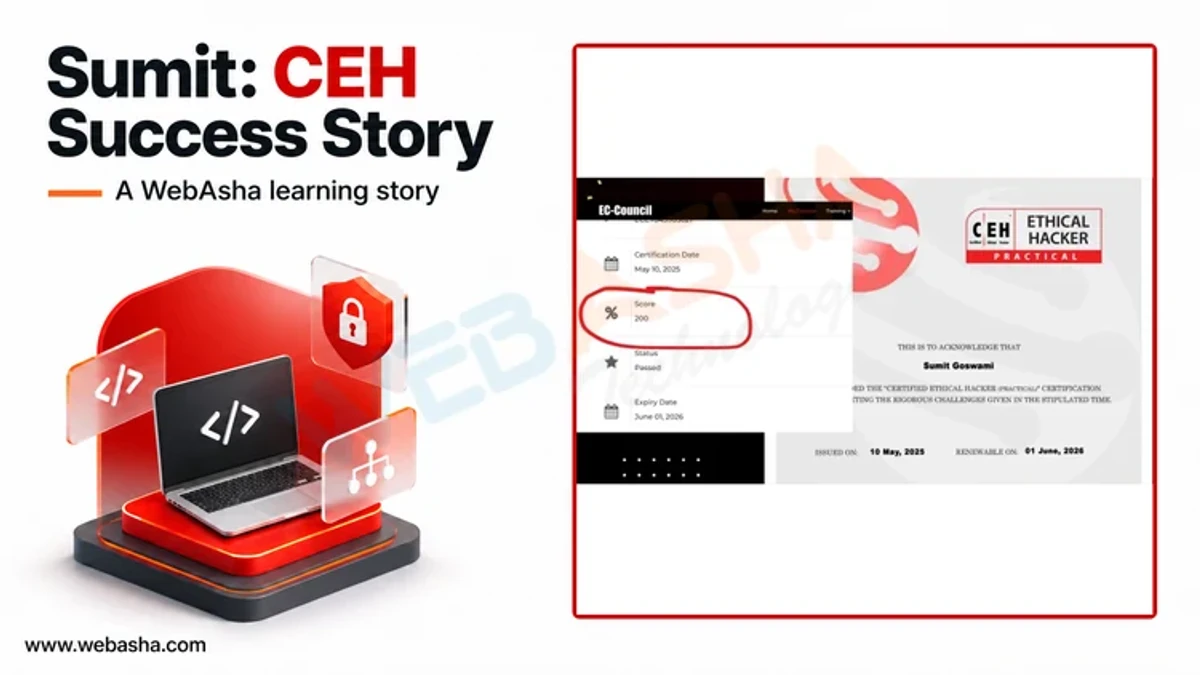
Before booking, check your current records with the issuer and obtain the applicable route and conditions in writing. A screenshot of someone else’s award does not establish your eligibility or completed designation.
Which current examination facts should shape your preparation?
The EC-Council CEH AI programme page describes the knowledge examination as 125 multiple-choice questions over four hours. Its published passing-score range is 60% to 85%, so do not substitute a universal 70% target or interpret a cut-score range as a pass-rate statistic.
The EC-Council CEH Practical exam page lists 20 practical challenges over six hours. Its current public table also displays a 60% to 85% passing-score range, while the EC-Council iClass CEH training page retains 70% wording. Ask EC-Council to confirm the applicable assessment conditions for your booking rather than combine conflicting pages into one rule.
Use a personal practice timer to reveal slow reasoning, but distinguish your study allocation from official examination rules. Check allowed resources, proctoring, scheduling and break arrangements directly for the current assessment.
| Record or assessment | What to verify |
|---|---|
| CEH knowledge exam | Current objectives, eligibility, format and booking conditions |
| CEH Practical | Applicable challenge assessment and current issuer instructions |
| Training package | Exact included products and access periods |
| Master designation | Both required issuer certifications are recorded |
Why should you verify eligibility before paying?
The current application policy provides an official-training route and a self-study approval route. For CEH and CEH Practical, it states relevant two-year information-security experience requirements for the self-study route unless official training is completed. Confirm which route applies to your experience and training.
The EC-Council Practical product page asks official-training applicants for attendance evidence or self-study applicants for eligibility approval before the Practical dashboard purchase. Confirm the precise requirements that apply to you, including any age, accommodation or entitlement conditions.
If a programme page, training page and purchase instructions differ, ask the issuer to resolve that difference before purchasing. A provider’s course completion record should not be assumed to satisfy an official-training policy without verification.
How should knowledge study and practical preparation work together?
Map current objectives to short explanations and suitable permitted exercises. For each concept, state the mechanism, the evidence a result would provide and an important limit. Then attempt an original task and review the explanation alongside its output.
Use official learning material for the intended programme. Treat current AI features as tools whose suggestions need checking, not an exemption from understanding scope, inputs and results. A confidently written explanation can still misinterpret a harmless encoding as encryption.
Keep an error journal with the objective, mistaken reasoning, corrective source and a fresh follow-up task. A study group can review these original exercises, while protected examination questions and another candidate’s confidential assessment content must remain out of the learning material.
What does the checked Base64 and UTF-8 exercise show?
The first supplied string represents the harmless text “training note”. The second contains an invalid Base64 alphabet character. The third is valid Base64 for a byte sequence that is not valid UTF-8 text.
The Python 3.14 Base64 reference explains decoding to bytes and the validate option. This exact Python 3.14.4 fixture ran offline with matching output and empty standard error. It does not use files, credentials, network traffic or suspicious code.
import base64
import binascii

samples = [
    ("note", "dHJhaW5pbmcgbm90ZQ=="),
    ("bad_alphabet", "not*base64"),
    ("non_text", "/w=="),
]
for label, encoded in samples:
    try:
        raw = base64.b64decode(encoded, validate=True)
    except binascii.Error:
        print(f"{label}: rejected Base64")
        continue
    try:
        text = raw.decode("utf-8")
    except UnicodeDecodeError:
        print(f"{label}: decoded bytes are not UTF-8 text")
        continue
    print(f"{label}: {text}")
Expected output:
note: training note
bad_alphabet: rejected Base64
non_text: decoded bytes are not UTF-8 text
How would you explain the result without overstating it?
Base64 is an encoding, not encryption. Decoding the first sample requires no secret key and does not establish authenticity, permission or trust. The result merely reveals the supplied representation’s bytes, then interprets those bytes under the chosen text encoding.
The third sample is particularly useful: successful Base64 decoding does not imply successful UTF-8 decoding. Preserve that distinction instead of treating every failed text conversion as invalid Base64.
Write a short result note naming the input, validation policy and decoded representation. The exercise checks a small technical distinction; it does not reproduce an official challenge, establish readiness across the syllabus or prove that any real system has a weakness.
| Sample result | Supported explanation |
|---|---|
| training note | Valid Base64 and valid UTF-8 for this supplied text |
| rejected Base64 | Strict decoder rejected the supplied alphabet |
| decoded bytes are not UTF-8 text | Byte decoding succeeded but the chosen text interpretation failed |
| No secret key used | This representation did not provide encryption |
How do you rehearse and review without a first-attempt promise?
Create a practice session with a clear objective and a small set of original tasks. Reserve time to inspect inputs, perform the permitted work, verify results and write supported conclusions. Afterward, identify the next specific gap instead of treating a timer alone as a readiness score.
For this example, a learner who explains all three output lines accurately has improved a defined skill. A learner who merely copies the output should repeat the task with a different harmless supplied string and explain the separate byte and text stages.
Before an actual appointment, confirm issuer instructions, permitted resources, identification and technology requirements. Keep eligibility, entitlement and both assessment records organised. These steps support preparation and a correct award application; they do not guarantee a first-attempt result or a job.
Related reading: CEH knowledge-exam preparation; ten CEH study and review tips.
References
Frequently Asked Questions
What's Your Reaction?
 Like
0
 Dislike
0
 Love
0
 Funny
0
 Wow
0
 Sad
0
 Angry
0

With a passion for staying on the cutting edge of technology trends, I am dedicated to delivering content that not only informs but also inspires. Whether you need in-depth analysis pieces, informative guides, or thought-provoking opinion pieces, I craft content that resonates with tech enthusiasts and professionals alike.