OffSec Course Map: PEN-200, PEN-300, WEB-300, EXP-301 and More
OffSec groups its courses by code: 100-level courses build foundations, 200-level courses lead to entry and intermediate certifications such as OSCP (PEN-200), and 300 and 400-level courses go deeper. For penetration testers the usual route is PEN-200 (OSCP) then PEN-300 (OSEP). Web specialists move from WEB-200 (OSWA) to WEB-300 (OSWE). Exploit developers take EXP-301 (OSED), then EXP-401 (OSEE).
Topic: Penetration Testing in Cybersecurity & Ethical Hacking · Certification preparation
Also covers: Cybersecurity Careers & Certifications
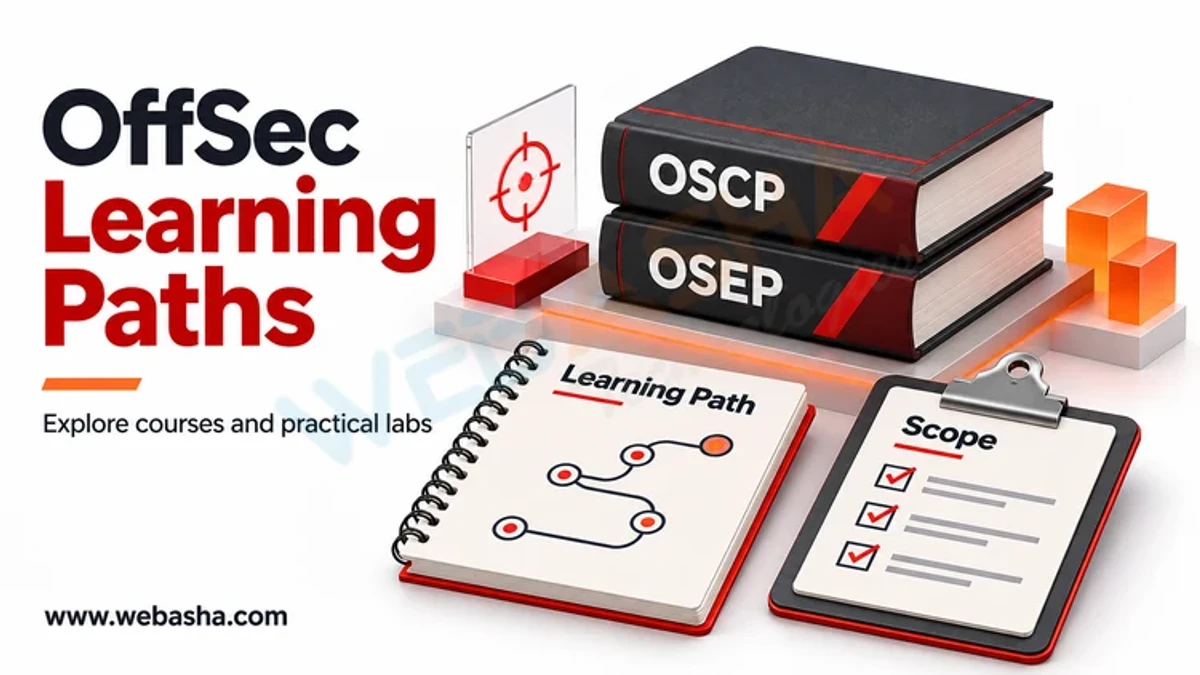
Quick answer: OffSec groups its courses by code: 100-level courses build foundations, 200-level courses lead to entry and intermediate certifications such as OSCP (PEN-200), and 300 and 400-level courses go deeper. For penetration testers the usual route is PEN-200 (OSCP) then PEN-300 (OSEP). Web specialists move from WEB-200 (OSWA) to WEB-300 (OSWE). Exploit developers take EXP-301 (OSED), then EXP-401 (OSEE). Defenders have SOC-200 (OSDA), TH-200 (OSTH) and IR-200 (OSIR). Newer additions include SEC-100 for beginners and AI-300 (OSAI) for AI red teaming. Choose by the job you want, not by course number alone.
Key takeaways
- OffSec currently lists 14 courses, each tied to a certification.
- The course number roughly signals depth: 100 foundations, 200 core, 300 and 400 advanced.
- PEN-200 and OSCP remain the usual starting point for penetration testing.
- OffSec also offers defensive courses for SOC, threat hunting and incident response.
- Check each course page for recommended prerequisites before enrolling.
Table of Contents
- What Courses Does OffSec Offer?
- How Do OffSec Courses and Certifications Map Together?
- Where Should Beginners Start?
- Which Path Suits Penetration Testers?
- Which Courses Cover Web Testing and Exploit Development?
- Which OffSec Courses Are Defensive?
- In What Order Should You Take Them?
- References
What Courses Does OffSec Offer?
OffSec, formerly Offensive Security, publishes its full list on the course catalogue page. Each course has a code, such as PEN-200, and an exam that awards a certification, such as OSCP, now expanded by OffSec as OffSec Certified Professional. Course content, labs and exam rules change over time, so confirm details on each course page before you plan.
How Do OffSec Courses and Certifications Map Together?
| Course | Certification | Focus |
|---|---|---|
| SEC-100 | OSCC-SEC | Cybersecurity essentials for beginners |
| PEN-103 | KLCP | Kali Linux itself |
| PEN-200 | OSCP and OSCP+ | Penetration testing with Kali Linux |
| PEN-210 | OSWP | Wireless security testing |
| WEB-200 | OSWA | Web application attacks with Kali tools |
| SOC-200 | OSDA | Security operations and defensive analysis |
| TH-200 | OSTH | Threat hunting |
| IR-200 | OSIR | Incident response |
| PEN-300 | OSEP | Evasion techniques and breaching defences |
| WEB-300 | OSWE | Advanced, white-box web application testing |
| EXP-301 | OSED | Windows user-mode exploit development |
| AI-300 | OSAI | Red teaming AI systems such as LLMs and RAG pipelines |
| EXP-401 | OSEE | Expert-level exploitation |
The catalogue also lists SJD-100 alongside SEC-100 in the CyberCore range.
Where Should Beginners Start?
Complete newcomers can start with SEC-100: Cybersecurity Essentials, a 100-level course with no formal prerequisites beyond basic computer literacy. Learners who already know Linux, Windows, TCP/IP and basic scripting usually go straight to PEN-200. Passing its exam gives OSCP, which does not expire, plus OSCP+, which expires after three years unless renewed.
Which Path Suits Penetration Testers?
PEN-200 builds the core: enumeration, web and client-side attacks, privilege escalation, pivoting and Active Directory. PEN-300: Evasion Techniques and Breaching Defenses builds on it, and OffSec recommends completing PEN-200 and OSCP+ or having equivalent knowledge first. PEN-300 leads to OSEP, which OffSec says does not expire. For a view of how OSCP compares with other credentials, see our OSCP vs CPENT comparison.
Which Courses Cover Web Testing and Exploit Development?
WEB-200: Web Attacks with Kali Linux covers common web flaws such as cross-site scripting, SQL injection and SSRF. WEB-300: Advanced Web Attacks and Exploitation moves to white-box testing, where you analyse source code to find vulnerabilities. For exploit development, EXP-301: Windows User Mode Exploit Development teaches reverse engineering and bypassing memory protections such as DEP and ASLR, leading to OSED.
Which OffSec Courses Are Defensive?
SOC-200: Security Operations and Defensive Analysis teaches log analysis and detection with SIEM tools, leading to OSDA. TH-200: Foundational Threat Hunting leads to OSTH, and IR-200 leads to OffSec Incident Responder (OSIR). Defensive courses fit people heading into SOC and incident response roles. AI-300 sits at the newer edge, covering assessment of AI systems for experienced professionals.
In What Order Should You Take Them?
| Target role | Suggested sequence |
|---|---|
| Penetration tester or red teamer | PEN-200, then PEN-300 |
| Web application tester | WEB-200 or PEN-200, then WEB-300 |
| Exploit developer | PEN-200 basics, then EXP-301, then EXP-401 |
| SOC analyst or threat hunter | SEC-100 if new, then SOC-200 and TH-200 |
| Incident responder | SOC-200, then IR-200 |
The NIST NICE Framework describes the tasks behind each of these roles, which helps you match a course to a job. Whichever path you take, practise only on authorised labs; in India unauthorised access can attract action under Sections 43 and 66 of the IT Act, 2000. Our guide to certifications for penetration testers compares other options. For help choosing a path, ask about OffSec course training.
References
Frequently Asked Questions
What's Your Reaction?
 Like
0
 Dislike
0
 Love
0
 Funny
0
 Wow
0
 Sad
0
 Angry
0

Vaishnavi is a skilled tech professional at the Ethical Hacking Training Institute in Pune, responsible for managing and optimizing the technical infrastructure that supports advanced cybersecurity education. With deep expertise in network security, backend operations, and system performance, she ensures that practical labs, online modules, and assessments run smoothly and securely. Her behind-the-scenes contributions play a vital role in delivering a seamless and secure learning experience for aspiring ethical hackers.