VirusTotal Explained: How to Scan Files and URLs With 70+ AV Engines
VirusTotal is a free online service, owned by Google, that checks files, URLs, domains and IP addresses against more than 70 antivirus engines and many website reputation services at once. You upload a file or paste a link, and it shows how many engines flag it, along with behaviour and relationship details. It is excellent for a second opinion, but it is not a replacement for endpoint protection.
Topic: Security Tools, Authorized Labs & CTFs in Cybersecurity & Ethical Hacking · Tutorial
Also covers: Cyber Threats, Scams & Online Safety
Quick answer: VirusTotal is a free online service, owned by Google, that checks files, URLs, domains and IP addresses against more than 70 antivirus engines and many website reputation services at once. You upload a file or paste a link, and it shows how many engines flag it, along with behaviour and relationship details. It is excellent for a second opinion, but it is not a replacement for endpoint protection. Search by the file’s SHA-256 hash first, because anything you upload can be seen by the security community. Never upload confidential documents, and treat a few detections or a clean result as a clue, not a verdict.
Key takeaways
- VirusTotal aggregates many antivirus engines and URL scanners in one report.
- Uploaded files are shared with security partners, so never upload private data.
- Look up a hash before uploading anything.
- A clean result does not prove a file is safe; new malware may be undetected.
- One or two detections can be false positives; check engine names and context.
Table of Contents
- What Is VirusTotal and How Does It Work?
- How Do You Check a File or URL Safely?
- How Do You Read a VirusTotal Report?
- What Are the Privacy Risks?
- What Are VirusTotal’s Limits?
- References
What Is VirusTotal and How Does It Work?
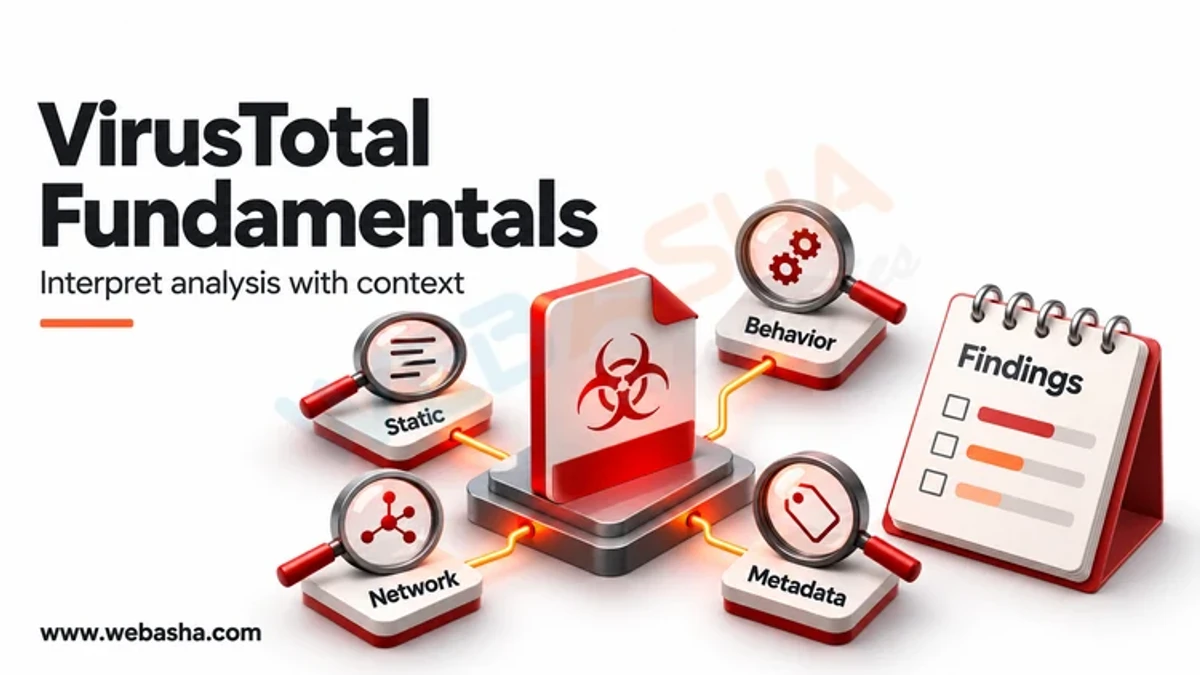
According to the VirusTotal documentation, submitted files are scanned by more than 70 antivirus scanners, and URLs are checked against many blocklisting and reputation services. Some files also run in sandboxes that record behaviour such as network connections and files created. Results are stored, so a later search for the same hash shows previous analysis. Security teams use it to triage suspicious items quickly. It sits alongside, not instead of, the prevention and handling steps in NIST SP 800-83r1.
How Do You Check a File or URL Safely?
- Do not open the suspicious file. Opening it is how malware runs (MITRE T1204).
- Calculate its SHA-256 hash and search that on virustotal.com.
- If no report exists and the file contains no private data, upload it.
- For links, paste the URL into the URL tab instead of clicking it.
- If your company has EDR, report the file to your security team as well.
Get a file hash on Windows with Get-FileHash, or on Linux and macOS with the built-in tools:
Get-FileHash .\invoice.pdf -Algorithm SHA256
sha256sum invoice.pdf
shasum -a 256 invoice.pdf
How Do You Read a VirusTotal Report?
| Section | What it tells you |
|---|---|
| Detection | Which engines flag the item and the names they give it |
| Details | File type, hashes, size, signatures and first seen date |
| Relations | Linked domains, IPs, URLs and dropped files |
| Behavior | Sandbox activity such as processes and network calls |
| Community | Comments and votes from researchers and users |
| Result | Sensible reading |
|---|---|
| Many engines flag it with similar names | Very likely malicious; delete and report |
| One or two lesser-known engines flag it | Possible false positive; check signature and source |
| Zero detections, file seen long ago from a known vendor | Probably fine |
| Zero detections, new file from an unexpected email | Still suspicious; may be new malware |
If you believe a detection is wrong, or a malicious file is missed, you can submit it to vendors such as Microsoft Security Intelligence.
What Are the Privacy Risks?
Files uploaded to VirusTotal are shared with its security partners and can be downloaded by premium users. People have accidentally exposed contracts, invoices and internal documents this way. Do not upload anything containing personal data, credentials or confidential business information. Under India’s DPDP Act 2023, uploading customer data to a third-party service could itself be a reportable problem. Search by hash, or use an internal sandbox for sensitive files.
What Are VirusTotal’s Limits?
- Engines in VirusTotal may use different settings from desktop products, so results can differ.
- Brand-new or targeted malware may show zero detections for hours or days.
- Attackers also check their malware on such services before using it.
- It does not clean an infected computer. Use your endpoint security tool and follow CERT-In advisories.
Related: AI tools for malware analysis and how to spot phishing attachments. WebAsha offers malware analysis and SOC training.
References
Frequently Asked Questions
What's Your Reaction?
 Like
0
 Dislike
0
 Love
0
 Funny
0
 Wow
0
 Sad
0
 Angry
0

Vaishnavi is a skilled tech professional at the Ethical Hacking Training Institute in Pune, responsible for managing and optimizing the technical infrastructure that supports advanced cybersecurity education. With deep expertise in network security, backend operations, and system performance, she ensures that practical labs, online modules, and assessments run smoothly and securely. Her behind-the-scenes contributions play a vital role in delivering a seamless and secure learning experience for aspiring ethical hackers.