
Deloitte and the Brain Cipher Ransomware Claim: What Was Alleged and How to Read It
Deloitte, one of the largest professional services firms globally, has been targeted by the Brain Cipher ransomware group in a major cyberattack that reportedly occurred in December 2024. The group claims to have stolen 1 terabyte of sensitive data, including client records, employee details, and internal communications. Using advanced tactics like phishing and exploiting vulnerabilities, they accessed Deloitte's systems and threatened to expose the stolen data unless their demands were met. This breach highlights significant risks, such as financial losses from investigation costs, non-compliance fines, and reputational damage. Deloitte may also face legal challenges from affected parties. The incident shows the growing sophistication of cyber threats and the urgent need for businesses to enhance their cybersecurity defenses, conduct regular audits, train employees, and maintain secure data backups to mitigate the impact of such attacks.
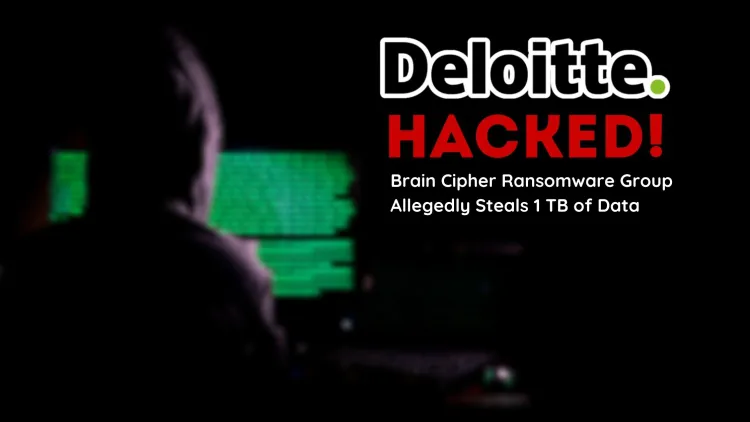
Quick answer: In December 2024 the Brain Cipher ransomware group claimed to have stolen about 1 TB of data from Deloitte UK. This was an unverified claim by the attackers. Deloitte was reported as saying one client's system was involved and its internal systems were not affected. Treat it as alleged, not confirmed.
Key takeaways
- The 1 TB figure was a claim by the attackers, not a confirmed breach.
- Deloitte was reported as saying a single client system was involved, not its internal network.
- Professional services firms are attractive targets because they hold many clients' data.
- Backups, MFA, segmentation, third-party controls and a response plan reduce risk.
What was claimed?
In early December 2024, the Brain Cipher ransomware group listed Deloitte UK on its leak site and claimed to have taken about 1 terabyte of data. This is a claim by criminals, and it is not proof. Ransomware groups often exaggerate, and the victim's account matters.
Press reports at the time quoted Deloitte as saying that the issue involved a single client's system and that its own internal systems had not been affected. Read Deloitte's wording in the original news coverage and any later statements, and treat anything beyond that as unconfirmed. This post is kept as a record of the claim and as a lesson in how to read such claims, not as a confirmed breach of Deloitte.
Who is Brain Cipher?
Brain Cipher is a ransomware group that became widely known in 2024, including for an attack that disrupted Indonesia's national data centre services in June 2024. Public reporting described it as using ransomware derived from a leaked LockBit 3.0 builder. Details about its members, location and operations are unconfirmed, so avoid repeating guesses.
How to read a ransomware leak-site claim
| Question | Why it matters |
|---|---|
| Has the victim confirmed anything? | Claims alone are not confirmation |
| Whose systems were involved? | A service provider's client system is different from its core network |
| What proof was shown? | Sample files can be old, public or from a third party |
| Was data encrypted, stolen or both? | Data theft and encryption are separate harms |
| What did regulators or the company say later? | Early reports are often revised |
Why are consulting and professional services firms targets?
- They hold sensitive information about many clients, so one compromise has value across all of them.
- They connect to client networks and share data through portals and file transfer systems, which widens the attack surface.
- Third parties and client-side systems can be weaker than the firm's own network.
- The pressure to pay is high because disclosure threatens client trust.
What organisations can do
- Back up properly. Keep offline or immutable copies and test restores. Backups reduce the damage of encryption, not of data theft.
- Patch and reduce exposure. Prioritise internet-facing systems and remote access.
- Use multi-factor authentication on email, VPN and admin accounts.
- Limit privileges and segment networks so one compromised account or client system cannot reach everything.
- Protect third-party connections. Review vendor and client access, and monitor data transfers.
- Prepare a response plan. Know who decides, who talks to clients, regulators and police, and rehearse it.
- Monitor and encrypt. Detect unusual large outbound transfers, and encrypt sensitive data at rest.
Reporting in India
Indian organisations are expected to report certain cyber incidents to CERT-In. Directions issued in 2022 set a six-hour reporting window for specified incident types. Check the current directions on the CERT-In website to see what applies to you.
What individuals should take from this
If a firm that holds your data announces an incident, change relevant passwords, enable multi-factor authentication, watch for phishing that uses details from the incident, and monitor accounts. Do not download leaked data to "check" it, since it may contain malware and handling stolen data can create legal problems.
Next steps
To learn how teams detect and respond to incidents like this, see the ECIH incident handler course. For other incident write-ups, read the Cipla ransomware attack and AT&T data breaches in 2024.
Related reading
Frequently Asked Questions
What's Your Reaction?
 Like
0
Like
0
 Dislike
0
Dislike
0
 Love
0
Love
0
 Funny
0
Funny
0
 Wow
0
Wow
0
 Sad
0
Sad
0
 Angry
0
Angry
0

Vaishnavi is a skilled tech professional at the Ethical Hacking Training Institute in Pune, responsible for managing and optimizing the technical infrastructure that supports advanced cybersecurity education. With deep expertise in network security, backend operations, and system performance, she ensures that practical labs, online modules, and assessments run smoothly and securely. Her behind-the-scenes contributions play a vital role in delivering a seamless and secure learning experience for aspiring ethical hackers.








