Future Trends in Artificial Intelligence: What Is Real, What Is Hype
The AI trends with the most substance right now are AI agents that carry out multi-step tasks using tools, multimodal models that work across text, images and audio, smaller models that run cheaply or on devices, AI on both sides of cyber security, and binding regulation, led by the EU AI Act. Each is real, and each is also oversold.
Topic: Machine Learning in AI & Data · Explainer
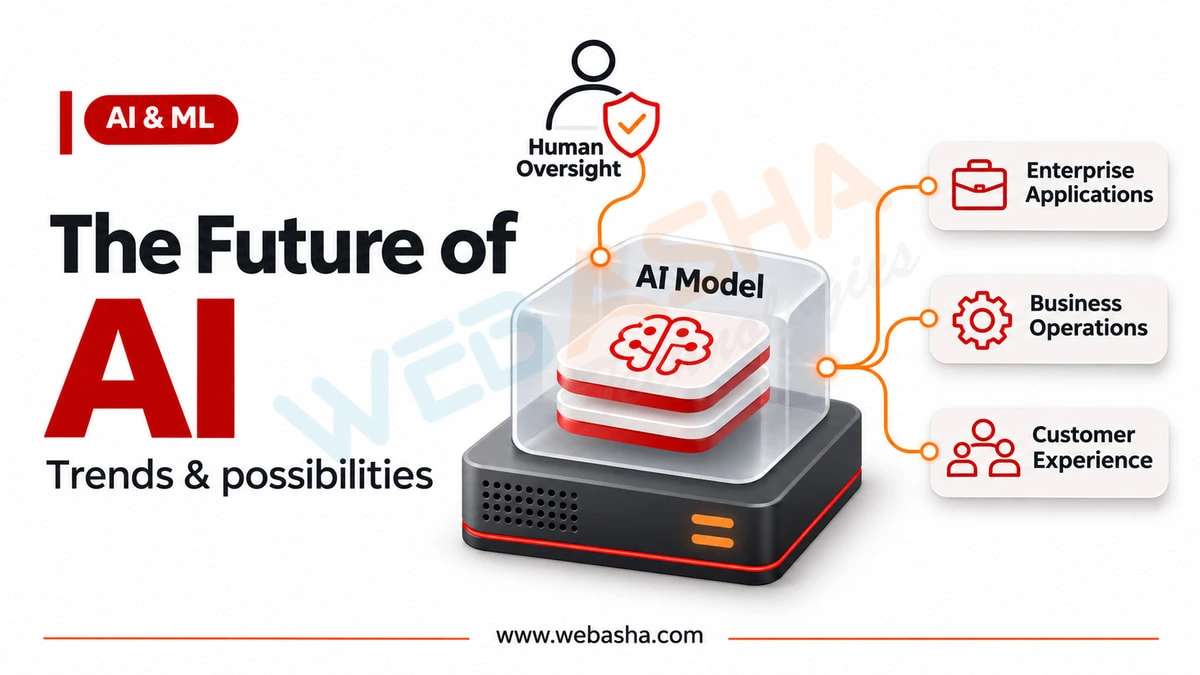
Quick answer: The AI trends with the most substance right now are AI agents that carry out multi-step tasks using tools, multimodal models that work across text, images and audio, smaller models that run cheaply or on devices, AI on both sides of cyber security, and binding regulation, led by the EU AI Act. Each is real, and each is also oversold. The useful question is never whether a trend exists, but what it reliably does today, at what cost, and with what risk.
Key takeaways
- Agents are the main direction of travel, and reliability and security are their main obstacles.
- Smaller and open-weight models make AI cheaper and more private, often with acceptable quality.
- Attackers and defenders both use AI. Phishing and fraud have become more convincing.
- The EU AI Act's high-risk obligations were postponed: stand-alone high-risk systems now face a 2 December 2027 deadline.
- India is investing through the IndiaAI Mission, approved in March 2024 with an outlay of Rs 10,371.92 crore.
Table of Contents
- What Are the Most Significant AI Trends Right Now?
- What Are AI Agents and Why Do They Matter?
- Why Does Multimodal AI Matter?
- Why Are Smaller Models Becoming Important?
- How Is AI Changing Cyber Security?
- What Is Happening With AI Regulation?
- What Is India Doing?
- What Should You Be Sceptical About?
- What Do These Trends Mean for Your Career?
- How Should Organisations Prepare?
- References
What Are the Most Significant AI Trends Right Now?
| Trend | What is real today | Main limitation |
|---|---|---|
| AI agents | Models that plan steps and call tools such as search, code and business systems | Errors compound over long tasks; prompt injection |
| Multimodal models | One model reading text, images, audio and documents together | Still makes confident mistakes about what it sees |
| Small and open-weight models | Useful models running on a laptop, phone or single server | Weaker on complex reasoning than the largest models |
| AI in cyber security | Better phishing for attackers, faster triage for defenders | Defensive gains depend on good data and staff |
| Regulation | The EU AI Act in force, with staged obligations | Deadlines have moved; standards still being written |
| Cost of inference | Running models getting cheaper per task | Heavy use still costs real money at scale |
What Are AI Agents and Why Do They Matter?
An agent is a language model given a goal and a set of tools, such as a web search, a code interpreter, a calendar or a company database, which it can call in a loop until the task is done. Instead of answering one question, it can book, update, analyse and report. That is why so much investment is going into agents.
Two problems hold them back. First, reliability: a small error rate per step becomes a large one over a twenty-step task. Second, security: an agent that reads untrusted content, such as an email or a web page, can be manipulated by instructions hidden in that content, an attack called prompt injection. Our explainer on prompt injection covers why it is hard to fix. The practical pattern today is agents with limited permissions and a human approving consequential actions.
Why Does Multimodal AI Matter?
Earlier systems needed separate models for text, images and speech. Multimodal models handle them together, so one system can read a scanned invoice, listen to a call or describe a chart. For businesses this opens up the large share of information that was never in neat text form. The limitation is the same as for text: outputs can be fluent and wrong, so anything consequential still needs checking.
Why Are Smaller Models Becoming Important?
The largest models are expensive to run and send your data to someone else's servers. Smaller models, often released with open weights, can run on a laptop, a phone or one server you control, which helps with cost, latency and privacy. For focused tasks such as classification, extraction or summarising internal documents, a small model is often good enough.
Trying one takes a few lines with Hugging Face Transformers. This downloads a small open model the first time it runs:
pip install transformers torch

from transformers import pipeline
generate = pipeline('text-generation', model='Qwen/Qwen2.5-0.5B-Instruct')
print(generate('Explain phishing in one sentence.', max_new_tokens=60)[0]['generated_text'])
Compare its answers with a large hosted model on your own tasks. That comparison, not a benchmark table, tells you whether a small model is enough.
How Is AI Changing Cyber Security?
On the attacking side, AI writes fluent phishing messages in any language, produces convincing voice and video deepfakes for fraud, and helps less skilled attackers write code. On the defending side, it summarises alerts, helps analysts query logs in plain language, and speeds up malware triage. Neither side has a decisive advantage; outcomes still depend on basics such as multi-factor authentication, patching and verification of payment requests. Our guide to how hackers use AI covers the attacker side in detail.
What Is Happening With AI Regulation?
The EU AI Act is the most developed law. It entered into force on 1 August 2024 and applies in stages:
| Date | What applies |
|---|---|
| 2 February 2025 | Prohibited AI practices and AI literacy duties |
| 2 August 2025 | Obligations for general-purpose AI models |
| 2 December 2027 | Stand-alone high-risk systems in Annex III, such as hiring and credit scoring |
| 2 August 2028 | High-risk AI in products covered by Annex I, such as medical devices |
The last two dates are later than originally planned. The Digital Omnibus on AI, in force since July 2026, postponed the high-risk deadlines from August 2026 and August 2027, citing the absence of finished technical standards. It is a postponement, not a repeal. Indian companies selling AI systems into the EU fall within its scope.
Outside binding law, the NIST AI Risk Management Framework is widely used as a voluntary structure for managing AI risk.
What Is India Doing?
The Union Cabinet approved the IndiaAI Mission in March 2024 with an outlay of Rs 10,371.92 crore, covering shared computing capacity, datasets, foundation models, skills and start-up support. For learners and companies in India, the practical effects to watch are access to subsidised computing and the growth of models and datasets for Indian languages.
What Should You Be Sceptical About?
- Demos versus reliability. A working demo shows something is possible, not that it works every time.
- Benchmark claims. Scores on public tests do not always reflect performance on your tasks.
- Dates for general intelligence. Predictions vary widely and are not evidence.
- Job numbers. Forecasts of jobs lost or created rest on assumptions worth reading before repeating.
- AI-washing. Products relabelled as AI without meaningful change.
For grounded data on the field, the annual Stanford AI Index is a better starting point than headlines.
What Do These Trends Mean for Your Career?
Skills that hold their value across trends: Python, data handling, evaluating model output, understanding security risks such as prompt injection, and knowing a domain well enough to tell when AI is wrong. Building and deploying applications on top of models is growing faster than training new foundation models, which few organisations do. Our guide on how to become an AI engineer in India sets out a path.
How Should Organisations Prepare?
- Inventory where AI is already used, including staff using public tools with company data.
- Set a usage policy: what data may go into which tools.
- Start with narrow, measurable use cases and evaluate them against a baseline.
- Give agents the minimum permissions, and keep humans approving consequential actions.
- Check whether any system falls into a regulated category, especially if you sell into the EU.
Talk to a WebAsha training advisor about AI courses, batches and current fees.
References
- Regulation (EU) 2024/1689, the AI Act
- Digital Omnibus on AI, overview
- NIST AI Risk Management Framework
- IndiaAI Mission
- Stanford HAI AI Index
- Hugging Face Transformers pipelines
Related reading
Frequently Asked Questions
What's Your Reaction?
 Like
0
 Dislike
0
 Love
0
 Funny
0
 Wow
0
 Sad
0
 Angry
0

I am dedicated to staying up-to-date on the most current technology trends and like to craft content that informs and inspires. Whether through detailed analysis, informative guides, or exact opinion articles, I desire to create engaging content for both technology lovers and industry experts.