Ethical Hacking Projects for a Beginner Portfolio
Build a beginner ethical hacking portfolio around authorised assessment work you can verify and explain. Start with a clear scope, compare observed behaviour with an expected rule, and document the evidence, remediation proposal and retest status. A small completed assessment gives a reviewer something concrete to inspect.
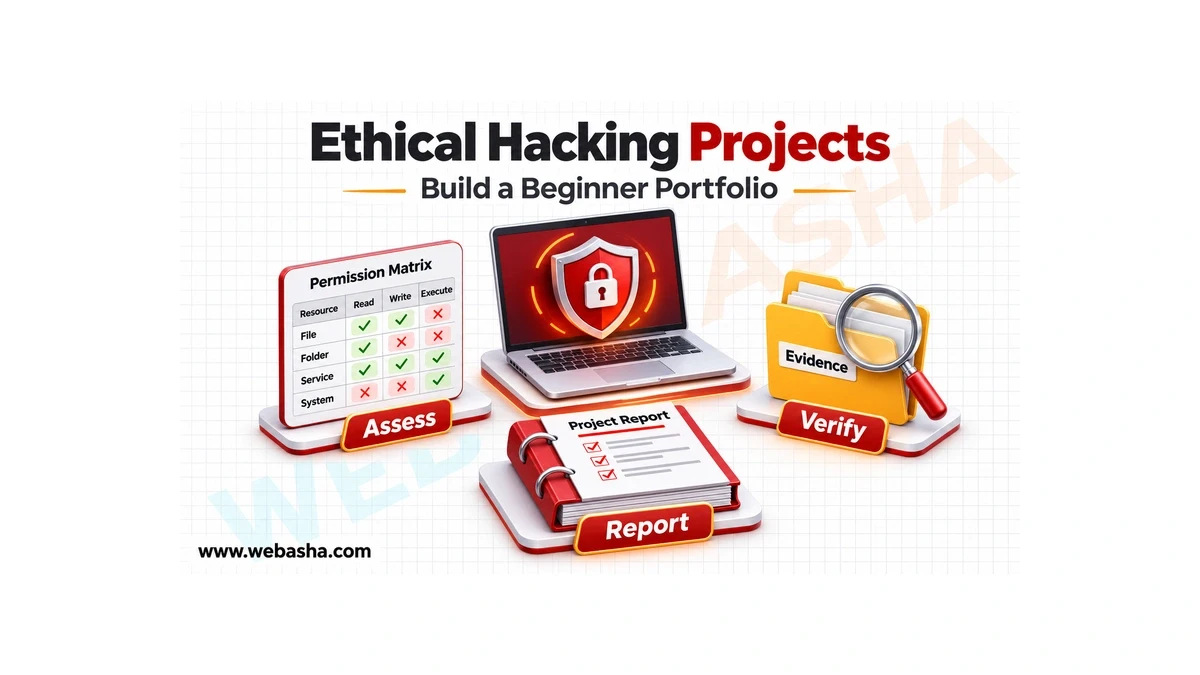
Build a beginner ethical hacking portfolio around authorised assessment work you can verify and explain. Start with a clear scope, compare observed behaviour with an expected rule, and document the evidence, remediation proposal and retest status. A small completed assessment gives a reviewer something concrete to inspect.
The four projects below focus on defensive assessment skills. One includes a locally tested Python policy exercise; the other briefs describe work to perform in a permitted lab. None requires testing a public target or collecting real credentials.
Save evidence of the reasoning
- State the rule or requirement before the check.
- Record the environment and actual result.
- Explain the consequence supported by that evidence.
- Keep proposed fixes separate from verified retests.
Choose a project with a clear assessment question
| Project | Question | Portfolio evidence |
|---|---|---|
| Permission matrix | Does the intended role have only its approved actions? | Policy table, test cases, output and limitations. |
| Synthetic cookie review | Which documented cookie attributes are present? | Example header, interpretation and context questions. |
| Vulnerability triage | Does a sample finding apply to the stated lab? | Evidence comparison, status and review rationale. |
| Remediation retest | Did the approved change produce the intended behaviour? | Before/after results, test scope and remaining uncertainty. |
Pick the project whose prerequisites you can already explain. For a foundation checklist, use the WebAsha beginner cybersecurity guide. Increase complexity after you can reproduce the first result.
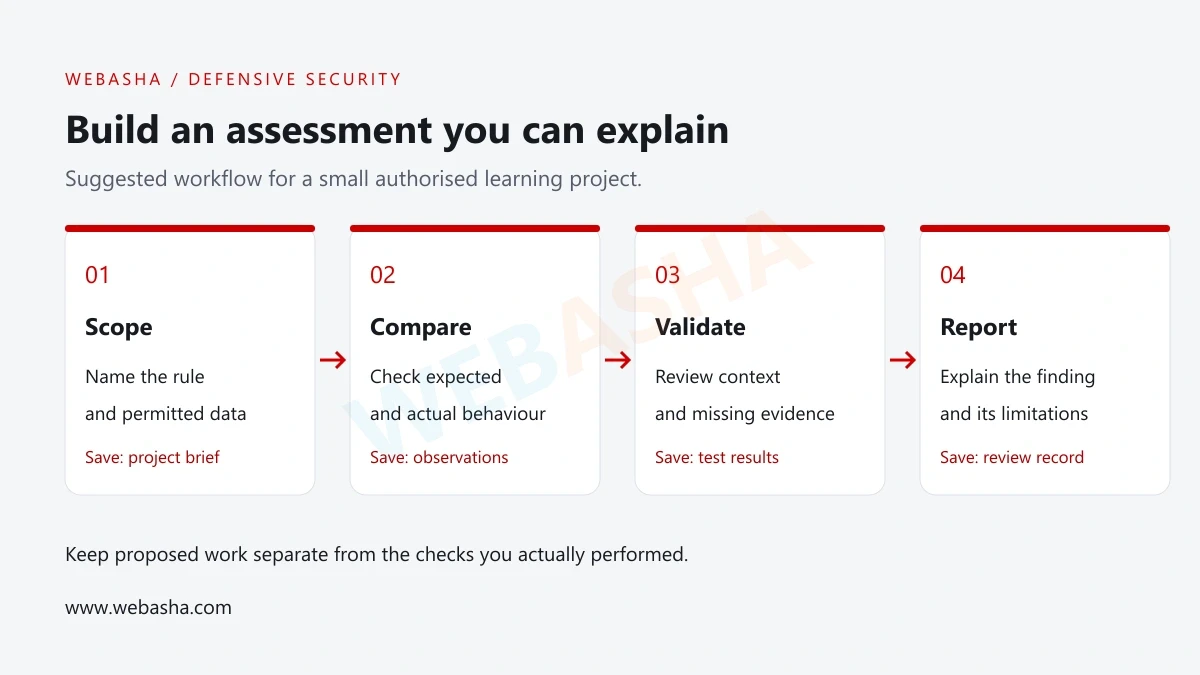
Write the scope before collecting evidence
Name the files, identities or lab services you may inspect. Define the permitted checks, expected outcome and point at which you should stop and contact the owner. Use fictional users and synthetic data for the first version.
Store the original task brief with your notes. An instructor’s permission to perform a lab does not automatically grant permission to publish its materials. Ask which parts can appear in a public portfolio and remove confidential assessment content.
OWASP Juice Shop is an intentionally insecure training application. If you use it for a later extension, follow the official setup documentation and keep the environment isolated. The offline project below does not require installing it. [4]
Project 1: check a fictional permission matrix
OWASP recommends least privilege, default denial and permission checks on every request. Use those principles to create a fictional policy before attempting an application-level test. [1]
Give a viewer read access, an editor read/write access and an administrator the actions listed in your task brief. Include a role that does not exist. The purpose is to compare the policy with expected cases, not to build a complete authentication system.
Save the following as check_policy.py. Prerequisite: a local Python 3 interpreter. Run python check_policy.py using your workstation’s Python 3 launcher. It uses synthetic in-memory data, prints results and makes no network request.
Run and explain the policy exercise
permissions = {
    "viewer": {"read"},
    "editor": {"read", "write"},
    "admin": {"read", "write", "delete"},
}

cases = [
    ("viewer", "read", True),
    ("viewer", "delete", False),
    ("editor", "write", True),
    ("unknown", "read", False),
    ("admin", "export", False),
]

for role, action, expected in cases:
    allowed = action in permissions.get(role, set())
    result = "PASS" if allowed == expected else "FAIL"
    decision = "ALLOW" if allowed else "DENY"
    print(f"{role}:{action} {decision} {result}")
Expected output:
viewer:read ALLOW PASS
viewer:delete DENY PASS
editor:write ALLOW PASS
unknown:read DENY PASS
admin:export DENY PASS
The sample was executed locally and the output matched. The unknown role and unlisted action are denied because the lookup does not supply permission for them. The administrator label does not silently grant every possible action.
Acceptance check: add an expected case, explain its intended result and run the exercise again. Temporarily remove the editor’s write permission in your own copy and confirm that the corresponding test reports FAIL. Record that controlled change and restore your baseline.
This checks a dictionary policy only. It does not authenticate a user, enforce a web endpoint or establish resistance to bypasses. A later approved application test must verify the real enforcement location and relevant request paths.
Project 2: review a synthetic cookie configuration
Use a fictional header rather than copying a live session value. MDN documents that Secure restricts a cookie to secure requests, subject to the documented localhost exception, while HttpOnly prevents direct JavaScript access through interfaces such as document.cookie. [2]
Set-Cookie: demo_session=synthetic-value; Secure; HttpOnly; SameSite=Lax; Path=/Label the example as synthetic. Describe each attribute and note which questions remain: what the application needs, where the cookie is used and how the server manages the session. Do not treat the presence of flags as proof of complete session security.
MDN explains that SameSite affects cookie handling with cross-site requests. Its appropriate setting depends on application behaviour; a static example alone cannot establish whether a production workflow is correct. [2]
Finish with: the example, a short interpretation and a list of application-specific checks you would request. No live cookie, password or session token belongs in the public report.
Project 3: triage a fictional vulnerability finding
Create a small fictional report describing a software issue and a separate lab inventory with product name, version and configuration. Include one finding that fits the inventory and another that lacks enough context to decide.
For each item, state the claim, relevant evidence and review status. Suitable learning statuses include confirmed within the exercise, not applicable to the supplied inventory and insufficient evidence. Explain what would change your conclusion.
A useful triage note does more than repeat a scanner label. It identifies the asset, the applicability question and the next verification step. Use invented identifiers clearly labelled as fictional, or obtain a real advisory from the vendor and preserve its exact scope.
Completion check: a peer can trace your conclusion to the supplied records. You have not claimed a live system is vulnerable or safe based on an incomplete fictional inventory.
Project 4: document an approved remediation retest
Use a disposable local exercise where you can change a simple permission rule. Record the baseline, propose the intended correction and repeat the relevant allowed and denied cases after the change. Keep unrelated files and services outside scope.
| Record | What it should establish |
|---|---|
| Original observation | The behaviour before the approved change. |
| Expected correction | The specific action or boundary that should change. |
| Changed configuration | What you actually modified in the exercise. |
| Retest cases | Allowed and denied behaviour checked after the change. |
| Actual outcome | What the evidence supports and whether more checks are needed. |
| Limitations | Other paths or conditions you did not test. |
Use accurate status wording. “Proposed” means the change has not been implemented. “Retested within this lab” describes the checked cases, without asserting that every possible path is secure.
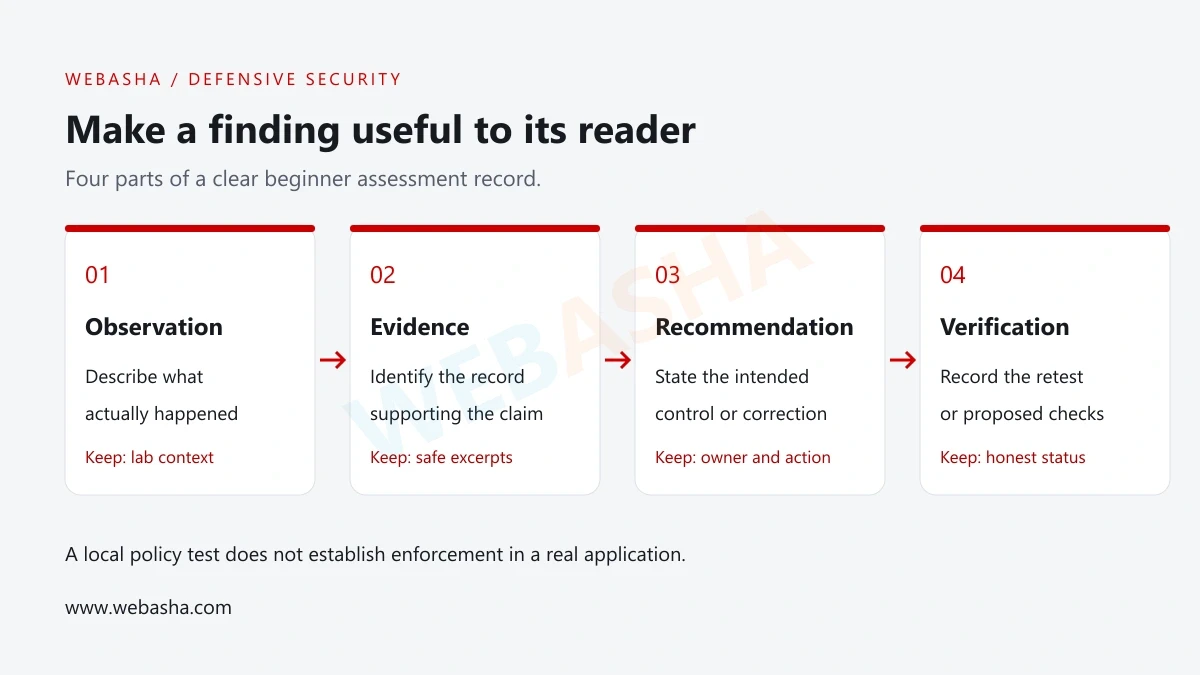
Package the work so another person can review it
GitHub’s README guidance includes explaining a project’s purpose and how someone can get started. Put that overview before detailed screenshots or tool output. [3]
Include scope, prerequisites, safe sample inputs, steps and expected results. State what you completed yourself and credit tutorials or assistance. Name the limitation most relevant to the project, such as the policy exercise’s lack of application enforcement.
Keep raw private notes out of the publication package. Test links while signed out, inspect attachments and confirm reuse permissions. The WebAsha beginner portfolio guide offers more documentation ideas.
Review the project before adding it to a resume
Ask someone to follow the instructions with the supplied sample. Record where they needed help and update the README. Then practise explaining the assessment question, your evidence and one failed attempt you corrected.
Describe personal lab work as a project. Do not turn it into an employment claim or imply you tested an organisation that did not authorise the work. For a SOC direction, compare your evidence and handover habits with the SOC analyst skills guide.
Ask WebAsha Technologies about ethical hacking foundation training and supervised project review. Contact WebAsha with your starting skills and the assessment task you want to learn.
Official references
Frequently Asked Questions
What's Your Reaction?
 Like
0
 Dislike
0
 Love
0
 Funny
0
 Wow
0
 Sad
0
 Angry
0

With a passion for staying on the cutting edge of technology trends, I am dedicated to delivering content that not only informs but also inspires. Whether you need in-depth analysis pieces, informative guides, or thought-provoking opinion pieces, I craft content that resonates with tech enthusiasts and professionals alike.