What Is an IPv6 Address? Format, Types and Why India Leads
An IPv6 address is a 128-bit identifier written as eight groups of four hexadecimal digits separated by colons. Shorten it by dropping leading zeros in each group and replacing one run of all-zero groups with::, which may appear only once. IPv6 exists because the 32-bit IPv4 space ran short. It has no broadcast, replacing it with multicast.

Topic: Networking in IT Infrastructure · Explainer
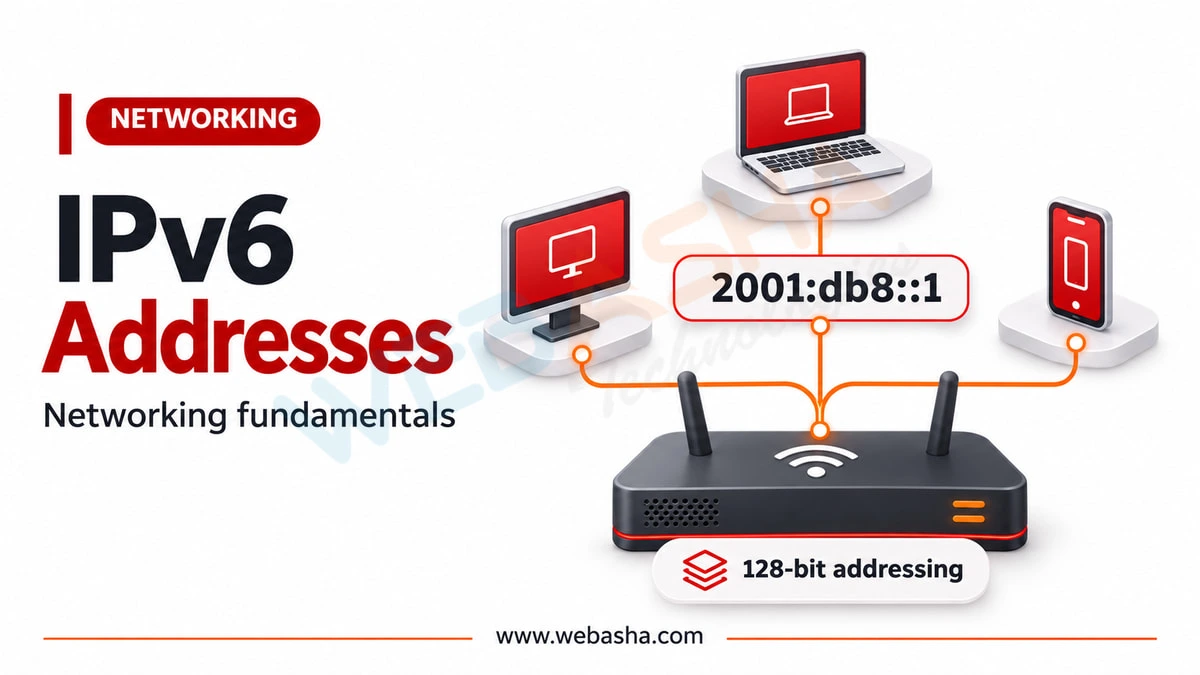
Quick answer: An IPv6 address is a 128-bit identifier written as eight groups of four hexadecimal digits separated by colons. Shorten it by dropping leading zeros in each group and replacing one run of all-zero groups with ::, which may appear only once. IPv6 exists because the 32-bit IPv4 space ran short. It has no broadcast, replacing it with multicast. If you are reading this in India, IPv6 is not a future technology here: Google measured Indian IPv6 adoption at 73.79 percent on 11 November 2026, against a world figure of 47.47 percent.
Key takeaways
- Eight groups of four hex digits. Drop leading zeros, and collapse one run of all-zero groups to
::. ::may appear only once, because two would make the expansion ambiguous.- There are no broadcast addresses in IPv6. RFC 4291 says so in those words, and multicast took over the job.
- Every IPv6 interface has a link-local address from
FE80::/10whether you configured one or not. - India is at 73.79 percent IPv6 adoption, fifth in the world. The United States is at 54.89 percent and China at 7.57 percent.
Topics covered in this guide: what an IPv6 address is, the format and shortening rules, why IPv6 was needed, address types and their prefixes, why broadcast is gone, SLAAC and DHCPv6, dual stack, IPv6 security, adoption figures and how to troubleshoot IPv6 from the command line.
Table of Contents
- What Is an IPv6 Address?
- How Do You Read and Shorten an IPv6 Address?
- Why Was IPv6 Needed?
- What Are the Main IPv6 Address Types?
- What Happened to Broadcast?
- How Do Devices Get an IPv6 Address?
- What Is Dual Stack Operation?
- How Does IPv6 Affect Security?
- How Widely Is IPv6 Actually Used?
- How Do You Troubleshoot IPv6 Connectivity?
- What Should You Learn First About IPv6?
- References
What Is an IPv6 Address?
An IPv6 address is a 128-bit identifier for an interface on a network, written as eight groups of four hexadecimal digits separated by colons. It exists because the 32-bit IPv4 address space, roughly 4.3 billion addresses, ran short.
The addressing architecture is defined by RFC 4291, published in February 2006. Nearly everything in this article is in that document, and it is worth knowing it exists: when a vendor's documentation and a tutorial disagree, RFC 4291 settles it.
One small convention first. Every example address here uses 2001:db8::/32, which RFC 3849 reserves "for use in examples in RFCs, books, documentation, and the like". If you see that prefix in someone's configuration rather than their documentation, it is a mistake.
How Do You Read and Shorten an IPv6 Address?
Two rules do nearly all the work, and RFC 4291 states both.
- Drop leading zeros in any group.
0db8becomesdb8, and0000becomes0. - Collapse one run of all-zero groups to a double colon. In the RFC's words, 'The use of "::" indicates one or more groups of 16 bits of zeros', and it "can also be used to compress leading or trailing zeros in an address".
The restriction that catches people out is also in the RFC: 'The "::" can only appear once in an address.' Two of them would make the expansion ambiguous, because a reader could not tell how many zero groups belonged to each.
| Full form | Shortened | What happened |
|---|---|---|
2001:0db8:0000:0000:0000:0000:0000:0001 | 2001:db8::1 | Leading zeros dropped, one zero run collapsed |
2001:0db8:0001:0000:0000:0002:0000:0003 | 2001:db8:1::2:0:3 | Only the longer zero run collapses; the single 0000 is written as 0 |
0000:0000:0000:0000:0000:0000:0000:0001 | ::1 | The loopback address |
0000:0000:0000:0000:0000:0000:0000:0000 | :: | The unspecified address |
The second row is the one worth studying. Both zero runs cannot be collapsed, so the convention is to collapse the longer one and write the shorter out.
Why Was IPv6 Needed?
Because IPv4 ran out of addresses. The 32-bit space was allocated faster than anticipated, and the main workaround, Network Address Translation, extended IPv4's life by letting many devices share one public address at the cost of making any device hard to reach directly.
IPv6 uses 128 bits instead of 32. That is not four times larger, it is 2 to the power of 96 times larger, which is the point most comparisons get wrong by talking about "four times the digits".
The practical consequence is that direct addressability becomes the normal case again. A device can have a globally routable address without translation, which simplifies anything that needs inbound reachability.
What Are the Main IPv6 Address Types?
Four types cover almost everything you will meet, and each has a prefix you can recognise on sight. The prefixes below are from section 2.4 of RFC 4291, except unique local which is from RFC 4193.
| Type | Prefix | Scope | Typical use |
|---|---|---|---|
| Global unicast | 2000::/3 in practice | Internet routable | Normal public addressing |
| Link-local unicast | FE80::/10 | One segment only | Automatic, always present |
| Unique local | FC00::/7 | Within a site | Internal addressing |
| Multicast | FF00::/8 | Group delivery | Replaces IPv4 broadcast |
| Loopback | ::1/128 | The host itself | Equivalent of 127.0.0.1 |
| Unspecified | ::/128 | None | "I have no address yet" |
Two of these behave differently from their IPv4 equivalents in ways worth knowing.
Link-local addresses are not optional. Every IPv6 interface has one, configured or not, and much of IPv6's own signalling runs over them. This is why an interface with no global address still shows an fe80:: address, and why routing protocol neighbours are often identified by link-local address.
Unique local is not quite private IPv4. RFC 4193 describes these addresses as "globally unique and is intended for local communications, usually inside of a site", and says "These addresses are not expected to be routable on the global Internet." The uniqueness matters: unlike RFC 1918 space, two organisations using ULA are unlikely to collide when they merge, because the prefix includes a random global ID.
What Happened to Broadcast?
It is gone, and RFC 4291 says so plainly: "There are no broadcast addresses in IPv6, their function being superseded by multicast addresses."
This is a real efficiency gain rather than a cosmetic change. An IPv4 broadcast forces every device on the segment to process the frame and decide whether it cares. An IPv6 multicast reaches only the devices that joined the group, so a host that has not joined never sees the packet.
Two multicast groups come up constantly in practice: ff02::1, all nodes on the link, and ff02::2, all routers on the link. Pinging the first is the fastest way to find out what is on a segment.
How Do Devices Get an IPv6 Address?
Two mechanisms, and unlike IPv4 they are commonly used together.
- SLAAC, stateless address autoconfiguration. The router advertises a prefix and the device builds its own address from it. No server is required, which is why an IPv6 network can work with nothing configured beyond the router.
- DHCPv6, for environments that need central control, recorded assignments or options the router advertisement does not carry.
The practical difference from IPv4 is that an interface normally ends up with several addresses at once: a link-local, one or more global addresses, and often a temporary privacy address used for outbound connections. Seeing four addresses on one interface is normal and not a misconfiguration.
What Is Dual Stack Operation?
Dual stack means running IPv4 and IPv6 at the same time on the same devices. It is the dominant transition approach because it needs no translation and nothing breaks if one protocol fails: the host simply uses the other.
The operational catch is that you now have two of everything, including two sets of firewall rules. An ACL that blocks a service over IPv4 and says nothing about IPv6 leaves the service reachable, and that is one of the most common findings in a dual-stack network. Our guide to access control lists in networking covers how those rules are written and reviewed.
How Does IPv6 Affect Security?
Mostly by being enabled when nobody is watching it. Three issues recur.
- Unfiltered IPv6 alongside filtered IPv4. The firewall policy was written for IPv4 and never duplicated, so the same service is exposed over IPv6.
- Rogue router advertisements. Any device on a segment can send advertisements, so an attacker or a misconfigured host can offer itself as a gateway. Switch features such as RA Guard exist for exactly this.
- Scanning assumptions that no longer hold. A /64 subnet is too large to sweep, which defeats casual scanning but should not be relied on as a control. Attackers enumerate from DNS, logs and multicast instead.
The loss of NAT is often described as a security regression. It is more accurate to say NAT was never a security control, and removing it exposes whether the firewall policy was doing the work people assumed NAT was doing.
How Widely Is IPv6 Actually Used?
Widely, and in India more than almost anywhere. Google publishes a continuous measurement of the share of its users who reach it over IPv6. On 11 November 2026 the global figure was 47.47 percent.
| Country | IPv6 adoption |
|---|---|
| France | 87.90% |
| Russia | 76.91% |
| Germany | 76.07% |
| Belgium | 74.69% |
| India | 73.79% |
| Japan | 58.54% |
| Brazil | 58.05% |
| United Kingdom | 55.21% |
| United States | 54.89% |
| China | 7.57% |
Figures read from Google's published dataset on 13 November 2026.
This is worth stating clearly because a great deal of IPv6 writing still treats it as a future technology whose adoption has stalled. For an engineer working in India that framing is wrong. Close to three quarters of Indian users already reach Google over IPv6, which is ahead of the United States and roughly ten times China. If you work on Indian networks, IPv6 is production traffic, and an IPv6-blind monitoring or filtering setup has a large blind spot rather than a theoretical one.
How Do You Troubleshoot IPv6 Connectivity?
The order below moves outward from the interface, which is the fastest way to find where it stops working.
1. Does the interface have the addresses you expect?
# Linux
ip -6 addr show
ip -6 route show

# Windows
ipconfig /all
netsh interface ipv6 show address
Expect at least one fe80:: link-local address. If that is missing, IPv6 is disabled on the interface and nothing further will work.
2. Can you reach the local segment?
# every node on the link responds, interface must be named
ping -6 ff02::1%eth0

# every router on the link
ping -6 ff02::2%eth0
The %eth0 suffix is the zone index and is required for link-local and link-scope multicast, because the same address can exist on several interfaces. Forgetting it is the single most common beginner error.
3. Is the router advertising a prefix?
# Linux: watch for Router Advertisements
sudo tcpdump -i eth0 -n icmp6 and ip6[40] == 134

# show what the kernel learned
ip -6 route show default
4. Is name resolution returning IPv6 records?
dig AAAA www.example.com +short
nslookup -type=AAAA www.example.com
A host with working IPv6 and no AAAA record will quietly use IPv4, which looks like IPv6 not working when it is actually DNS.
5. Does it work end to end, and over which protocol?
curl -6 -sS -o /dev/null -w '%{http_code} %{remote_ip}
' https://www.google.com
traceroute6 www.google.com
mtr -6 www.google.com
Printing the remote IP tells you which protocol actually carried the request, which matters on a dual-stack host where the operating system chooses.
What Should You Learn First About IPv6?
- Read and shorten addresses fluently. Until this is automatic, everything else is slower than it needs to be.
- Recognise the prefixes on sight:
fe80::link-local,ff02::link multicast,fc00::/7unique local,2001:db8::/32documentation. - Understand /64. Almost every IPv6 subnet is a /64, and SLAAC depends on it. Subnetting in IPv6 is mostly about allocating /64s from a shorter prefix rather than squeezing hosts into a mask.
- Write dual firewall rules. Every rule you write for IPv4 needs an IPv6 counterpart or an explicit decision not to have one.
- Use the zone index. Link-local addressing without
%interfacewill fail and the error message rarely says why.
If you are building networking skills more broadly, our guides to basic networking and network security courses and certifications cover where this fits, and Wireshark packet analysis is the fastest way to see IPv6 signalling for yourself.
Talk to a WebAsha training advisor about batches, syllabus and current fees.
References
- RFC 4291, IP Version 6 Addressing Architecture, February 2006
- RFC 4193, Unique Local IPv6 Unicast Addresses, October 2005
- RFC 3849, IPv6 Address Prefix Reserved for Documentation, July 2004
- RFC 8200, Internet Protocol, Version 6 (IPv6) Specification, July 2017
- Google IPv6 adoption statistics, read 13 November 2026
Related reading
Frequently Asked Questions
What's Your Reaction?
 Like
0
 Dislike
0
 Love
0
 Funny
0
 Wow
0
 Sad
0
 Angry
0