Best Programming Languages for AI and ML
A practical comparison of the languages used in AI and machine learning - what each is genuinely good for, where it is used in production, and the order a beginner should learn them.
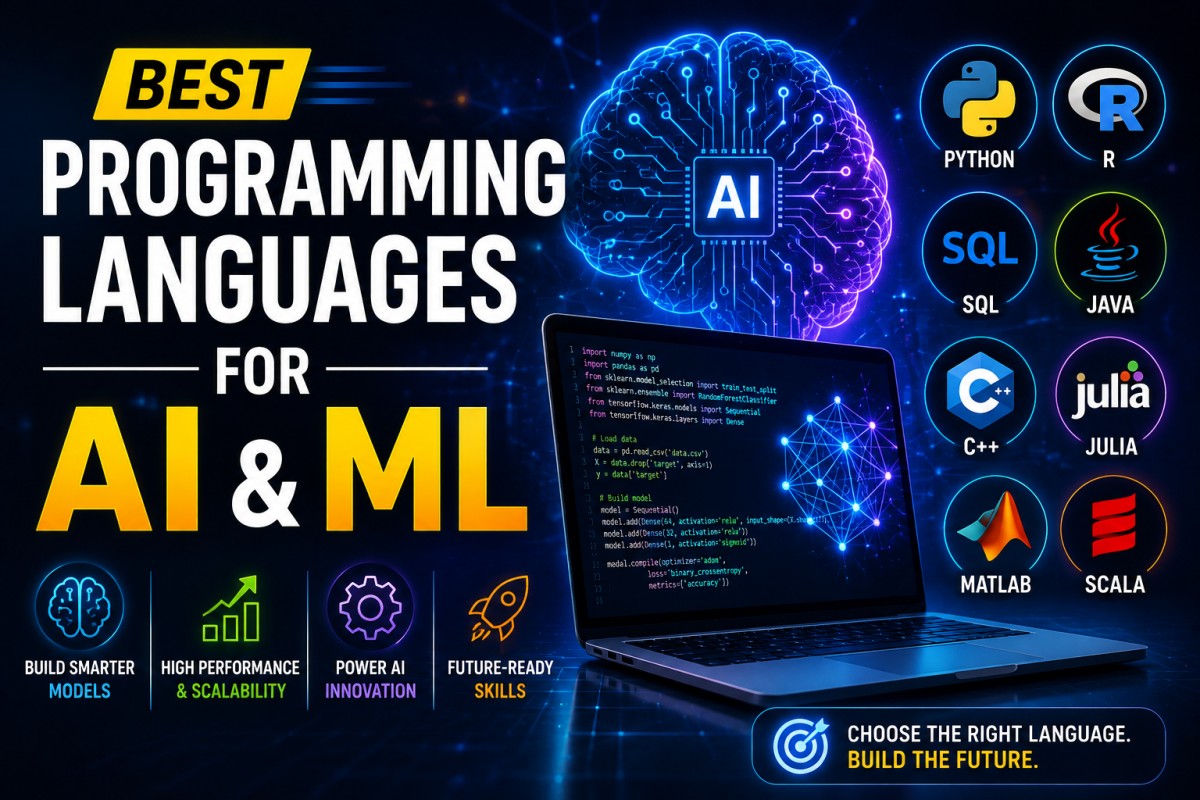
Language choice in AI is less contested than the internet suggests: one language dominates, and the others occupy specific niches. This guide explains what each is actually good for, where it shows up in production systems, and the order that gets a beginner productive fastest.
Table of Contents
- What Is the Best Programming Language for AI and ML?
- Language Comparison for AI and ML
- Why Does Python Dominate AI and Machine Learning?
- Do You Need to Learn C++ for AI?
- Is R Still Relevant?
- What Order Should a Beginner Learn In?
- How Do Python Libraries Fit Together in an AI Project?
- Does the Language You Choose Affect Performance?
- What Should You Learn Beyond the Language Itself?
What Is the Best Programming Language for AI and ML?
Python is the best first language for AI and machine learning by a wide margin, because the major frameworks, libraries and tutorials are built around it. Other languages matter in specific contexts: SQL for data access, C++ for performance-critical inference, Java in enterprise pipelines, and R in statistics-heavy research.
This is not a matter of Python being technically superior in every respect. It dominates because the ecosystem is there, which means faster problem-solving, more examples and easier hiring.
Language Comparison for AI and ML
| Language | Best For | Learn It When |
|---|---|---|
| Python | Model building, data work, nearly all ML frameworks | First, always |
| SQL | Extracting and shaping data from databases | Alongside Python |
| R | Statistical analysis, academic research, visualisation | If your work is statistics-led |
| C++ | High-performance inference, embedded and real-time AI | For latency-critical deployment |
| Java / Scala | Enterprise data pipelines and big-data platforms | In large corporate data stacks |
| Julia | Numerical and scientific computing | Specialised research contexts |
Why Does Python Dominate AI and Machine Learning?
Python dominates because the entire modern ML ecosystem is written for it: the major deep learning frameworks, the data manipulation libraries, the visualisation tools and the deployment tooling. Its readable syntax also means less time fighting the language and more time on the actual problem.
- Frameworks - the dominant deep learning libraries expose Python APIs first
- Data tooling - mature libraries for arrays, dataframes and visualisation
- Community - most tutorials, answers and example code assume Python
- Glue - easy to call optimised C and C++ code underneath
Worth understanding: the heavy numerical work usually runs in compiled C or CUDA underneath. Python is the control layer, which is why its own speed rarely limits training.
Do You Need to Learn C++ for AI?
Not to start, and not for most roles. C++ becomes relevant when you deploy models where latency or memory is tightly constrained, such as embedded devices, robotics, real-time systems or the internals of ML frameworks themselves. Learn it when a specific requirement demands it.
A practical pattern in industry: prototype and train in Python, then port only the inference path to C++ if measurement shows Python is genuinely the bottleneck.
Is R Still Relevant?
Yes, in statistics-heavy and research contexts. R remains strong for statistical modelling, exploratory analysis and publication-quality visualisation, particularly in academia, biostatistics and some analytics teams. For general machine learning engineering, Python is the more employable choice.
If your work is inference in the statistical sense - hypothesis testing, experimental design - R is genuinely excellent. If it is building and shipping models, Python.
What Order Should a Beginner Learn In?
Start with Python fundamentals, add SQL early because real data lives in databases, then learn the numerical and dataframe libraries, then a machine learning framework. Only add a second language once a concrete need appears rather than out of completeness.
- Python basics - syntax, data structures, functions
- SQL - querying and joining real data
- Data libraries - arrays, dataframes, plotting
- Classical ML - regression, classification, evaluation
- Deep learning framework - once the fundamentals hold
- Deployment - packaging a model so others can use it
How Do Python Libraries Fit Together in an AI Project?
A typical project uses a numerical library for array mathematics, a dataframe library for tabular data, a visualisation library for exploration, a classical machine learning library for standard algorithms, and a deep learning framework when neural networks are required.
| Layer | Role in a Project |
|---|---|
| Numerical arrays | Efficient mathematics underneath everything else |
| Dataframes | Loading, cleaning and joining tabular data |
| Visualisation | Exploring distributions and diagnosing problems |
| Classical ML | Standard algorithms plus evaluation utilities |
| Deep learning | Neural networks for unstructured data |
| Serving | Exposing the trained model as an API |
Beginners often learn these in isolation and struggle to connect them. Building one complete small project that touches every layer teaches the relationships far more effectively than studying each library separately.
Does the Language You Choose Affect Performance?
Less than beginners expect, because Python's heavy numerical work executes in compiled C or GPU code underneath. Python acts as the control layer, so its own execution speed rarely limits model training, though it can matter for data preprocessing loops.
Where Python speed genuinely matters is in tight loops over individual data items. The standard remedy is not switching language but expressing the operation as a vectorised array operation, which pushes the work into optimised compiled code.
For inference at very low latency or on constrained hardware, porting the serving path to a compiled language is a legitimate optimisation - but only after measurement demonstrates Python is actually the bottleneck. Optimising before measuring wastes effort with striking reliability.
What Should You Learn Beyond the Language Itself?
Programming language ability alone is insufficient. Employers expect version control, an understanding of how to structure a project, testing basics, working with APIs, and enough command line and container knowledge to run your code somewhere other than a notebook.
- Git - every team uses it, and notebook-only workflows do not survive collaboration
- Project structure - moving from notebooks to reusable modules
- Testing - even basic tests distinguish engineering from experimentation
- APIs - consuming data sources and exposing your own model
- Command line - environments, dependencies, running things reliably
- Containers - packaging so your code runs on someone else's machine
The gap between someone who can train a model in a notebook and someone who can ship it is exactly these skills. It is also the gap that separates candidates who interview well from those who do not, because interviewers probe how you would deploy and maintain what you built.
Learning them alongside the modelling work is far more efficient than treating them as a separate later project.
Talk to a WebAsha training advisor about batches, syllabus and current fees.
Programming Languages for AI and ML: FAQs
What's Your Reaction?
 Like
0
Like
0
 Dislike
0
Dislike
0
 Love
0
Love
0
 Funny
0
Funny
0
 Wow
0
Wow
0
 Sad
0
Sad
0
 Angry
0
Angry
0

With a passion for staying on the cutting edge of technology trends, I am dedicated to delivering content that not only informs but also inspires. Whether you need in-depth analysis pieces, informative guides, or thought-provoking opinion pieces, I craft content that resonates with tech enthusiasts and professionals alike.