Best DevOps Engineer Course in Mumbai: Training, Fees, Syllabus, Certification & Career Guide
A practical guide to choosing a DevOps engineer course in Mumbai: what a complete syllabus covers, how to evaluate any institute objectively, certification paths, career roles and where WebAsha's DevOps Master Program fits.
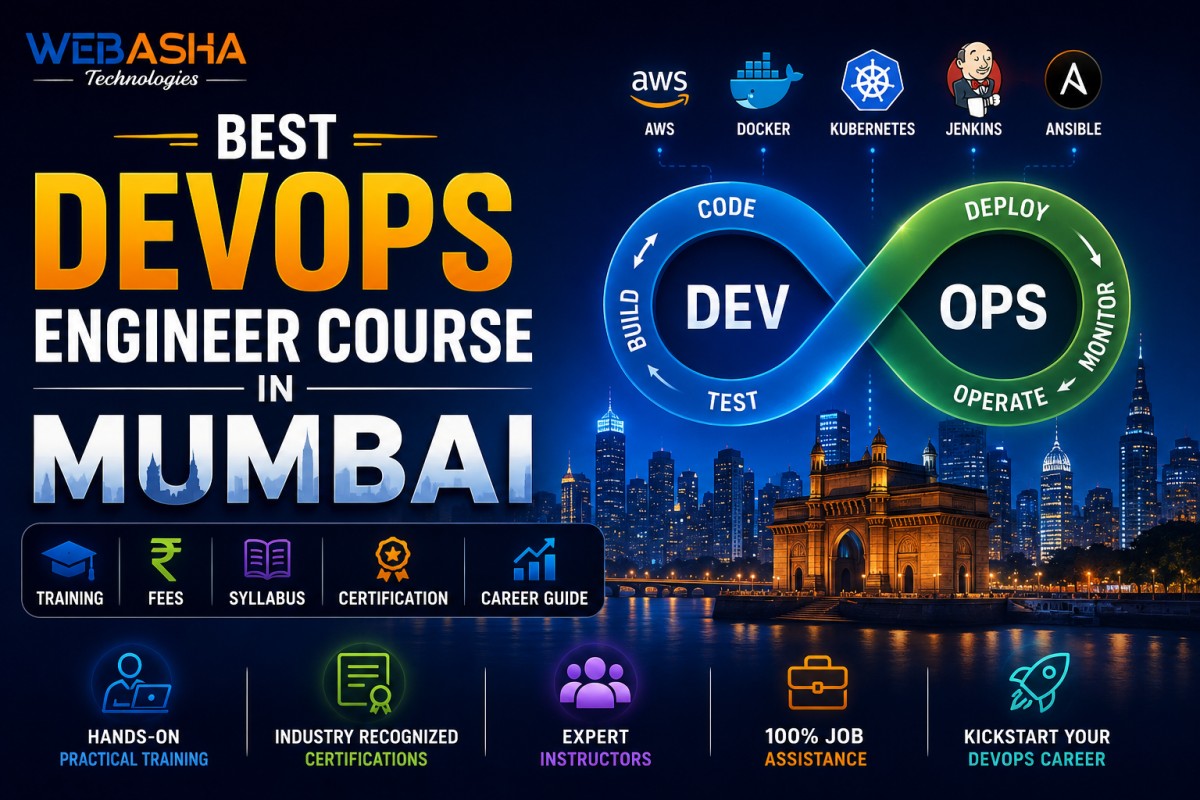
If you are searching for the best DevOps Engineer course in Mumbai, the honest answer is that no single institute is objectively "the best" for everyone — but the right course for you is identifiable, and it comes down to five things: a syllabus that covers the whole toolchain rather than a few popular tools, real lab access, projects you can defend in an interview, instructor-led sessions, and a batch format that fits your schedule. This guide explains what a DevOps engineer actually does, what a complete syllabus looks like, how to evaluate any institute in Mumbai against an objective checklist, and where WebAsha Technologies' DevOps Master Program fits. Everything stated here about WebAsha comes from its published course information; where a detail is not published, we say so rather than guessing.
Topics covered in this guide: best DevOps engineer course in Mumbai, DevOps training institute in Mumbai, DevOps course syllabus, DevOps course fees, DevOps course duration, DevOps certification path, DevOps engineer salary factors, DevOps career roadmap, online and classroom DevOps classes in Mumbai.
Talk to a WebAsha training advisor if you want the current Mumbai batch schedule and fee before you read further.
Table of Contents
- What Is a DevOps Engineer and What Do They Actually Do?
- Why Learn DevOps in Mumbai?
- What Makes a DevOps Course Actually Good?
- What Is the Best DevOps Engineer Course in Mumbai?
- Why Choose WebAsha Technologies for DevOps Training in Mumbai?
- DevOps Course Syllabus: What You Will Learn
- How Do the DevOps Tools Fit Together?
- Training Methodology, Batch Timings and Learning Modes
- Hands-On Labs and Real-Time Projects
- DevOps Certification Path: Which Ones Are Worth It?
- Who Is Eligible for a DevOps Course?
- How Long Is the DevOps Course in Mumbai?
- How Much Does a DevOps Course Cost in Mumbai?
- DevOps Career Opportunities and Job Roles
- What Determines a DevOps Engineer's Salary in Mumbai?
- DevOps Career Roadmap: Step by Step
- Classroom Training vs Self-Learning vs Generic Online Courses
- How to Choose the Best DevOps Training Institute in Mumbai
- Who Should Join This Course?
- How to Enrol
What Is a DevOps Engineer and What Do They Actually Do?
A DevOps engineer builds and maintains the systems that take code from a developer's laptop into production reliably and repeatedly. That means automating builds and tests, packaging applications into containers, provisioning infrastructure through code, deploying to cloud platforms, and monitoring what happens afterwards. It is an infrastructure and automation role rather than an application development one.
In practice the day involves a mix of pipeline work, infrastructure changes and responding to things that are not behaving. A typical week might include adding an automated security scan to a build pipeline, writing a Terraform module so a new environment can be created without manual clicking, debugging why a Kubernetes pod restarts under load, and tuning an alert that fires too often.
The reason the role exists is that release frequency increased faster than manual processes could cope with. When a company deployed four times a year, a manual checklist was adequate. When it deploys several times a week, that checklist becomes the bottleneck and the source of most outages. DevOps engineering is the discipline of removing that bottleneck without making the system less safe.
If you are entirely new to the subject, our complete beginner's guide to DevOps covers the concepts before the tools.
Why Learn DevOps in Mumbai?
Mumbai concentrates banking, financial services, insurance, media, e-commerce and a large captive-centre presence — sectors that run regulated, high-availability systems and have been migrating them to cloud platforms. That combination produces sustained demand for engineers who can automate deployment and maintain reliability under compliance constraints.
The character of Mumbai DevOps work is worth understanding before you train for it. BFSI employers place heavy weight on audit trails, change control, secrets management and access segregation. A pipeline that deploys quickly but cannot demonstrate who approved what will not survive review. This makes infrastructure-as-code and policy-driven automation particularly valuable in this market, because they make change reviewable by design.
Media and consumer-facing businesses in the city pull in a different direction — traffic spikes, content delivery, autoscaling and cost control. Between them, the two clusters mean a Mumbai-based DevOps engineer benefits from genuine breadth rather than deep specialisation in one tool.
There is also a practical consideration. Mumbai commutes are long, which is why the choice between classroom and live online training matters more here than in most cities. A course you can attend consistently from home beats a marginally better one you miss a third of.
What Makes a DevOps Course Actually Good?
A good DevOps course covers the full lifecycle rather than isolated tools, gives you an environment to break things in, is taught live by someone who has run production systems, includes projects that connect the tools together, and prepares you for recognised certifications. Anything missing from that list is a gap you will have to fill yourself.
- Complete toolchain coverage — plan, code, build, test, release, deploy, operate, monitor. A course that stops at Jenkins has taught you a third of the job.
- Lab access outside class hours — you cannot learn Kubernetes by watching someone else use it. Ask specifically how many hours of lab access you get and whether it continues after the course ends.
- Live instruction — recorded video has its place, but you cannot ask a recording why your pipeline failed at step four.
- Integrated projects — separate exercises per tool teach syntax. One project that runs code from commit through to a monitored production deployment teaches the job.
- Cloud exposure — DevOps without AWS or Azure is an incomplete skill set in the current market.
- Certification alignment — the syllabus should map onto CKA, Terraform Associate, AWS DevOps Professional or AZ-400 rather than being purely institute-specific.
- Honest support — resume help, mock interviews and referrals are real value. Guaranteed placement claims are not.
What Is the Best DevOps Engineer Course in Mumbai?
Choosing the best DevOps course in Mumbai comes down to syllabus depth, practical lab time, instructor quality, project work, certification preparation and career support. WebAsha Technologies runs a DevOps Master Program in Mumbai covering Linux and shell scripting, Git and GitHub, Jenkins CI/CD, Docker, Kubernetes, Ansible, Terraform, and monitoring with Prometheus and Grafana on AWS and Azure.
Judged against the checklist above, that syllabus covers the full lifecycle rather than a subset, which is the single most common weakness in shorter courses. The programme is listed as 40 hours of instruction across weekday and weekend sessions, with online and classroom options, hands-on labs, two real-time projects and a job-oriented completion certificate.
What it does not publish is a fixed fee, which is normal for instructor-led training where the price depends on mode and batch. Ask for it directly rather than relying on a figure quoted in a third-party article.
The comparable programme in Pune is covered in our best DevOps engineer course in Pune guide if you are weighing up locations.
Why Choose WebAsha Technologies for DevOps Training in Mumbai?
WebAsha positions its Mumbai DevOps training around practical delivery: instructor-led sessions, hands-on labs with round-the-clock cloud lab access, two real-time projects, certification preparation for CKA, Terraform Associate, Docker DCA, AWS DevOps Engineer Professional and Azure AZ-400, and career support covering resume preparation, mock interviews and placement assistance.
| What is offered | Why it matters |
|---|---|
| Full toolchain syllabus across eight modules | You leave able to discuss the whole delivery pipeline, not one segment of it |
| Hands-on labs with full-day and round-the-clock cloud access | Practice time is what converts a syllabus into a skill |
| Two real-time projects | Gives you concrete work to describe in interviews |
| Online and classroom modes | Attendance is the single biggest predictor of finishing |
| Weekday, weekend and fast-track batches | Working professionals can complete it without taking leave |
| Certification-aligned content | The study effort counts twice — course and exam |
| Resume preparation, mock interviews, placement assistance | Structured job-search support rather than a guarantee |
| Job-oriented completion certificate | Documents the programme; vendor certifications carry the external weight |
One point deserves emphasis because institutes across the industry blur it. Placement assistance means help finding and preparing for opportunities. It is genuinely useful. It is not the same as a guaranteed job, and no training provider can offer that honestly. Evaluate WebAsha, and every alternative, on the quality of the training first.
DevOps Course Syllabus: What You Will Learn
The WebAsha DevOps Master Program is structured into eight modules that follow the delivery lifecycle in order: Linux and shell scripting, Git and GitHub, CI/CD with Jenkins, containers with Docker, orchestration with Kubernetes, configuration management with Ansible, infrastructure as code with Terraform, and monitoring plus cloud DevOps on AWS and Azure.
| Module | Topics covered | Practical skill gained |
|---|---|---|
| Linux & Shell Scripting | Command line, filesystem, permissions, processes, Bash automation | Operating and automating the systems everything else runs on |
| Git & GitHub | Version control, branching, merging, collaboration workflows | Managing source and configuration the way teams actually do |
| CI/CD with Jenkins | Pipeline building, build automation, deployment automation | Turning a commit into a tested, deployable artefact automatically |
| Docker | Images, containers, Dockerfiles, Docker Compose | Packaging applications so they run identically everywhere |
| Kubernetes | Deployments, workload management, orchestration | Running containerised applications at scale with self-healing |
| Ansible | Configuration management, playbooks, automation | Making server configuration repeatable instead of manual |
| Terraform | Infrastructure as code, cloud provisioning, modules, state | Creating and versioning infrastructure through code |
| Monitoring & Cloud DevOps | Prometheus, Grafana, AWS, Azure | Knowing what production is doing and deploying on real cloud platforms |
The ordering is not arbitrary. Each module supplies something the next one assumes: you cannot script pipelines without the shell, cannot build pipelines without version control, cannot orchestrate containers you have not learned to build, and cannot monitor infrastructure you have not learned to provision.
Specific tracks are covered in more depth on the Git and GitHub for DevOps, AWS Certified DevOps Engineer Professional and Microsoft Azure DevOps course pages.
Request the full DevOps syllabus and current fee for the Mumbai batches.
How Do the DevOps Tools Fit Together?
The DevOps toolchain maps onto eight lifecycle stages — plan, code, build, test, release, deploy, operate, monitor — with different tools owning different stages. Git covers code, Jenkins covers build, test and release, Docker and Kubernetes cover deploy and operate, Terraform and Ansible provision what runs underneath, and Prometheus with Grafana closes the loop by telling you what actually happened.
| Stage | What happens | Typical tools |
|---|---|---|
| Plan | Work is defined and tracked | Issue trackers, boards |
| Code | Source is written and versioned | Git, GitHub |
| Build | Source becomes a runnable artefact | Jenkins, Docker |
| Test | Automated checks run against the build | Jenkins pipelines, test frameworks |
| Release | Approved artefacts are versioned and stored | Jenkins, registries |
| Deploy | Artefacts are pushed to an environment | Kubernetes, Ansible |
| Operate | Infrastructure is provisioned and maintained | Terraform, Ansible, AWS, Azure |
| Monitor | Behaviour is measured and alerted on | Prometheus, Grafana |
The reason this matters more than tool-by-tool knowledge is that interviews test the joins. Anyone can list Docker commands. Fewer candidates can explain what happens between a merged pull request and a running pod, where the artefact is stored, how the deployment is triggered, and what would roll it back. That narrative is the actual skill.
Official documentation is the best reference for each: Git, Jenkins, Docker, Kubernetes, Terraform, Prometheus and Grafana.
Training Methodology, Batch Timings and Learning Modes
WebAsha delivers the Mumbai DevOps programme through instructor-led sessions in both online and classroom formats. Published batch options include weekday mornings at 8:00 AM IST, weekday evenings at 6:30 PM IST, weekends at 10:00 AM IST, and a fast-track batch at 11:00 AM IST. Confirm current timings when you enquire, as schedules change.
| Batch type | Listed timing (IST) | Suits |
|---|---|---|
| Weekday morning | 8:00 AM | Students, job seekers, early risers |
| Weekday evening | 6:30 PM | Working professionals |
| Weekend | 10:00 AM | Full-time employees with weekday commitments |
| Fast track | 11:00 AM | Learners on a notice period or career break |
Choose on the basis of what you can sustain, not what finishes soonest. A fast-track batch compresses the same 40 hours into fewer weeks, which leaves less time between sessions to practise. For anyone new to Linux, that trade-off usually works against them.
For candidates outside Mumbai or on unpredictable schedules, the online DevOps training programme covers the same ground.
Hands-On Labs and Real-Time Projects
WebAsha lists hands-on labs, full-day lab access, cloud labs available around the clock, and two real-time projects as part of the Mumbai programme. Lab time is the component that separates a course you can talk about from one you can work from, because DevOps skills are procedural rather than theoretical.
The kind of work that produces interview-ready experience looks like this:
- Building a CI/CD pipeline that triggers on a commit, runs tests, and produces a versioned container image
- Containerising an application and running it with Docker Compose alongside its dependencies
- Deploying that application to Kubernetes with rolling updates and health checks
- Provisioning the underlying cloud infrastructure with Terraform rather than the console
- Configuring servers reproducibly with Ansible playbooks
- Instrumenting the result with Prometheus and building a Grafana dashboard that shows whether a deployment made things worse
Ask any institute — WebAsha included — exactly what the projects build before you enrol. Two connected projects that carry an application end to end are worth substantially more than a dozen disconnected exercises, because the connected version gives you a story with cause and effect in it. Interviewers probe the joins.
When you reach interview stage, our top 50 DevOps interview questions and answers is a useful revision list.
DevOps Certification Path: Which Ones Are Worth It?
WebAsha issues its own DevOps Master Program completion certificate and states that the programme also prepares candidates for the Certified Kubernetes Administrator, HashiCorp Terraform Associate, Docker Certified Associate, AWS Certified DevOps Engineer Professional and Microsoft Azure AZ-400. Vendor certifications carry external recognition; an institute certificate documents what you studied.
| Certification | Issued by | Best taken when |
|---|---|---|
| Certified Kubernetes Administrator (CKA) | CNCF / Linux Foundation | After genuine hands-on Kubernetes practice — it is a practical exam |
| HashiCorp Terraform Associate | HashiCorp | Once you have written and applied real Terraform configurations |
| Docker Certified Associate | Docker | Early, alongside the container module |
| AWS Certified DevOps Engineer – Professional | AWS | After associate-level AWS knowledge and practical pipeline experience |
| Microsoft Azure DevOps Engineer Expert (AZ-400) | Microsoft | If your target employers run on Azure — common in Mumbai BFSI |
A word on sequencing. CKA is a hands-on exam performed in a live cluster, which is exactly why it is respected and exactly why attempting it early tends to end badly. Build the practical foundation first; the certificate then reflects something real.
Exam details, prerequisites and fees change, so verify current requirements with the issuing body — the CNCF, HashiCorp, AWS or Microsoft Learn — rather than any third-party page.
Who Is Eligible for a DevOps Course?
WebAsha states that no prior experience is required and the DevOps Master Program is beginner-friendly, with basic Linux and command-line familiarity recommended for online participants. That distinction matters: command-line comfort is a recommendation that makes the course easier, not a barrier that keeps you out.
| Background | What you already have | Focus your effort on |
|---|---|---|
| Fresher / final-year student | Learning capacity, time | Linux and Git before anything else |
| Linux or system administrator | The strongest starting position | CI/CD, containers, Terraform |
| Developer | Git, scripting, build awareness | Infrastructure, networking, monitoring |
| QA / test engineer | Automation mindset, release-cycle knowledge | Linux depth, containers, orchestration |
| Support / NOC engineer | Production behaviour, incident handling | Version control, pipelines, IaC |
| Cloud engineer | AWS or Azure fundamentals | Pipelines, Kubernetes, configuration management |
Recommended knowledge and mandatory prerequisites are frequently conflated in course marketing. Here, the only genuine prerequisite is willingness to work in a terminal. Everything else is taught.
How Long Is the DevOps Course in Mumbai?
WebAsha lists the DevOps Master Program as 40 hours of instruction across weekday and weekend sessions, described as approximately a two-month duration. Fast-track batches deliver the same content over a shorter calendar period. Time spent practising outside class is additional and is what determines how job-ready you become.
A realistic way to think about it: the 40 hours give you the map. Becoming employable usually takes a comparable amount of independent lab time on top, spread over the same period. Learners who treat the course as the entire commitment tend to finish able to describe the tools but not to use them under pressure.
If you want a longer-horizon plan, our six-month roadmap to becoming a DevOps engineer sets out how the training fits into a full career transition.
How Much Does a DevOps Course Cost in Mumbai?
WebAsha does not publish a fixed fee for the Mumbai DevOps Master Program, because pricing depends on the learning mode, batch type and any offer running at the time. Contact WebAsha directly for the current fee. Be cautious of third-party articles quoting exact amounts — they are usually outdated.
When comparing quotes across institutes in Mumbai, compare like for like. The questions that actually change the value are:
- Are the sessions live and instructor-led, or recorded?
- How many hours of lab access are included, and for how long after the course?
- Are certification exam fees included or separate? (They usually are separate, and they are not small.)
- Are the projects individual or watched demonstrations?
- Is there any repeat-batch entitlement if you miss sessions?
- What exactly does the career support include?
A cheaper course with no lab access is not cheaper in any meaningful sense; it just defers the cost to your own time and to a second course later.
Book a free counselling session to work out which starting point matches your background.
DevOps Career Opportunities and Job Roles
DevOps skills lead to several adjacent roles rather than one job title. The common destinations are DevOps engineer, cloud DevOps engineer, site reliability engineer, platform engineer, build and release engineer, automation engineer and cloud engineer. They share a toolchain but differ in emphasis and in who they answer to.
| Role | Core focus | Emphasises |
|---|---|---|
| DevOps Engineer | Pipelines, automation, deployment | Breadth across the toolchain |
| Cloud DevOps Engineer | DevOps on AWS or Azure | Cloud services, cost, IaC |
| Site Reliability Engineer | Availability and performance | Monitoring, incident response, error budgets |
| Platform Engineer | Internal developer platforms | Kubernetes, self-service tooling |
| Build / Release Engineer | Build systems and release management | CI, artefacts, versioning |
| Automation Engineer | Removing manual process | Scripting, configuration management |
| Cloud Engineer | Cloud infrastructure | Networking, security, provisioning |
Entry into these roles is rarely direct for a fresher. The more common path is an adjacent position — support, operations, QA automation or junior cloud work — followed by a lateral move once you have production exposure. That is not a setback; production exposure is precisely what the senior roles are paying for.
Security-adjacent work is a growing branch of this. Our cloud security interview questions covers where the two disciplines meet.
What Determines a DevOps Engineer's Salary in Mumbai?
DevOps compensation in Mumbai varies widely by experience, cloud platform, sector and how much production responsibility the role carries, so any single figure would mislead. Rather than quoting numbers that date quickly, it is more useful to understand the factors that move them and to check current data yourself.
What consistently raises compensation:
- Production on-call responsibility — being accountable for uptime is the clearest dividing line between junior and senior bands
- Kubernetes depth — operating clusters rather than deploying to them
- Cloud platform certification plus real usage — either alone is worth less than both together
- Infrastructure as code at scale — modular, reviewed Terraform, not one-off scripts
- Regulated-industry experience — particularly relevant in Mumbai BFSI, where compliance-aware automation is scarce
- Product companies over service companies — generally, though the gap varies
For current figures, check a salary aggregator such as AmbitionBox, Glassdoor or Naukri, filter for Mumbai and your experience band, and note the date of the data. Treat any article quoting a precise salary without naming a source and date as marketing rather than information — including articles about training courses.
DevOps Career Roadmap: Step by Step
A workable DevOps roadmap runs: Linux, then networking basics, then Git, then scripting, then CI/CD, then Docker, then Kubernetes, then Ansible, then Terraform, then a cloud platform, then monitoring, then projects, then interview preparation. Each stage is used by the next, which is why skipping ahead tends to produce shallow knowledge.
- Linux — filesystem, permissions, processes, services, logs. Everything else runs here.
- Networking basics — DNS, HTTP, TCP/IP, ports, load balancing. Most deployment failures are network failures.
- Git — branching, merging, pull requests. The entry point to every pipeline.
- Scripting — Bash first, then enough Python to automate. Not application development.
- CI/CD — build a Jenkins pipeline that tests and packages automatically.
- Docker — images, layers, Dockerfiles, Compose. Understand why containers are not virtual machines.
- Kubernetes — pods, deployments, services, config, scaling. The steepest stage; do not rush it.
- Ansible — playbooks and idempotent configuration.
- Terraform — declarative infrastructure, modules, and state management. State is where beginners come unstuck.
- Cloud — AWS or Azure. Pick one, learn it properly, then the second becomes easy.
- Monitoring — Prometheus metrics, Grafana dashboards, sensible alerting.
- Projects — connect all of it end to end, and document what you built and why.
- Interview preparation — practise explaining your architecture decisions out loud.
Two stages are routinely skipped and should not be. Networking, because it looks like someone else's job until a service will not resolve. And monitoring, because it comes last in the list and first in every production incident.
Linux depth is worth investing in properly — the RHCSA certification track is a structured way to do it, and it pairs naturally with DevOps work.
Classroom Training vs Self-Learning vs Generic Online Courses
Instructor-led training, self-study and generic recorded courses all work for some people. Self-study is cheapest and slowest and demands strong discipline. Recorded courses are convenient but cannot answer questions. Instructor-led training costs more and adds structure, feedback and accountability, which is what most learners actually lack.
| Factor | Instructor-led (e.g. WebAsha) | Self-learning | Generic recorded course |
|---|---|---|---|
| Instructor support | Live, during sessions | None | Forum or none |
| Lab environment | Provided | You build and pay for it | Sometimes, often limited |
| Structure | Fixed syllabus and pace | You design it, often badly at first | Fixed but unguided |
| Feedback on your work | Yes | No | Rarely |
| Projects | Defined and reviewed | Self-directed | Usually watch-along |
| Certification preparation | Aligned to the syllabus | Self-managed | Varies |
| Career support | Resume, mock interviews, assistance | None | Rare |
| Flexibility | Batch timings, online or classroom | Total | Total |
| Cost | Highest | Lowest | Low to moderate |
| Completion rate | Higher — fixed schedule creates accountability | Low without strong discipline | Notoriously low |
To be fair to self-study: plenty of working DevOps engineers learned this way, particularly those who already had a sysadmin or development background and a production system to practise on. If that describes you, documentation and a home lab may genuinely be enough. If you are starting from zero and fitting study around a full-time job, the honest failure mode of self-study is not learning badly — it is stopping in month two.
How to Choose the Best DevOps Training Institute in Mumbai
Evaluate any Mumbai DevOps institute against an objective checklist rather than testimonials. The things that predict outcomes are syllabus completeness, lab access, live instruction, project depth, cloud coverage, certification alignment, transparent fees, batch flexibility and honest claims about placement.
- Does the syllabus cover the full lifecycle, or stop at the popular tools?
- How many hours of lab access are included, and does it continue after the course?
- Are sessions live, and can you attend a demo before paying?
- Have the trainers run production systems, or only taught?
- Do the projects connect the tools, or exercise them separately?
- Is a real cloud platform used, or only local virtual machines?
- Does the content map onto CKA, Terraform Associate, AWS or AZ-400?
- Is the fee stated clearly, with exam costs separated out?
- Are there batch timings you can genuinely attend every week?
- Is career support described as assistance, or sold as a guarantee?
That last point is the most useful filter available to you. An institute that promises guaranteed placement is telling you something about its honesty, not its outcomes. WebAsha describes its offering as placement assistance with resume preparation and mock interviews, which is the accurate way to put it.
Against this checklist, WebAsha's published Mumbai programme covers the full lifecycle in eight modules, includes labs with round-the-clock cloud access and two real-time projects, is instructor-led in online and classroom formats, uses AWS and Azure, and aligns to recognised vendor certifications. The fee is the one item not published, so ask for it.
Who Should Join This Course?
This course suits IT freshers and final-year engineering students, Linux and system administrators, developers, QA and support engineers, cloud professionals, and working IT professionals planning a career change into automation and cloud infrastructure.
- Freshers and final-year students — you have the time to practise properly; use it on Linux and Git before anything else
- Linux and system administrators — the shortest route into DevOps, since the foundation is already there
- Developers — you bring Git and scripting; infrastructure and monitoring are the gap
- QA and automation engineers — the automation mindset transfers directly into pipelines
- Support and NOC engineers — you already understand how production misbehaves, which is harder to teach than tooling
- Cloud professionals — adding CI/CD and Kubernetes broadens you into higher-value roles
- Career switchers from non-IT backgrounds — possible, but budget more time and start with Linux fundamentals
How to Enrol
To enrol, contact WebAsha through the enquiry page or the Mumbai DevOps course page, confirm which batch mode fits your schedule, ask for the current fee and next start date, and complete registration. Requesting a counselling session or demo first is sensible if you are choosing between institutes.
- Review the DevOps Master Program course page for Mumbai
- Decide between classroom and live online, and between weekday, weekend and fast-track
- Contact a training advisor for the current fee and upcoming batch dates
- Ask what the two real-time projects build, and what lab access you get
- Confirm which certification you are aiming at afterwards, and budget the exam fee separately
- Register and start with the Linux module
One last piece of advice, offered without any commercial interest in which institute you choose: pick the course you can actually attend every week. Consistency beats syllabus quality by a wide margin, and it is the single strongest predictor of whether you finish with skills or with regret.
Check upcoming DevOps batches in Mumbai or speak with a course advisor about which starting point suits your background.
Frequently Asked Questions
What's Your Reaction?
 Like
0
Like
0
 Dislike
0
Dislike
0
 Love
0
Love
0
 Funny
0
Funny
0
 Wow
0
Wow
0
 Sad
0
Sad
0
 Angry
0
Angry
0

With a passion for staying on the cutting edge of technology trends, I am dedicated to delivering content that not only informs but also inspires. Whether you need in-depth analysis pieces, informative guides, or thought-provoking opinion pieces, I craft content that resonates with tech enthusiasts and professionals alike.