Welcome!

Unlock your personalized experience.
Sign Up
Tag

Kubernetes Articles, Guides & Tutorials

15 posts

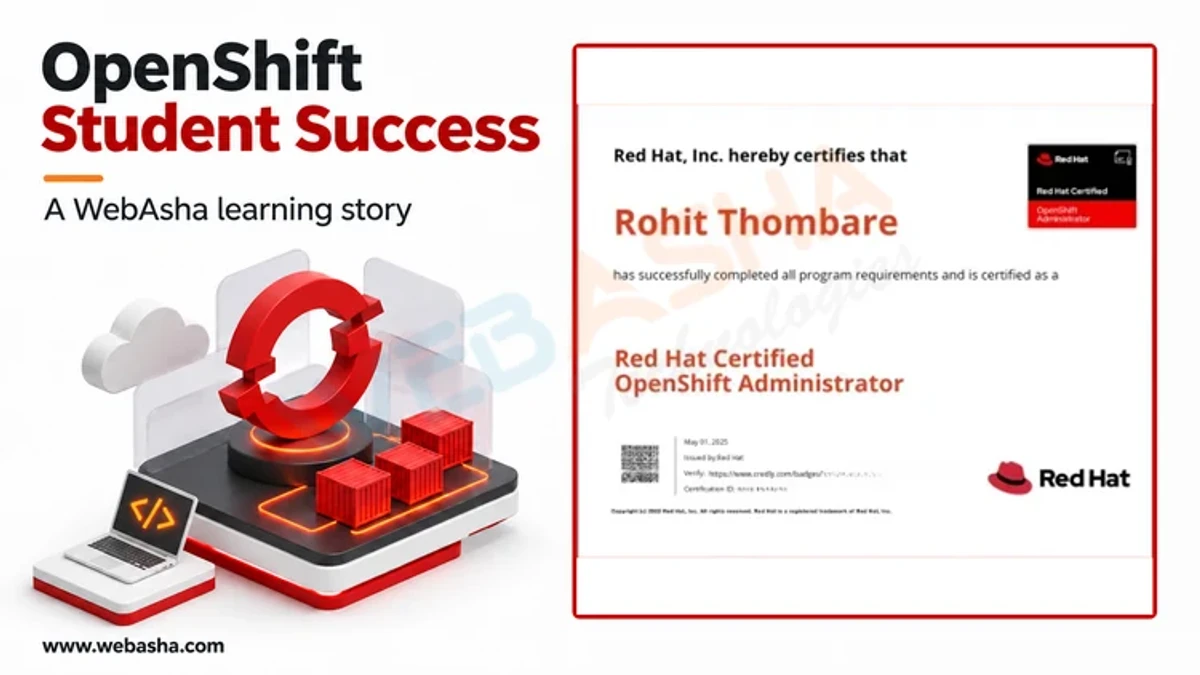
How to Pass Red Hat OpenShift DO280 and EX280: A Study Roadmap

Candidates who pass the Red Hat OpenShift Administrator exam (EX280) after the DO280 course usually follow a plan of about six to eight weeks. They first secure container and Kubernetes basics through DO180, then work through DO280 topics on a real cluster: users and RBAC, application deployment, networking and routes, storage, quotas, operators and cluster updates.

What an AWS Course in Pune Should Cover: A Syllabus Checklist

A good AWS course, in Pune or online, should cover the core building blocks first: the global infrastructure, IAM, EC2, storage with S3 and EBS, networking with VPC, databases such as RDS and DynamoDB, and monitoring with CloudWatch and CloudTrail. It should then add serverless with Lambda, containers, infrastructure as code with CloudFormation, and cost control with AWS Budgets.

Become a Certified Linux Administrator: Plan Study and Assessment

To become certified in Linux administration, choose a specific issuer and credential, read its current objectives and rules, build the required skills, and complete the relevant assessment. There is no single universal Linux-administrator certificate or requirement covering every employer.

Cloud Administrator Certifications: Build a Role-Based Shortlist

Choose a cloud administrator certification by the work and provider in a relevant vacancy. Compare operations-focused objectives with your current knowledge, recommended experience and renewal responsibilities. AWS CloudOps Engineer Associate, Azure Administrator Associate and Google Associate Cloud Engineer address different environments. None is a universal requirement for every cloud administration role.

DevOps Interviews: Explain a Failed Build Before Choosing a Fix

Prepare for DevOps interviews by explaining a delivery workflow and how you would investigate an incomplete or failed result. Use a small fictional run to separate source changes, test failure, artifact creation and deployment. Ask for missing context before recommending a fix. Read the actual vacancy and prepare evidence for its responsibilities rather than memorising a universal list of questions.

DevOps Tools: Follow a Change From Source to Observation

Learn DevOps tools by following one change through source review, checks, packaging, release and observation. Git, pipeline systems, containers, infrastructure tools and monitoring serve different parts of that workflow. Choose a small set you can explain before adding more products. Trace the relationship between a revision, its run and its output, and identify where approval or verification belongs.

Practise DevOps With a Small Local Check and Review Cycle

Start DevOps practice with a small change you can understand, check and explain locally. Define expected behaviour, run a few relevant checks, review the result and record what would be released. Add a pipeline or container only when it serves the learning task. A local exercise can teach useful delivery habits without a cloud account or public deployment.

AMD GPUs on OpenShift AI: Check the Stack Before Training

AMD accelerators can be part of an OpenShift AI environment when the hardware, OpenShift release, GPU operator, driver and workload runtime form a compatible combination. Begin with the selected release's configuration guidance and the accelerator vendor's matrix, then confirm that the cluster exposes the expected resources to the workload. A visible GPU does not prove that a particular training image can use it.

Cloud Development Toolchain Interview Questions and Answers

Cloud toolchain interviews ask how source control, CI, infrastructure definitions, identity and monitoring work together across a team. A useful answer identifies which event triggers work, which inputs are trusted and which identity can act on the cloud. The fictional review below separates an untrusted contribution’s test job from an approved deployment job.

Cloud Automation Interview Questions: Failures and Stop Controls

Cloud automation interviews test what happens after the happy path breaks. Explain how a workflow selects its targets, obtains permission, handles partial results and verifies its intended outcome. A scheduled job can finish while leaving an important task incomplete. The worked exercise below follows an invented certificate inventory workflow whose final report must stop when one region is missing.

Kubernetes Interview Questions on Workloads and Scheduling

Kubernetes interview answers should connect API objects, controllers, scheduling and useful application behaviour. Explain what each component controls and which evidence remains missing. A Bound volume claim does not prove that a Pod can use its storage on every node. The fictional topology case below pairs a zone-constrained volume with an incompatible Pod node selector.

Docker and Container Interview Questions with Answers

Docker interviews test images, processes, storage, networking and the operational behaviour of containers. Explain what each setting changes rather than assume that a container label proves the application works. In the fictional case below, a container remains running while its health check fails. A restart policy does not, by itself, restart an ordinary Docker container merely because it becomes unhealthy.

CKA, CKAD and CKS Preparation: Practise and Verify Tasks

Prepare for CKA, CKAD or CKS by matching current objectives to complete tasks you can perform and verify independently. Choose the assessment for your intended work, confirm its rules and build understanding before adding time pressure. The worked cluster-selection exercise shows why a correct manifest applied to the wrong target fails the task.

What Are Kubernetes and Containers, and Why Use Them?

Containers package applications with their user-space requirements; Kubernetes coordinates containerised workloads through declared resources and controllers. Together they can make deployment and operation more repeatable, but they do not remove application, networking or storage decisions.