How to Pass Red Hat OpenShift DO280 and EX280: A Study Roadmap
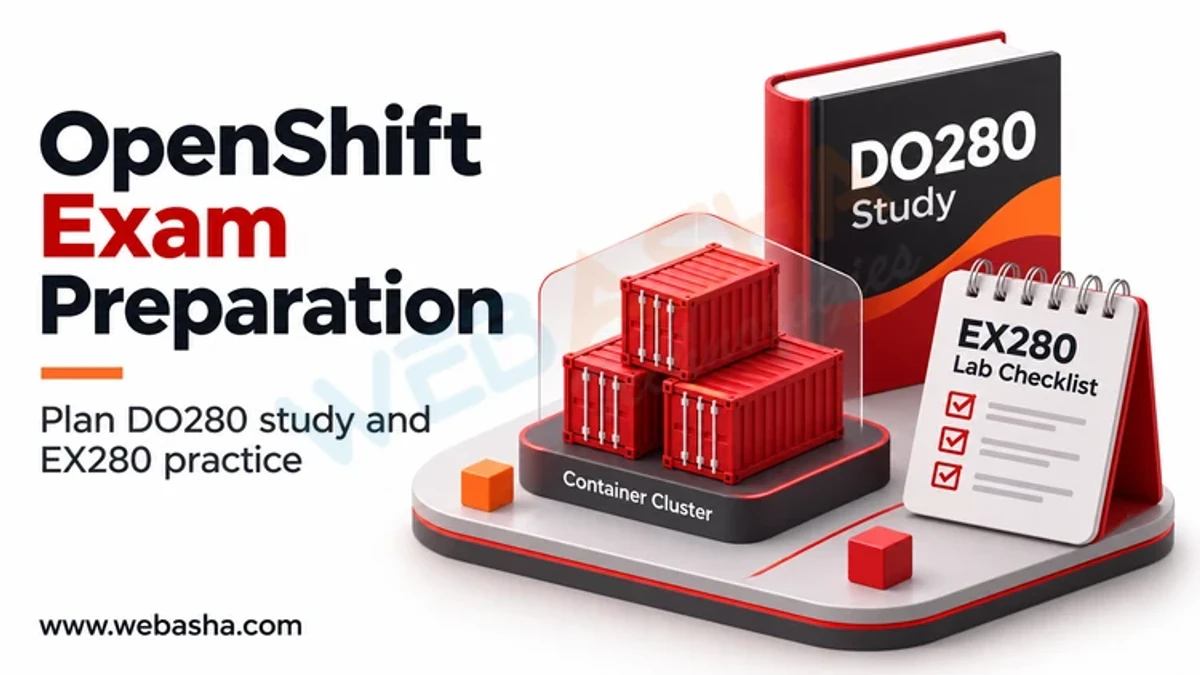
Candidates who pass the Red Hat OpenShift Administrator exam (EX280) after the DO280 course usually follow a plan of about six to eight weeks. They first secure container and Kubernetes basics through DO180, then work through DO280 topics on a real cluster: users and RBAC, application deployment, networking and routes, storage, quotas, operators and cluster updates.
Topic: OpenShift in IT Infrastructure · Certification preparation
Quick answer: Candidates who pass the Red Hat OpenShift Administrator exam (EX280) after the DO280 course usually follow a plan of about six to eight weeks. They first secure container and Kubernetes basics through DO180, then work through DO280 topics on a real cluster: users and RBAC, application deployment, networking and routes, storage, quotas, operators and cluster updates. EX280 is a 3-hour, hands-on exam currently based on OpenShift Container Platform 4.22, with product documentation available. The last two weeks go to timed mock tasks and troubleshooting drills. This roadmap sets weekly goals and readiness checks.
Key takeaways
- DO180 basics make DO280 much easier.
- Practise on a real or local OpenShift cluster every week.
- EX280 is 3 hours, hands-on, on OCP 4.22.
- Troubleshooting order saves time under pressure.
- Book only after clean timed mock runs.
Table of Contents
- What Is the DO280 and EX280 Path?
- Where Can You Practise OpenShift?
- What Does an 8-Week Roadmap Look Like?
- Which Habits Help Candidates Succeed?
- How Should You Practise Troubleshooting?
- How Do You Know You Are Ready?
- Why Does Cluster Security Matter?
- References
What Is the DO280 and EX280 Path?
| Step | What it covers |
|---|---|
| DO180 | Containers, Kubernetes and OpenShift basics |
| DO280 | Operating a production cluster: RBAC, networking, storage, updates |
| EX280 | 3-hour hands-on exam, OCP 4.22 |
Red Hat also suggests RH124 and RHCSA, though they are not required.
Where Can You Practise OpenShift?
Course labs are ideal. For extra practice, Red Hat OpenShift Local runs a small single-node cluster on a workstation with enough memory. Some cluster-wide features differ from a full cluster, so check against the OpenShift documentation.
oc whoami
oc get nodes
oc get clusterversion
oc get co
What Does an 8-Week Roadmap Look Like?
| Week | Focus | Check |
|---|---|---|
| 1 | Review DO180: pods, deployments, services | Deploy and expose an app |
| 2 | Identity providers, users, groups | Log in as a new user |
| 3 | RBAC and service accounts | Least-privilege roles work |
| 4 | Routes, TLS, network policies | Traffic allowed only as intended |
| 5 | Persistent storage, quotas, limit ranges | App keeps data after restart |
| 6 | Operators, scheduling, cluster updates | Install an operator |
| 7 | Troubleshooting drills | Fix five broken apps in a row |
| 8 | Timed mock tasks | Finish inside 3 hours |
The Kubernetes documentation helps with core object concepts behind each week.
Which Habits Help Candidates Succeed?
- Create resources from YAML and keep the files.
- Use oc explain to find fields instead of searching online.
- Match project names and resource names exactly.
- Verify every change with oc get and oc describe.
- Practise a little every day instead of cramming.
Keep a personal lab journal. For each week, record the tasks you completed, the commands you used, and anything that failed and why. Review the journal at the start of each session. This builds the recall you need when notes are not allowed. It also helps you notice patterns, such as always forgetting the namespace flag or mixing up role and cluster role bindings. Fixing these small habits early prevents the most common lost marks. In the final weeks, set yourself mixed task lists that jump between topics, since the real exam does not follow course chapter order.
How Should You Practise Troubleshooting?
Use one order every time: pod status, events, logs, then configuration such as secrets, quotas and security context constraints. Ask a study partner to break apps for you, or break them yourself and record the fix.
oc get pods -n demo
oc describe pod web-1 -n demo
oc logs deploy/web -n demo
oc get events -n demo --sort-by=.lastTimestamp
How Do You Know You Are Ready?
You are close when you can complete a full set of mock tasks inside 3 hours on a fresh cluster. Test yourself with our DO280 and EX280 practice questions, then read our OpenShift EX280 exam tips for exam-day tactics.
Why Does Cluster Security Matter?
Much of DO280 is about control: who can do what, which pods may talk, and how secrets are stored. NIST SP 800-190 explains these container security risks. WebAsha Technologies offers instructor-led cluster labs; ask about our OpenShift DO280 training.
References
Frequently Asked Questions
What's Your Reaction?
 Like
0
 Dislike
0
 Love
0
 Funny
0
 Wow
0
 Sad
0
 Angry
0
With a passion for staying on the cutting edge of technology trends, I am dedicated to delivering content that not only informs but also inspires. Whether you need in-depth analysis pieces, informative guides, or thought-provoking opinion pieces, I craft content that resonates with tech enthusiasts and professionals alike.