CEH vs CEH Practical: Exam Style, Skills and Preparation
CEH uses a knowledge-based examination, while CEH Practical assesses hands-on work in a cyber range. EC-Council lists 125 questions over four hours for CEH and 20 practical challenges over six hours for CEH Practical. Passing both is the route to the CEH Master designation.
CEH uses a knowledge-based examination, while CEH Practical assesses hands-on work in a cyber range. EC-Council lists 125 questions over four hours for CEH and 20 practical challenges over six hours for CEH Practical. Passing both is the route to the CEH Master designation. [1] [2] [4]
The formats reward different preparation habits. Use this guide to plan your learning, then verify the applicable eligibility, scoring and exam-day instructions directly with EC-Council before booking. Official details were checked on 17 November 2026.
What to decide first
- Identify the exact exam or credential you need.
- Confirm your eligibility route and package inclusions.
- Practise explaining concepts as well as working in an authorised lab.
- Resolve conflicting policy information through the issuer.
CEH vs CEH Practical at a glance
| Area | CEH | CEH Practical |
|---|---|---|
| Assessment | Knowledge-based multiple-choice examination. | Hands-on challenges in an iLabs cyber range. |
| Published exam size | 125 questions. | 20 practical challenges. |
| Published duration | Four hours. | Six hours. |
| Preparation emphasis | Understand concepts, interpret scenarios and distinguish answer choices. | Perform tasks, interpret results and manage a practical workflow. |
| Readiness evidence | Explain why an answer fits and alternatives do not. | Repeat a permitted lab task and verify its result. |
| Booking checks | Eligibility, exam identity, delivery instructions and voucher conditions. | Eligibility, lab access, proctoring instructions and permitted resources. |
The issuer’s CEH page identifies exam 312-50. Its Practical page describes an iLabs cyber-range assessment. These are separate assessments; a package name should not replace checking the actual exam entitlements. [1] [2]
What the CEH knowledge exam asks you to prepare for
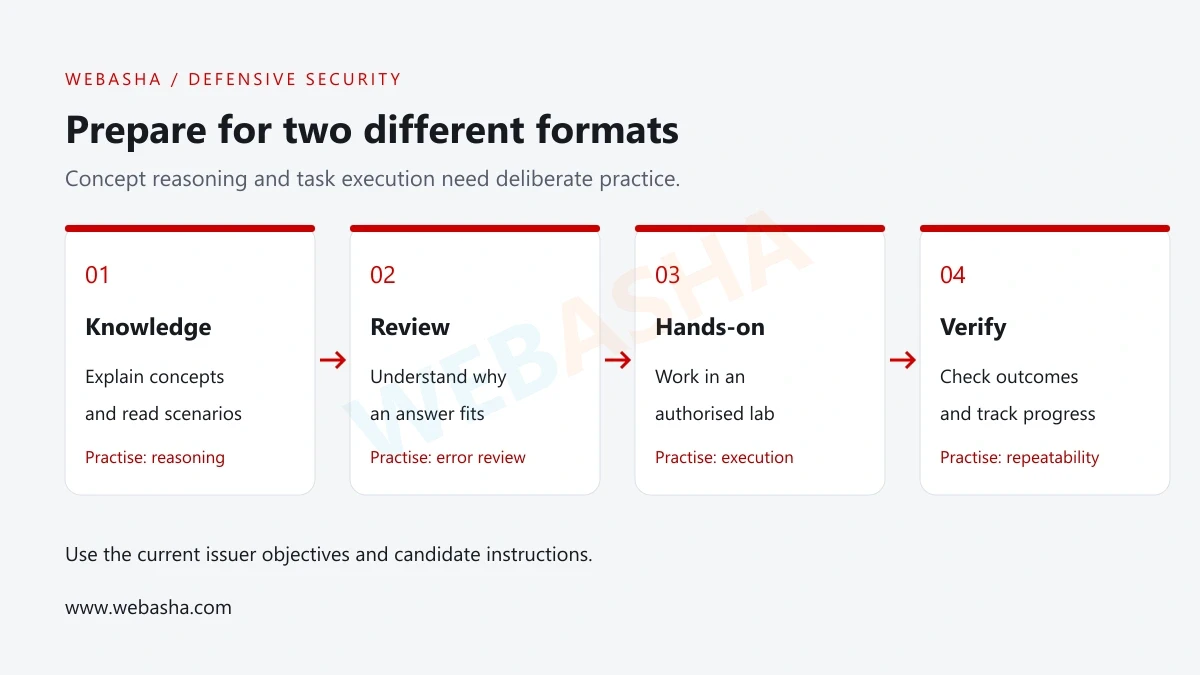
A multiple-choice format still calls for understanding. In preparation, explain the security concept, recognise the purpose of a control and interpret the context of a question. When several options look plausible, identify which requirement the question actually asks you to satisfy.
Use the issuer’s published exam blueprint as your study checklist. Record the version and download date, and revisit it before booking. Do not assume a courseware version label and an exam blueprint revision are interchangeable.
After practice questions, keep a short error log: the concept you missed, your original reasoning and the correction. Revisit the underlying topic with a small authorised example. Memorising the position or wording of an answer gives you little help when the scenario changes.
For foundation revision, use the WebAsha cybersecurity beginner guide. Fill gaps in networking, systems and security concepts before relying on timed quizzes alone.
What changes when you prepare for CEH Practical
Practical preparation should involve operating the environment yourself. Learn to inspect results, recognise an incorrect assumption and return to a task after a failed attempt. Keep work inside the supplied lab scope and follow the current candidate instructions.
The certification page recommends preparation through the CEH course or equivalent learning. That recommendation describes preparation; it should not be treated as a substitute for checking the separately published eligibility rules. [2]
Keep a lab record with the objective, environment, action, observed result and verification. Record what failed and why you changed your approach. A completed walkthrough is a starting point; repeat a similar exercise without following every step to find the parts you still need to learn.
Use training environments designed for the activity. OWASP Juice Shop is an intentionally insecure application for security education, for example; follow its documentation for an isolated instance and use it only for appropriately scoped learning. [6]
How CEH Master relates to the two exams
EC-Council describes CEH Master as requiring both the CEH knowledge exam and CEH Practical. It is a designation within the CEH programme, not a university master’s degree. [4]
Write down which result you want: the knowledge credential, the Practical assessment or the combined designation. Then ask for the exact exam names and entitlements in your proposed package. Confirm what is included rather than inferring it from a sales headline.
You do not need to choose based on a claim that one option is universally better. Review your intended role, the employer’s wording and your present skills. Training and examination results can support an application, but they do not establish that you can perform every task in a professional penetration test.
Eligibility and passing-score details need a fresh check
The issuer’s application page describes official-training and application-without-training routes. For the CEH and CEH Practical entries reviewed, it states two years of information-security experience unless the candidate attends official training. Ask EC-Council to confirm which route and supporting documents apply to you. [3]
A general blog statement that anyone can book an exam is insufficient evidence of your eligibility. Likewise, do not assume that a course advertised as preparation is official training for the relevant route. Validate the provider’s status through the issuer and retain the written response.
The discrepancy is between official materials, so repeating an older number without qualification would hide a material uncertainty. [2] [5]
Recheck eligibility, scoring, permitted resources, scheduling and voucher conditions immediately before purchase and again before the exam. Keep the issuer’s booking-specific instructions as your operational reference.
Build skills shared by both preparation paths
| Foundation | Knowledge practice | Practical learning evidence |
|---|---|---|
| Networking | Explain addressing, services and the purpose of a control. | Interpret an approved sample capture and document what is visible. |
| Operating systems | Explain users, permissions, files and relevant logs. | Resolve a permission issue in your own disposable lab. |
| Web security | Distinguish identity, permissions and application behaviour. | Review a permitted training scenario and propose a verifiable fix. |
| Cryptography | Explain confidentiality, integrity and key-related boundaries. | Compare synthetic files and explain what a digest match establishes. |
| Professional practice | Explain scope and reporting responsibilities. | Write a short record of findings, uncertainty and next steps. |
These are editorial practice suggestions. They do not claim to reproduce the live exam or guarantee coverage of every objective. Match your study tasks to the official blueprint and authorised learning materials.
A preparation plan with reviewable outputs
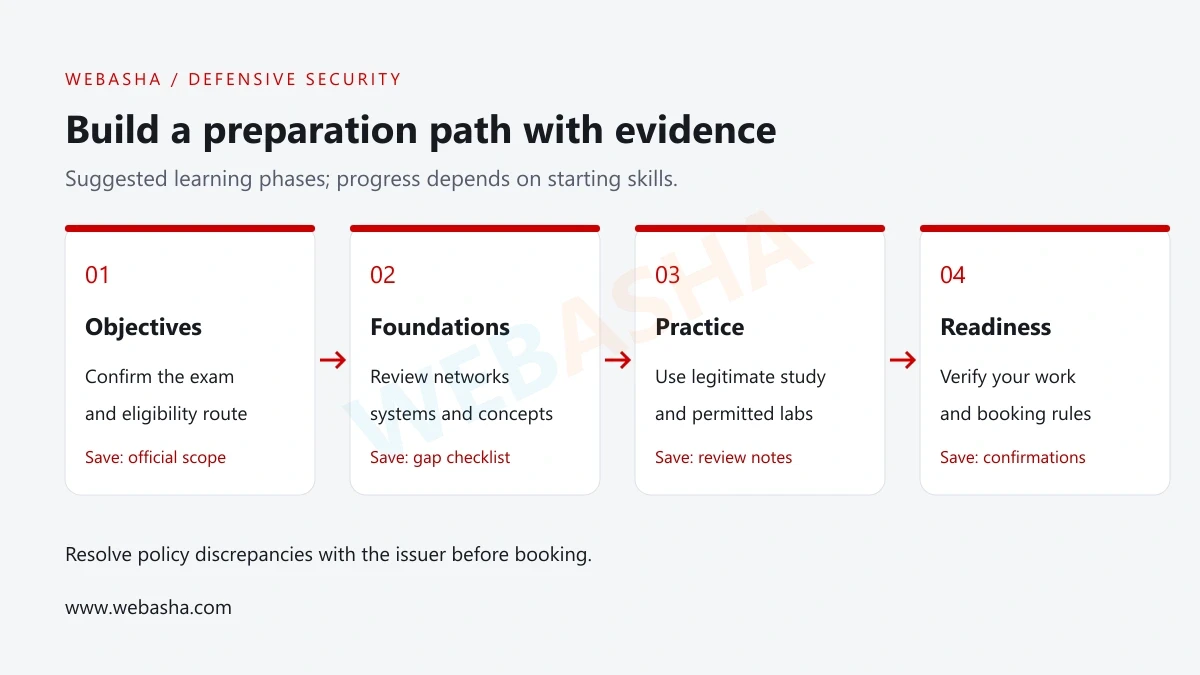
Begin by assessing foundations. Choose one unfamiliar objective, study the concept and explain it in your own words. Use a small permitted exercise to connect the concept to observable behaviour. Increase scope when you can explain and reproduce the result.
| Phase | Work to complete | Move on when |
|---|---|---|
| Confirm scope | Save the official objectives and applicable eligibility instructions. | You know which assessment and route you are preparing for. |
| Build foundations | Review networks, systems and security concepts. | You can explain the prerequisites behind a sample scenario. |
| Practise concepts | Use legitimate practice questions and analyse mistakes. | You can explain why your selected answer fits the scenario. |
| Practise tasks | Complete authorised lab exercises and repeat weak areas. | You can verify the result without copying a walkthrough. |
| Rehearse conditions | Practise time allocation and environment handling. | You can track progress and recover from a failed step. |
| Check booking | Review issuer instructions and unresolved policy questions. | The relevant details are confirmed before the exam date. |
The phases are a planning aid, not a promised number of weeks to pass. Your starting skills, available practice time and assessment choice determine the work still needed.
How to check readiness without relying on a pass promise
For knowledge preparation, answer a new practice question and explain your reasoning before checking the answer. If you chose correctly for the wrong reason, record the gap. For practical preparation, repeat an authorised task with a small change in the starting conditions.
Ask a peer or trainer to review one result. Can they reproduce your method? Does your report distinguish what you observed from what you inferred? Can you explain the role of the tool instead of listing its name?
Keep a portfolio of permitted learning work, separate from confidential exam content. The WebAsha beginner portfolio guide can help you structure project evidence. Do not publish live exam questions, flags or other protected assessment material.
Common preparation mistakes
| Problem | Useful correction |
|---|---|
| Treating knowledge and Practical as the same assessment | Confirm the format and practise the relevant type of response. |
| Using a fixed pass mark from an old blog | Check the current certification page and ask the issuer about discrepancies. |
| Copying labs without understanding results | Repeat a small task and explain your verification step. |
| Assuming AI or notes are permitted | Follow written instructions for the booked exam and clarify ambiguous rules. |
| Using question dumps or leaked material | Use authorised study resources and legitimate practice exercises. |
| Buying a package without checking inclusions | Request exact exam names, access periods and applicable terms in writing. |
If your goal is a SOC role, compare the role’s actual requirements with your study plan. The SOC analyst skills guide can help you identify relevant areas beyond the name of a certification.
Discuss CEH preparation with WebAsha
Bring your starting skills, target assessment and official objective list to a training discussion. Ask how concept review, individual lab work and feedback are organised. Confirm the course and exam entitlements separately.
Ask about CEH preparation at WebAsha Technologies. Contact WebAsha to discuss prerequisites, authorised lab practice and the current training syllabus.
Official references
Frequently Asked Questions
What's Your Reaction?
 Like
0
 Dislike
0
 Love
0
 Funny
0
 Wow
0
 Sad
0
 Angry
0

With a passion for staying on the cutting edge of technology trends, I am dedicated to delivering content that not only informs but also inspires. Whether you need in-depth analysis pieces, informative guides, or thought-provoking opinion pieces, I craft content that resonates with tech enthusiasts and professionals alike.