Claude Certification Career Roadmap 2026: From Beginner to AI Developer or AI Architect
A stage-by-stage roadmap from beginner to AI developer or AI architect - engineering foundations, the Claude stack, MCP, evaluation, the portfolio that gets interviews, and where certification actually belongs.
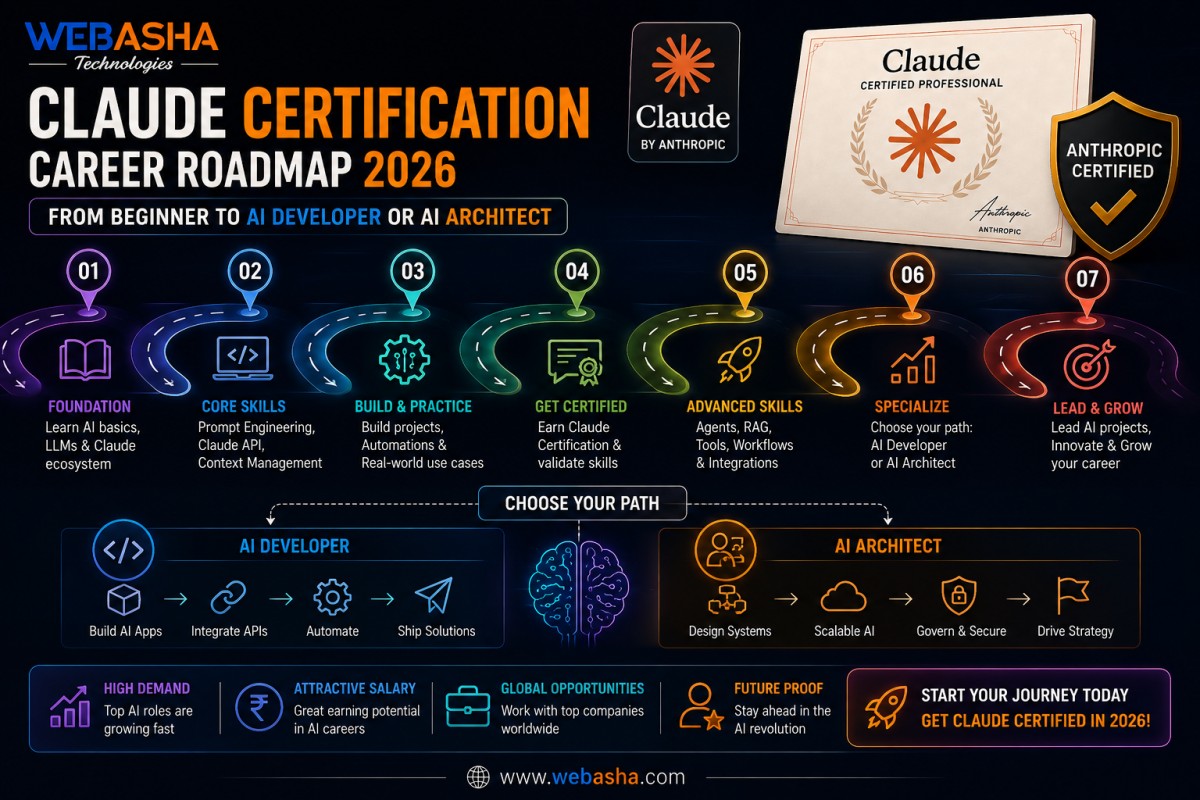
Most Claude career roadmaps open with the certificate, because that is what people search for - and that order produces candidates who hold a credential and cannot discuss anything they have built. This roadmap puts certification where it belongs, near the end: engineering foundations, the Claude stack, MCP and integration, evaluation, a portfolio, and only then an exam - if you can register for one.
Before you read on: Anthropic's Claude certifications are delivered through the Anthropic Partner Academy and are oriented to people at organisations in the Claude Partner Network. Network membership is free for organisations, but it is an organisational route rather than an open public booking like a typical vendor exam. If you are an individual learner in India, read the eligibility section before spending money on preparation.
Topics covered in this guide: AI developer career, AI architect career, engineering foundations, Claude API, Claude Code, agents, MCP, evaluation, portfolio projects, certification timing, realistic timeline.
Table of Contents
- What Does the Claude Career Roadmap Look Like?
- Stage 1: Engineering Foundations
- Stage 2: The Claude API
- Stage 3: Claude Code and Agents
- Stage 4: MCP and Integration
- Stage 5: Evaluation and Production Concerns
- Stage 6: Portfolio and First Role
- Stage 7: Certification, If You Can Register
- Developer Track or Architect Track?
- A Realistic Timeline
What Does the Claude Career Roadmap Look Like?
Software engineering foundations, then the Claude API, then Claude Code and agents, then MCP and integration, then evaluation and cost engineering, then a portfolio, then certification if you can register - and then a specialisation into either the developer or architect track. Certification sits near the end, not the beginning.
That last point is where most roadmaps for this go wrong. They open with the certificate because that is what people search for, which produces candidates who hold a credential and cannot discuss anything they have built. Employers detect this quickly.
Stage 1: Engineering Foundations
Before anything Claude-specific: one language you can build production code in, version control, testing, debugging, HTTP and JSON, and deployment. Everything in this field sits on top of ordinary software engineering, and weakness here surfaces later as confusion that is hard to diagnose.
If you already work as a developer, you have this and can move on. If you do not, this stage is the majority of your first year and there is no way around it - AI application development is software development with an additional, unusually unpredictable dependency.
Stage 2: The Claude API
Messages, system prompts, tool definitions and handling, streaming, context management, and the cost and latency consequences of your choices. Build a working integration with retries, logging and a spending cap before moving on.
The milestone is not "I called the API". It is "I built something that handles failure, that I know the per-request cost of, and that I would be comfortable putting in front of users".
Stage 3: Claude Code and Agents
Agentic development inside a real codebase, then multi-step agents that use tools and recover from failure. The skills that matter are specification, review and knowing when an agent is the wrong pattern.
Learn Claude Code on a repository you already understand, so you can judge what it produces. Then build an agent that completes a genuine multi-step task - and deliberately break one of its steps to see what your design does about it.
More on this in our Claude Code guide.
Stage 4: MCP and Integration
The Model Context Protocol connects models to external tools and data. This is where AI features stop being demos and start being useful, because real value comes from reaching real systems and real data.
Build a server that exposes something genuine - a database, an internal API, a document store - and think about boundaries as you do it: what is exposed, to what, and what must never cross into model context. Documentation is at modelcontextprotocol.io.
Stage 5: Evaluation and Production Concerns
Evaluation, guardrails, cost control, latency management and failure handling. This stage is what separates people who can build a demo from people who can run a system, and it is disproportionately what senior roles are paid for.
Build an evaluation harness. It is the single most differentiating thing on a junior AI engineer's portfolio, because almost nobody does it and every production team needs it.
The full skills breakdown is in our top Claude certification skills guide.
Stage 6: Portfolio and First Role
Four small working projects with written explanations beat one large half-finished one. Then apply - and expect the first role to be a software engineering position with AI responsibilities rather than a title with 'AI' in it.
| Portfolio item | What it demonstrates |
|---|---|
| API integration with retries and cost logging | You can ship something operable |
| Agent that recovers from a failed step | You design for failure |
| MCP server exposing real data | You can integrate, not just call |
| Evaluation harness | You can prove a change helped |
| Write-ups of your decisions | You can explain trade-offs - the interview itself |
Stage 7: Certification, If You Can Register
Certification confirms capability rather than creating it, and it comes after the portfolio. The exams run through the Anthropic Partner Academy and are oriented to Claude Partner Network organisations, so check eligibility before planning around it.
If you can sit an exam, choose by role: developer if you build, architect if you design. If you cannot, nothing above this line changes - the portfolio is what gets you hired either way.
Full eligibility detail is in our complete Claude certification guide, and the value question in is it worth it.
Developer Track or Architect Track?
The developer track goes AI application developer, integration engineer, agent developer, senior AI engineer. The architect track goes solution architect, lead architect, AI consultant. Most people should spend several years building before moving to designing, because architectural judgement comes from living with your own decisions.
| Developer track | Architect track | |
|---|---|---|
| Day-to-day | Building and shipping | Designing and defending |
| Core skill | Implementation and debugging | Trade-off judgement |
| Grows through | Owning features end to end | Owning system outcomes |
| Certification | Developer - Foundations | Architect - Foundations, then Professional |
| Suits you if | You like making things work | You like deciding how they should work |
Neither is senior to the other. They are different jobs, and a good architect who cannot build loses credibility with the people who have to implement the design.
A Realistic Timeline
For an existing developer, six to twelve months to become genuinely useful in an AI engineering role. From no programming background, eighteen months to two years, because the engineering foundations come first and cannot be skipped.
| Months | Focus | Milestone |
|---|---|---|
| 1-2 | Claude API | An integration you would put in front of users |
| 3-4 | Claude Code and agents | An agent that survives a failed step |
| 5-6 | MCP and integration | A server exposing real data |
| 7-8 | Evaluation, cost, latency | A harness you trust |
| 9-10 | Portfolio and write-ups | Four projects, documented |
| 11-12 | Applications, certification if eligible | Interviewing |
Start applying around month nine rather than month twelve. Interview feedback tells you what your preparation is missing faster than another course will.
The order matters more than the speed: foundations, stack, projects, portfolio, then certification. People who follow it interview well whether or not they hold a credential. People who reverse it hold a credential and struggle. Talk to a WebAsha advisor about where you should start.
Frequently Asked Questions
What's Your Reaction?
 Like
0
Like
0
 Dislike
0
Dislike
0
 Love
0
Love
0
 Funny
0
Funny
0
 Wow
0
Wow
0
 Sad
0
Sad
0
 Angry
0
Angry
0

With a passion for staying on the cutting edge of technology trends, I am dedicated to delivering content that not only informs but also inspires. Whether you need in-depth analysis pieces, informative guides, or thought-provoking opinion pieces, I craft content that resonates with tech enthusiasts and professionals alike.