
How to Get Claude Certified in 2026: Step-by-Step Anthropic Certification Roadmap
A practical seven-step roadmap to Claude certification, starting with the eligibility check most guides skip, then exam choice, the stack to learn, projects to build and a realistic preparation timeline.
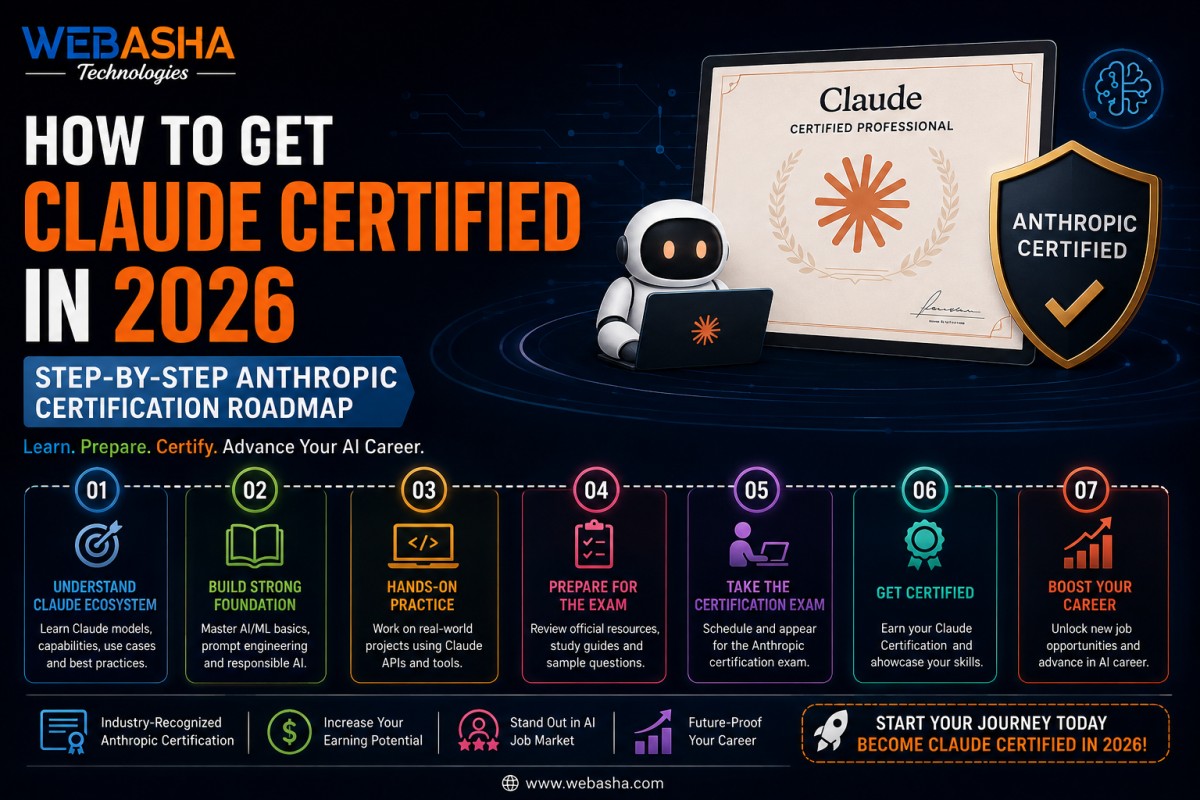
Most Claude certification roadmaps start with study material and never mention registration, which is how people end up weeks into preparation before discovering the exam is not open to them. This roadmap puts the eligibility check first, then walks through choosing the right exam, learning the Claude API, Claude Code, the Agent SDK and MCP, building the projects that scenario questions actually test, and sitting the exam - with an honest plan for what to do if you cannot register yet.
Before you read on: Anthropic's Claude certifications are delivered through the Anthropic Partner Academy and are oriented to people at organisations in the Claude Partner Network. Network membership is free for organisations, but it is an organisational route rather than an open public booking like a typical vendor exam. If you are an individual learner in India, read the eligibility section before spending money on preparation.
Topics covered in this guide: how to get Claude certified, Anthropic certification roadmap, Claude exam preparation, Claude API, Claude Code, Agent SDK, MCP, exam eligibility, Claude Partner Network, study plan.
Table of Contents
- How Do You Get Claude Certified?
- Step 1: Check Whether You Can Register
- Step 2: Choose the Right Exam
- Step 3: Learn the Stack
- Step 4: Build Two or Three Real Projects
- Step 5: Practise With Scenario Questions
- Step 6: Book and Sit the Exam
- Step 7: After You Pass
- A Realistic Preparation Timeline
- What If You Cannot Register Yet?
How Do You Get Claude Certified?
Confirm you are eligible to register, choose the exam matching your role, learn the Claude API, Claude Code, the Agent SDK and MCP, build two or three real projects, practise with scenario-based questions, then book and sit the proctored exam. Eligibility comes first because every later step depends on it.
That order is deliberate. Most roadmaps for this start with study material and never mention registration, which leaves people several weeks and several thousand rupees into preparation before they discover the exam is not open to them.
Step 1: Check Whether You Can Register
The exams are delivered through the Anthropic Partner Academy and are oriented to practitioners at organisations in the Claude Partner Network. Anthropic states that any organisation bringing Claude to market is eligible to join and that membership is free of charge. Establish which side of that line you are on before anything else.
- You work at a firm delivering Claude work - ask whether it is in the Partner Network. If not, the membership itself is free, so it is a reasonable request to make.
- You are independent or a student - assume for now that the exam may not be directly bookable, and plan around the skills instead.
- An institute is selling you a voucher - get written confirmation that you personally can register and sit the exam before paying.
Anthropic's Partner Network announcement and Services Track post are the primary sources. This is a fast-moving programme, so check them rather than relying on any third-party summary including this one.
Step 2: Choose the Right Exam
Pick the credential that matches what you actually do rather than the most senior one available. The associate foundations exam covers broad practitioner knowledge, the developer exam targets coding, API and integration work, and the architect exams target designing and defending production solutions.
| If your work is... | Take | Because |
|---|---|---|
| Broad - consulting, pre-sales, general practitioner | Associate - Foundations | Breadth without deep implementation |
| Writing and shipping code | Developer - Foundations | API, integration, testing and deployment |
| Designing production systems | Architect - Foundations | Trade-off decisions across a whole solution |
| Leading complex architectures | Architect - Professional | The advanced tier; assumes real delivery experience |
Step 3: Learn the Stack
Anthropic describes the architect foundations exam as covering Claude Code, the Claude Agent SDK, the Claude API and the Model Context Protocol. Learn those four in that order of dependency: the API first, then Claude Code, then agents, then MCP as the integration layer.
- Claude API - messages, system prompts, tool use, streaming, context management, and the cost and latency consequences of each choice.
- Claude Code - agentic coding inside a real repository, not toy examples.
- Claude Agent SDK - multi-step agents that call tools and recover from failure.
- Model Context Protocol - connecting models to external tools and data; see the MCP documentation.
- Production concerns - evaluation, guardrails, cost control, latency, failure modes.
Anthropic Academy courses cover much of this publicly and issue a certificate on completion, which is worth having on a CV regardless of whether you later sit an exam. Start at Anthropic's learning hub.
Step 4: Build Two or Three Real Projects
Scenario-based exams are difficult to pass on reading alone, because they ask what you would do rather than what a term means. Build a small number of genuinely working systems and you will have encountered most of the trade-offs the exam asks about.
- A production-shaped API integration with proper error handling, retries and cost logging
- An agent that uses tools to complete a multi-step task and recovers when a step fails
- An MCP server exposing an internal data source to Claude
- An evaluation harness that tells you whether a prompt change made things better or worse
That last one is the most underrated. Anyone can make a demo work once; knowing whether a change improved the system is what production work actually requires, and it is exactly the judgement these exams are described as testing.
Step 5: Practise With Scenario Questions
Use practice questions to find gaps rather than to memorise answers. Anthropic does not publish exam duration, question count or passing score, so treat any practice material claiming exact replication of the real exam with appropriate scepticism.
A practical method: take a full-length mock early, before you feel ready. The point is not the score, it is the map of what you do not know. Then study the weak domains, build something in each, and re-test.
WebAsha's exam pages include practice questions, full-length mocks and hands-on labs, with an objective-by-objective score breakdown - which is the part that actually tells you where to spend your remaining study time.
Step 6: Book and Sit the Exam
The exams are described as proctored, closed-book and multiple-choice with scenario questions, and no AI assistance is permitted. Confirm the retake policy and any waiting period before booking, since Anthropic has not published these publicly.
Practical points worth settling in advance: what identification is required, what the proctoring setup demands of your room and connection, whether the fee differs by region, and what a retake costs. None of these are difficult, but discovering them on exam day is avoidable.
Step 7: After You Pass
Add the credential to your CV and professional profiles with the exact certification name, keep using Claude in real work, and watch for renewal requirements. Anthropic's partner tiering counts practitioners who hold a current certification and have used Claude in the past 90 days, which suggests currency matters.
Do not let the certificate become the story. In interviews, the credential gets you past the filter and then someone asks what you have built. Keep the projects current - they are what the conversation will actually be about.
A Realistic Preparation Timeline
For a working developer, six to ten weeks of consistent study alongside project work is realistic. For someone new to building on language models, three to four months. Compressing it further is usually possible only by skipping the project work, which is the part that determines whether you pass a scenario-based exam.
| Weeks | Focus | Milestone |
|---|---|---|
| 1-2 | Claude API fundamentals | A working integration with error handling |
| 3-4 | Claude Code and agentic workflows | Used in a real repository |
| 5-6 | Agent SDK and tool use | A multi-step agent that recovers from failure |
| 7-8 | MCP and integration patterns | Your own MCP server running |
| 9 | Production concerns and evaluation | An evaluation harness you trust |
| 10 | Mocks and gap closing | Consistent mock performance; book the exam |
What If You Cannot Register Yet?
Build the skills anyway. The Claude API, Claude Code, the Agent SDK and MCP are what employers hire for, and they are all publicly learnable. Take Anthropic Academy courses for the certificates of completion, build a portfolio, and revisit certification when your employer joins the Partner Network or the programme opens further.
This is not a fallback so much as the correct order. The certificate is a signal about capability; the capability is the asset. People who build first and certify later interview far better than people who do the reverse, in this field as in every other.
For the wider picture, see our complete Claude certification guide, and for the money side, what it costs in India.
Start with the eligibility question this week, before you buy anything. Everything else on this roadmap is useful regardless of the answer - but the answer determines whether you are preparing for an exam or building a portfolio, and those are different plans.
Speak to a WebAsha advisor about which Claude exam fits your role and whether you can sit it.
Frequently Asked Questions
What's Your Reaction?
 Like
0
Like
0
 Dislike
0
Dislike
0
 Love
0
Love
0
 Funny
0
Funny
0
 Wow
0
Wow
0
 Sad
0
Sad
0
 Angry
0
Angry
0

With a passion for staying on the cutting edge of technology trends, I am dedicated to delivering content that not only informs but also inspires. Whether you need in-depth analysis pieces, informative guides, or thought-provoking opinion pieces, I craft content that resonates with tech enthusiasts and professionals alike.











![Top 10 Famous Ethical Hackers in India [Updated 2026]](https://www.webasha.com/blog/uploads/images/202608/image_140x98_da23f65c290cfbf1237d77aec58a2f0f.jpg)