Claude Certified Developer 2026: Exam Guide, Skills, Preparation & Career Roadmap
Everything a working developer needs on Claude Certified Developer - Foundations: what it tests, the skills assumed, a realistic ten-week preparation plan, the non-determinism shift, and where the credential leads.
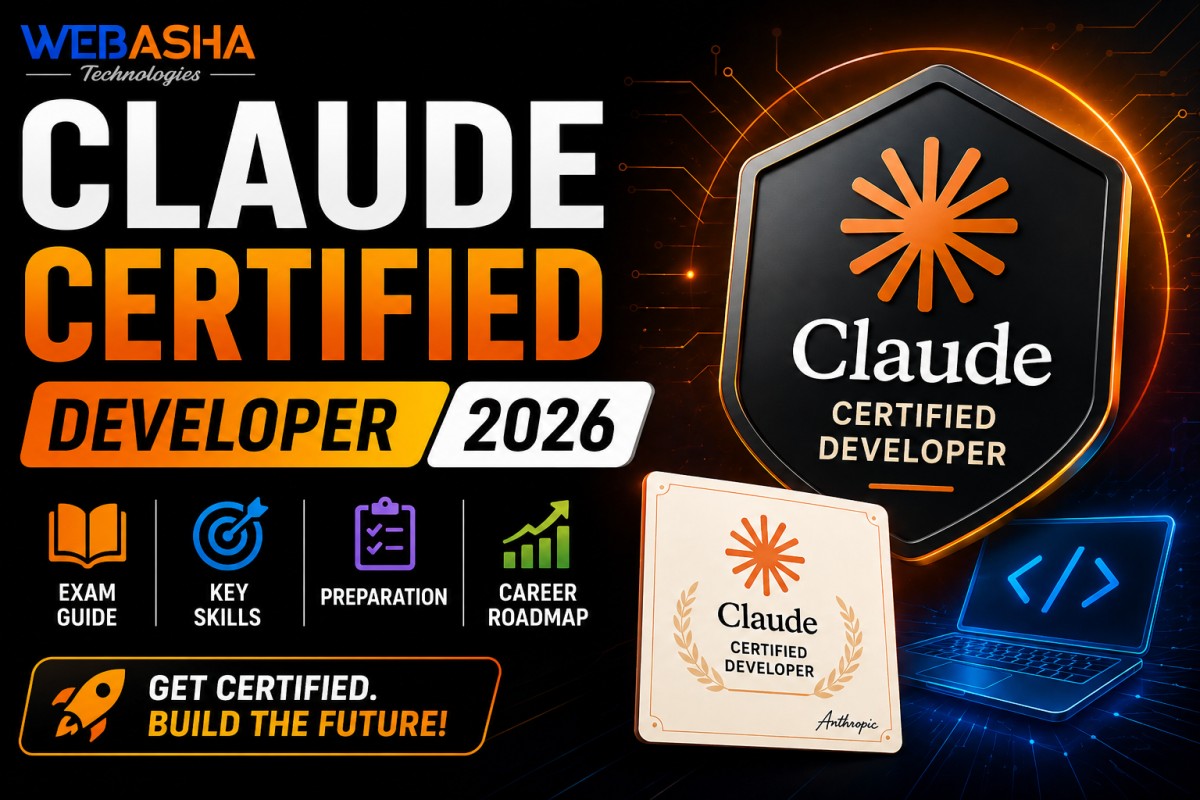
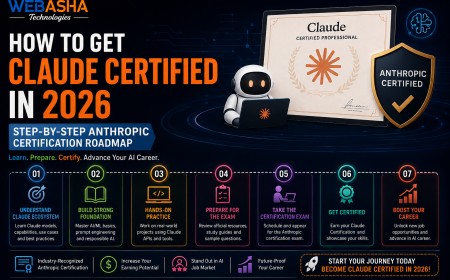
Claude Certified Developer - Foundations is the credential that matches what most engineers actually do: writing code, calling APIs, wiring integrations, and shipping and debugging them. This guide covers who it suits, what it tests, the skills it assumes you already have, a realistic ten-week preparation plan, and the one adjustment traditional developers find hardest.
Before you read on: Anthropic's Claude certifications are delivered through the Anthropic Partner Academy and are oriented to people at organisations in the Claude Partner Network. Network membership is free for organisations, but it is an organisational route rather than an open public booking like a typical vendor exam. If you are an individual learner in India, read the eligibility section before spending money on preparation.
Topics covered in this guide: Claude Certified Developer, CCDV-F, exam format, skills required, Claude API, Claude Code, Agent SDK, MCP, evaluation, preparation plan, developer career path.
Table of Contents
- What Is the Claude Certified Developer Certification?
- Who Is This Exam For?
- What Does It Test?
- Skills You Need Before Attempting It
- How to Prepare
- The Hardest Adjustment for Traditional Developers
- Career Roadmap After Certification
- What WebAsha Offers
What Is the Claude Certified Developer Certification?
Claude Certified Developer - Foundations (CCDV-F) is Anthropic's developer-level Claude credential. WebAsha's exam page describes it as a proctored, closed-book, multiple-choice and scenario-based exam with no AI assistance permitted, covering the work developers actually do: writing and debugging code, API and integration work, and testing and deployment.
It sits between the associate credential, which covers broad practitioner knowledge, and the architect credentials, which cover designing whole production systems. If you write code for a living and build things on Claude, this is the one that matches your work.
Before going further: these exams run through the Anthropic Partner Academy and are oriented to Claude Partner Network organisations. Confirm you can register before spending anything. The eligibility position is covered in full in our complete Claude certification guide.
Who Is This Exam For?
Developers building applications on Claude: backend and full-stack engineers adding AI features, integration engineers connecting Claude to internal systems, and product engineers shipping agentic functionality. It is not aimed at data scientists or ML researchers, because it is about application development rather than model work.
| You are... | Right exam? | Why |
|---|---|---|
| Backend or full-stack developer | Yes | Matches API, integration and deployment work |
| Integration engineer | Yes | MCP and tool-use focus is directly relevant |
| Solution architect | Consider architect instead | Design and trade-offs, not implementation |
| Pre-sales or consultant | Consider associate | Breadth without implementation depth |
| Data scientist / ML researcher | Probably not | This is application development, not modelling |
What Does It Test?
Anthropic describes its Claude certifications as covering Claude Code, the Claude Agent SDK, the Claude API and the Model Context Protocol, and as validating whether a practitioner can make informed trade-off decisions in real implementations. For the developer credential, expect that framed around building and shipping working software.
| Area | What a developer needs to know |
|---|---|
| Claude API | Messages, system prompts, tool definitions, streaming, context management, token and cost implications |
| Claude Code | Agentic development inside a real repository |
| Agent SDK | Multi-step agents, tool orchestration, failure recovery |
| MCP | Building and consuming servers that expose tools and data |
| Testing | Evaluating non-deterministic output; regression detection |
| Deployment | Latency, rate limits, retries, observability, cost control |
Not published: duration, question count, passing score. WebAsha's CCDV-F exam page states this openly rather than inventing figures.
Skills You Need Before Attempting It
One language you can build production code in, comfort with HTTP APIs and JSON, error handling and retry logic, basic testing discipline, and a working understanding of how to evaluate output that is not deterministic. Everything Claude-specific sits on top of ordinary software engineering competence.
- General engineering - version control, testing, debugging, deployment
- API fluency - authentication, pagination, rate limits, idempotency, backoff
- Prompt and context design - treated as engineering, not as phrasing tricks
- Tool use - defining tools and handling model-issued calls correctly
- Evaluation - knowing whether a change improved anything
- Cost and latency awareness - the constraints that decide whether a feature ships
The full list with study order is in our top Claude certification skills guide.
How to Prepare
Learn the API first, then Claude Code, then agents, then MCP, building something real at each stage. Anthropic Academy courses cover much of this publicly and issue certificates of completion. Finish with scenario-based practice questions and full-length mocks to find gaps.
A preparation sequence that works:
| Weeks | Focus | Deliverable |
|---|---|---|
| 1-2 | Claude API | An integration with retries, logging and a cost cap |
| 3-4 | Claude Code | Used against a real repository, not a toy |
| 5-6 | Agent SDK and tool use | An agent that recovers from a failed step |
| 7 | MCP | Your own server exposing real data |
| 8 | Testing and evaluation | A harness that detects regressions |
| 9-10 | Mocks and gap closing | Consistent mock performance |
Start with Anthropic's learning hub and the MCP documentation. The step-by-step version is in our certification roadmap.
The Hardest Adjustment for Traditional Developers
Non-determinism. Code either works or it does not; a model may give a different answer to the same input. Designing around that - with evaluation, guardrails, retries and graceful degradation - is the genuine skill shift, and it is where scenario questions concentrate.
The practical consequences worth internalising:
- You cannot assert exact output equality in a test, so you need evaluation rather than assertions
- A prompt change that fixes one case can break three others, so you need regression detection
- Failure is a normal operating state, not an exception, so design the fallback path first
- Cost and latency scale with context, so context management is an engineering concern
Developers who internalise this build systems that survive production. Developers who do not ship demos that work impressively once.
Career Roadmap After Certification
The developer credential points toward AI application developer, AI integration engineer and agent developer roles, with a natural progression toward solution architect once you have designed and defended production systems. What moves you along that path is delivered work, not further certificates.
| Stage | Focus | Next step |
|---|---|---|
| AI Application Developer | Shipping features on the Claude API | Own a full integration end to end |
| AI Integration Engineer | Connecting Claude to internal systems via MCP | Design the integration layer |
| Agent Developer | Multi-step agents with real tool use | Take responsibility for reliability |
| Senior AI Engineer | Evaluation, cost, latency, architecture input | Lead a delivery |
| Solution Architect | Whole-system design and trade-offs | Architect certification |
The longer view is in our Claude certification career roadmap.
What WebAsha Offers
WebAsha's CCDV-F exam page lists live instructor-led training, five full-length mock tests, practice questions with coding and integration exercises, hands-on labs with persistent access outside class, exam vouchers, and an objective-by-objective score breakdown.
The score breakdown is the part worth paying attention to. Knowing you scored sixty percent tells you nothing actionable; knowing which domain you scored sixty percent in tells you exactly where the next fortnight should go.
Ask one question before enrolling anywhere, including here: am I personally eligible to register for and sit this exam? Get the answer in writing. See the CCDV-F exam page or speak to an advisor.
The developer credential matches what most engineers actually do, and the preparation for it - building real integrations, agents and evaluation harnesses - is worth doing whether or not you end up sitting the exam. Start there. Talk to a WebAsha advisor about eligibility and current fees.
Frequently Asked Questions
What's Your Reaction?
 Like
0
Like
0
 Dislike
0
Dislike
0
 Love
0
Love
0
 Funny
0
Funny
0
 Wow
0
Wow
0
 Sad
0
Sad
0
 Angry
0
Angry
0

With a passion for staying on the cutting edge of technology trends, I am dedicated to delivering content that not only informs but also inspires. Whether you need in-depth analysis pieces, informative guides, or thought-provoking opinion pieces, I craft content that resonates with tech enthusiasts and professionals alike.