Top 10 Famous Ethical Hackers in India [Updated 2026]
Explore the top 10 famous ethical hackers in India who have made significant contributions to cybersecurity. Learn about their backgrounds, achievements, and impact on the industry. From pioneering tools and frameworks to promoting cybersecurity education, these experts are shaping the future of digital security in India. Discover who stands out in the field of ethical hacking and how they are influencing cybersecurity.
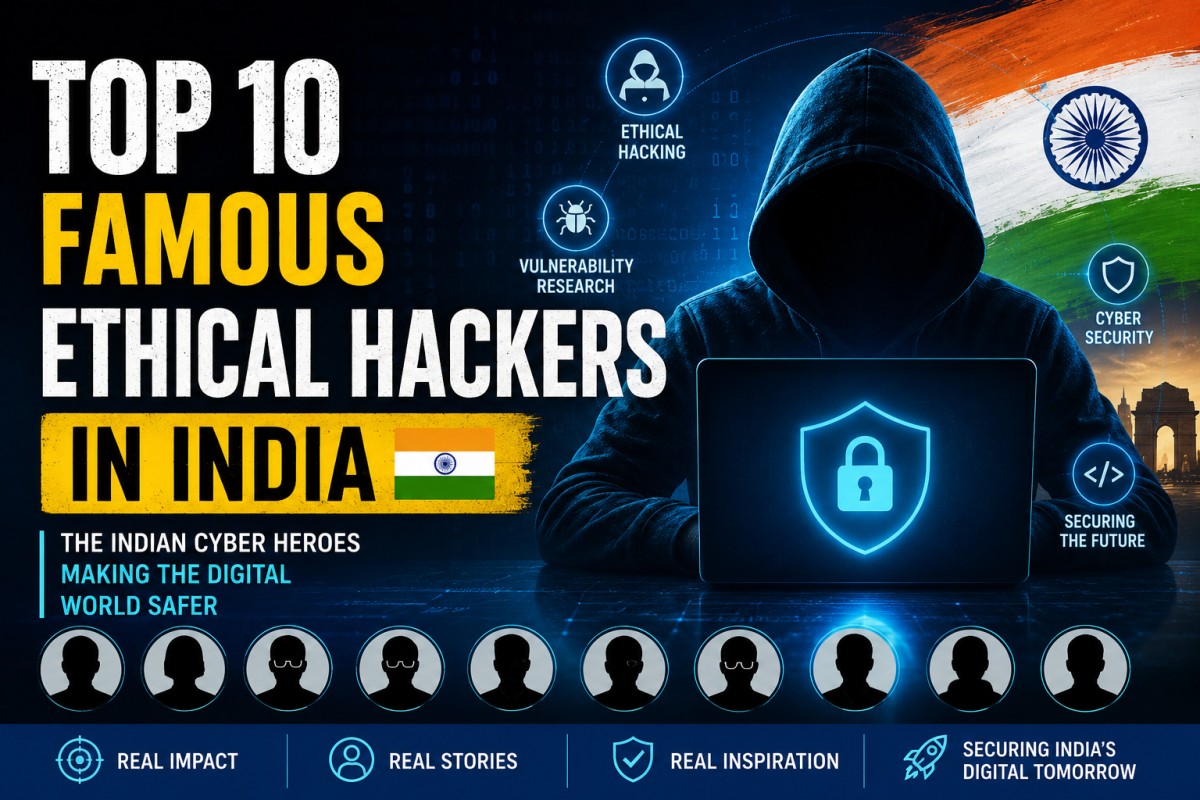
Quick answer: Well-known Indian ethical hackers and security researchers include Vivek Ramachandran (Wi-Fi security, SquareX), Aseem Jakhar (null community, Nullcon, Payatu), bug bounty researchers Anand Prakash and Laxman Muthiyah, founders Trishneet Arora (TAC Security), Saket Modi (Safe Security), Rahul Sasi (CloudSEK) and Nikhil Mittal (Altered Security), and trainer Sunny Vaghela. Ankit Fadia is the most-searched name, but his record is disputed.
Key takeaways
- Judge any hacker list by checkable evidence such as conference talks, bounty disclosures and company pages, not by popularity or press hype.
- Many Indian researchers began with bug bounties and published research, which shows you can build a credible profile without a famous employer.
- Pick one area, such as mobile, web or cloud security, go deep and publish your findings responsibly to earn recognition.
Most "top hackers" lists copy each other, and several include people who are not security researchers at all. This 2026 update keeps only names with a public, checkable record of security work, explains what each person is actually known for, and shows what their paths mean for your own career.
How we chose these names
Every person below meets at least one of these tests, and each fact can be checked against conference bios, company pages, vendor bounty disclosures or mainstream news reports:
- Published research: talks at recognised conferences such as Black Hat, DEF CON or Nullcon, or open-source tools other professionals use.
- Responsible disclosure: vulnerabilities reported to and rewarded by vendors through official bug bounty programmes.
- Building the field: founding security companies, communities or training platforms with a real track record.
The list is not a ranking. "Best hacker" can't be measured fairly, and anyone who claims a precise order is guessing. Ankit Fadia is included because readers search for him, with an honest note on why his reputation is contested.
Famous ethical hackers in India at a glance
| Name | Known for | Type of work |
|---|---|---|
| Vivek Ramachandran | Wi-Fi attack research, SecurityTube, Pentester Academy, SquareX | Research, training, founder |
| Aseem Jakhar | null community, Nullcon, hardwear.io, Payatu, EXPLIoT | Community, IoT and hardware research |
| Anand Prakash | Facebook and Uber bug bounties, AppSecure, PingSafe | Bug bounty, founder |
| Laxman Muthiyah | Instagram and Microsoft account takeover reports | Bug bounty |
| Trishneet Arora | TAC Security | Founder |
| Saket Modi | Lucideus, now Safe Security | Founder |
| Rahul Sasi | CloudSEK | Research, founder |
| Nikhil Mittal | Nishang, Altered Security red team labs | Offensive research, training |
| Sunny Vaghela | Cybercrime investigation support, Techdefence | Investigation, training |
| Ankit Fadia | Early ethical hacking books and TV | Author, media (disputed record) |
1. Vivek Ramachandran
Vivek Ramachandran is best known for wireless security research and for making hands-on security training widely available. He co-presented the "Caffe Latte" attack on WEP-protected Wi-Fi clients at ToorCon in 2007, research that still appears in wireless testing textbooks.
- Created SecurityTube, a free video library for security learning, and later founded Pentester Academy, which INE acquired in 2021.
- Wrote the Packt book BackTrack 5 Wireless Penetration Testing, a common starting point for Wi-Fi testers.
- Founded SquareX in 2023, a browser security company.
What to learn from him: deep focus on one area (wireless) and teaching it well built a reputation that later supported two companies.
2. Aseem Jakhar
Aseem Jakhar founded null, a not-for-profit open security community with chapters across Indian cities, and started the Nullcon and hardwear.io conferences. His Black Hat presenter bio lists him as Director of Research at Payatu, a security testing firm focused on IoT, embedded, cloud and mobile security.
- Built open-source tools including EXPLIoT (an IoT security testing framework) and DIVA (a deliberately vulnerable Android app for learning).
- Has spoken and trained at Black Hat, DEF CON, Hack.lu and other international events.
What to learn from him: the free null chapter meetups he started are one of the easiest ways for Indian students to meet working professionals. Attend one before you spend money on anything else.
3. Anand Prakash
Anand Prakash is one of India's best-known bug bounty researchers. In 2016 he reported a flaw in Facebook's password reset flow that could have allowed account takeover, and Facebook paid him a USD 15,000 reward. He has also reported issues to Uber and other platforms.
- Started his career as a security engineer at Flipkart.
- Founded AppSecure, a security testing company, and co-founded PingSafe, a cloud security start-up that SentinelOne acquired in 2024.
- Named in the Forbes 30 Under 30 Asia list in 2017.
What to learn from him: bug bounty work done through official programmes builds a public, verifiable portfolio, which matters more to employers than any self-description.
4. Laxman Muthiyah
Laxman Muthiyah is a Chennai-based security researcher known for account takeover findings. Facebook rewarded him for Instagram password-recovery issues in 2019, and in 2021 Microsoft paid him USD 50,000 under its Identity Bounty Program for a flaw in the Microsoft account password reset process.
His write-ups are useful study material because they show the defensive lesson clearly: rate limiting and code verification must hold up even when requests are spread across many IP addresses at the same time.
What to learn from him: patiently studying one feature, such as password recovery, across several big platforms can lead to high-impact findings.
5. Trishneet Arora
Trishneet Arora, from Ludhiana in Punjab, is the founder and CEO of TAC Security, a company focused on vulnerability management and cyber risk assessment. He was named in the Forbes 30 Under 30 Asia list in 2018 and in Fortune India's 40 Under 40.
His story is often shared because he left mainstream schooling early and built his skills on his own. Bear in mind that this route is rare. Most people in the field still benefit from structured study and recognised certifications.
What to learn from him: security skills can turn into a product business as well as a consulting job.
6. Saket Modi
Saket Modi co-founded Lucideus in 2012 while studying at IIT Bombay, together with Vidit Baxi and Rahul Tyagi. The company began as an ethical hacking services firm and, according to Safe Security's own company page, rebranded as Safe Security in 2021 and now builds a cyber risk management platform. Modi is its CEO.
Rahul Tyagi is a co-founder of the same company, so the two are grouped here.
What to learn from him: many Indian security start-ups began as small ethical hacking and training firms before building products.
7. Rahul Sasi
Rahul Sasi is the co-founder of CloudSEK, a Bengaluru-based company that works on threat intelligence and digital risk monitoring. Before CloudSEK he worked in product security and presented security research at international conferences, and the null community recognised him as one of India's notable security researchers.
What to learn from him: research visibility at conferences can be the foundation for a product company.
8. Nikhil Mittal
Nikhil Mittal is known in red teaming circles for Nishang, an open-source PowerShell framework for offensive security testing that is published on his GitHub. He founded Altered Security, which runs Active Directory red team labs and certifications such as the Certified Red Team Professional (CRTP), and he trains at events such as Black Hat.
What to learn from him: open-source tools that defenders and testers actually use are a strong, lasting proof of skill.
9. Sunny Vaghela
Sunny Vaghela, from Ahmedabad, is known for cybercrime investigation support and security training. His own website states that he worked as a cybercrime investigation consultant with the Ahmedabad Crime Branch and helped trace the digital trail in the 2008 Ahmedabad serial blasts and the 26/11 Mumbai attacks. He runs Techdefence, a training and security company.
Most of the figures about his workshops and cases come from his own site, so treat them as self-reported.
What to learn from him: digital forensics and law-enforcement support is a real career path, separate from penetration testing.
10. Ankit Fadia: the most-searched name, with a disputed record
Ankit Fadia became famous as a teenager when Macmillan India published his book An Unofficial Guide to Ethical Hacking in 2001. He later co-hosted MTV What the Hack! and wrote several popular technology books.
Many security professionals and journalists have publicly questioned his hacking claims, and some of his books have faced plagiarism allegations. He is on this list because he did more than anyone to make "ethical hacking" a familiar phrase in India, not because his technical work has been independently shown.
What to learn from him: fame and expertise are different things. Judge any expert by verifiable work: CVEs, bounty disclosures, conference talks and open-source code.
Who was removed from this list, and why
Some names do not fit an "ethical hacker" list on the evidence available:
- Pranav Mistry is known for SixthSense and human-computer interface research, not security work.
- Koushik Dutta is known as an Android developer (ClockworkMod recovery and related tools), not as a security researcher.
- Sai Satish, Benild Joseph and some other names were dropped because we could not find enough independent public sources to describe their work accurately.
If you have verifiable sources about anyone we left out, they can be added in a future update.
What do these ethical hackers have in common?
They built public proof of their skills. None of them became known by calling themselves a hacker. Their reputations rest on things others can check:
- A specialism: Wi-Fi, IoT hardware, account recovery flows, Active Directory or threat intelligence.
- Public output: conference talks, open-source tools, blog write-ups and bounty disclosures.
- Community: many started or supported meetups, conferences and free learning resources.
- Legal work only: testing was done with permission or inside official bug bounty scopes.
Is ethical hacking legal in India?
Ethical hacking is legal in India only when you have clear permission from the system owner. Accessing or damaging a computer system without authorisation is covered by Sections 43 and 66 of the Information Technology Act, 2000, regardless of your intent. In practice that means:
- Practise on your own lab machines or deliberately vulnerable apps.
- Test real organisations only under a signed scope or within a published bug bounty programme's rules.
- Report what you find privately, and never keep or share other people's data.
How can you follow a similar path?
Start with fundamentals, then build public, legal proof of skill. A practical sequence for Indian students and working professionals:
- Learn the basics: networking, Linux, and how web applications work. Our guide on how to become an ethical hacker lays out the order.
- Practise in labs: use intentionally vulnerable machines and capture-the-flag platforms, never live third-party systems.
- Pick a specialism: web, cloud, mobile, IoT, Active Directory or forensics, as the people above did.
- Join the community: attend a null chapter meetup or Nullcon, and write up what you learn.
- Get certified where it helps hiring: employers in India often shortlist on credentials such as CEH or OSCP. A structured CEH v13 AI ethical hacking course can give you a guided lab path if you prefer that to self-study.
- Try bug bounties last: only after you can read a programme's scope and rules properly.
To see what these skills pay and which roles hire, read ethical hacking jobs and salaries in India and the USA.
Looking for more names?
This page covers well-known men in Indian security because that is what most readers search for, but the field is much wider. See our list of famous female ethical hackers in India and the top ethical hackers in the world for a global view.
Your next step: pick one person above whose work matches your interest, read one of their public talks or write-ups this week, and try to reproduce the idea safely in your own lab.
Related reading
Frequently Asked Questions
What's Your Reaction?
 Like
1
 Dislike
0
 Love
0
 Funny
0
 Wow
0
 Sad
0
 Angry
0

With a passion for staying on the cutting edge of technology trends, I am dedicated to delivering content that not only informs but also inspires. Whether you need in-depth analysis pieces, informative guides, or thought-provoking opinion pieces, I craft content that resonates with tech enthusiasts and professionals alike.