Which Industries Use Ethical Hackers? Compare the Work
Organisations use authorised security assessments to answer questions about systems, access and business risk. The useful comparison is the work involved: a payment service, hospital application and manufacturing network can require different permissions, evidence and timing. Choose an industry by examining its systems and assessment constraints, then compare actual vacancies.
Topic: Ethical Hacking in Cybersecurity & Ethical Hacking · Explainer
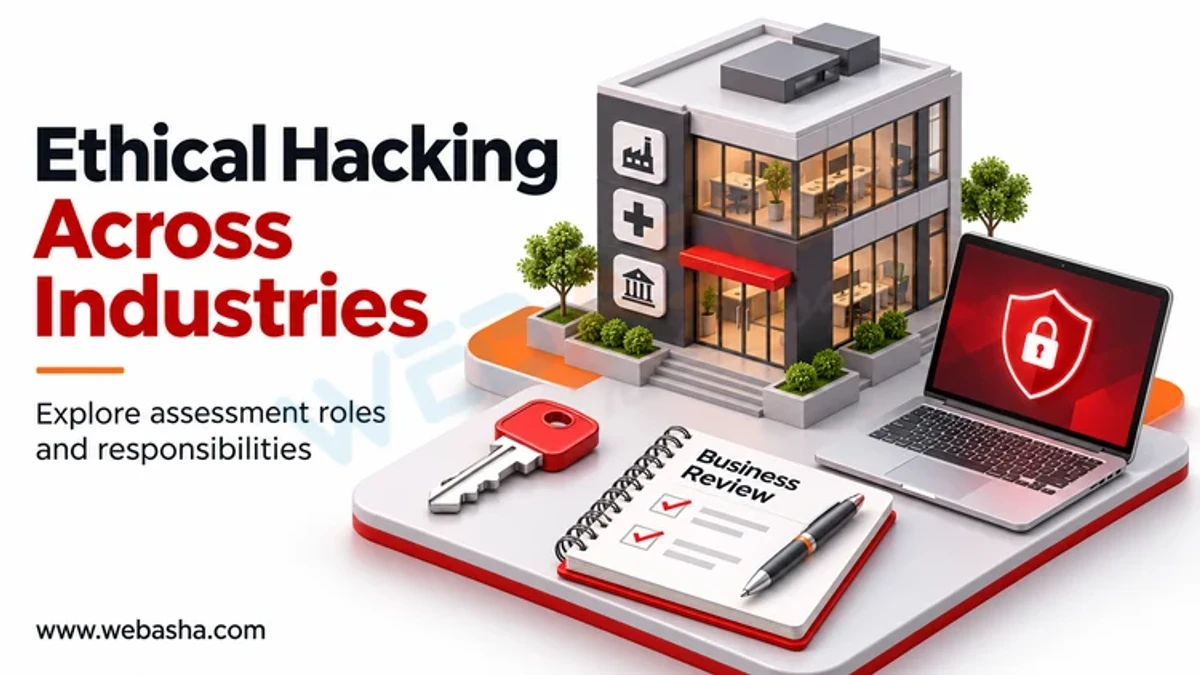
Quick answer: Organisations use authorised security assessments to answer questions about systems, access and business risk. The useful comparison is the work involved: a payment service, hospital application and manufacturing network can require different permissions, evidence and timing. Choose an industry by examining its systems and assessment constraints, then compare actual vacancies. Practise translating a technical observation into a business question using a fictional example. Industry labels alone do not establish hiring demand, entry requirements or the safety of a proposed test.
Key takeaways
- Compare assessment questions rather than unsupported industry rankings.
- Identify affected people and services before proposing tests.
- Check third-party ownership and written permission.
- Use realistic reporting exercises to explore sector interests.
- Match actual vacancies to evidence you can explain.
Table of Contents
- What does an industry change about an assessment?
- How might three assessment briefs differ?
- How would you scope the retailer example?
- How should you handle unfamiliar systems?
- What would useful sector-specific evidence contain?
- Where can you practise before choosing a sector?
- How do you turn an industry interest into a job search?
- References
What does an industry change about an assessment?
An online retailer wants assurance that one customer cannot see another customer's order. A hospital wants appointment services to remain available while patient information stays restricted. A factory may care about whether an office network can affect production. These are illustrative questions, not claims about every employer in those industries.
The technical weakness could resemble one seen elsewhere, while the acceptable test and reporting audience differ. Use the NIST Cybersecurity Framework to organise outcomes around business risk. First ask what the organisation needs to protect, who owns the system and which activity can be interrupted. That conversation should happen before selecting a testing tool.
How might three assessment briefs differ?
| Illustrative setting | Assessment question | Constraint to clarify |
|---|---|---|
| Retail web application | Can the intended customer access only their order? | Test accounts and synthetic orders |
| Healthcare booking service | Who can view or change appointment details? | Patient privacy and service continuity |
| Manufacturing support network | Which approved connections reach sensitive services? | Operational owner and change window |
The table is a way to read a brief. It is not permission to test any organisation in the named sector. Mark uncertain dependencies, such as a hosted payment page or supplier-managed device. The NIST SP 800-115: security assessment planning explains assessment planning and rules of engagement. A customer can authorise work on its own assets without necessarily authorising a test of every connected provider.
How would you scope the retailer example?
Write a one-page fictional brief for a training application. The owner provides two test customers, synthetic orders and a permitted lab. Your question is whether the application enforces the intended access rule. Record the allowed environment, test accounts, prohibited actions and contact for unexpected behaviour. Do not use real customer orders as sample evidence.
Next, write the report heading before doing the exercise: intended rule, observed result, evidence and recommended check. The OWASP Web Security Testing Guide provides a structured web-testing reference. Select the relevant topic rather than claiming that one exercise covers the entire guide. A narrow, clear question is easier to review than an unrestricted promise to find everything.
How should you handle unfamiliar systems?
Stop when the brief reaches equipment or services you cannot assess safely. For the factory example, a learner can discuss network diagrams and approved inventory without interacting with production equipment. Familiarity with a laptop scanner is not evidence of competence on an operational system. Ask who must approve the method and what would require specialist supervision.
The NIST NICE Framework: tasks, knowledge and skills describes work through tasks, knowledge and skills, which helps expose that gap. Make a list of tasks you can explain and tasks requiring another person. This is also useful during applications: an honest boundary gives the interviewer a concrete starting point for discussing supervision and training.
What would useful sector-specific evidence contain?
| Portfolio item | Useful detail | Avoid |
|---|---|---|
| Retail lab brief | Synthetic accounts and intended access rule | Customer records |
| Healthcare case discussion | Access roles and continuity questions | Unapproved patient information |
| Manufacturing diagram exercise | Assumptions and review points | Claims of production testing |
Build the evidence around a decision. For example, show why a sensitive system was excluded pending approval, or why a supplier boundary needed clarification. A screenshot of a tool result cannot show that reasoning on its own. The GitHub Docs: repository READMEs can help organise the supporting repository so a reader finds the scenario, method and limitations without searching through unrelated files.
Where can you practise before choosing a sector?
Use a provider's authorised learning environment for technical practice and write a separate fictional business brief around the lesson. The PortSwigger Web Security Academy supplies web-security learning material and labs. Follow the lab's scope and publication rules. Do not carry techniques from that environment onto an employer's public website to make an application stand out.
Try two report versions after one lab: a short note for an application owner and a technical appendix for a reviewer. Explain the same observation in both. If you enjoy understanding workflows and discussing fixes, application assessment may interest you. If your questions centre on service dependencies, further systems study may be the more useful next step.
How do you turn an industry interest into a job search?
Compare several real advertisements from the sector and location you want. Copy the advertised responsibilities into a private worksheet, then mark which ones involve testing, monitoring, audit support or administration. Record experience requirements and supervision separately. A security analyst title may involve little penetration testing, even within a company that commissions assessments.
For each shortlisted role, prepare one relevant example and one question about its scope. Ask who reviews junior findings and how testing is authorised. In India, unauthorised access and related conduct can raise issues under Sections 43 and 66 of the Information Technology Act, with application depending on the facts. Permission belongs in the work plan, not in an assumption about the industry.
Related reading: prepare for assessment interviews; build assessment skills; practise with permission.
If you want instructor feedback, ask WebAsha for a syllabus, supervised lab arrangements and written access terms before enrolling.
References
Frequently Asked Questions
What's Your Reaction?
 Like
0
 Dislike
0
 Love
0
 Funny
0
 Wow
0
 Sad
0
 Angry
0

Vaishnavi is a skilled tech professional at the Ethical Hacking Training Institute in Pune, responsible for managing and optimizing the technical infrastructure that supports advanced cybersecurity education. With deep expertise in network security, backend operations, and system performance, she ensures that practical labs, online modules, and assessments run smoothly and securely. Her behind-the-scenes contributions play a vital role in delivering a seamless and secure learning experience for aspiring ethical hackers.