AI Automation Projects for Small Businesses: Start With Reviewable Workflows
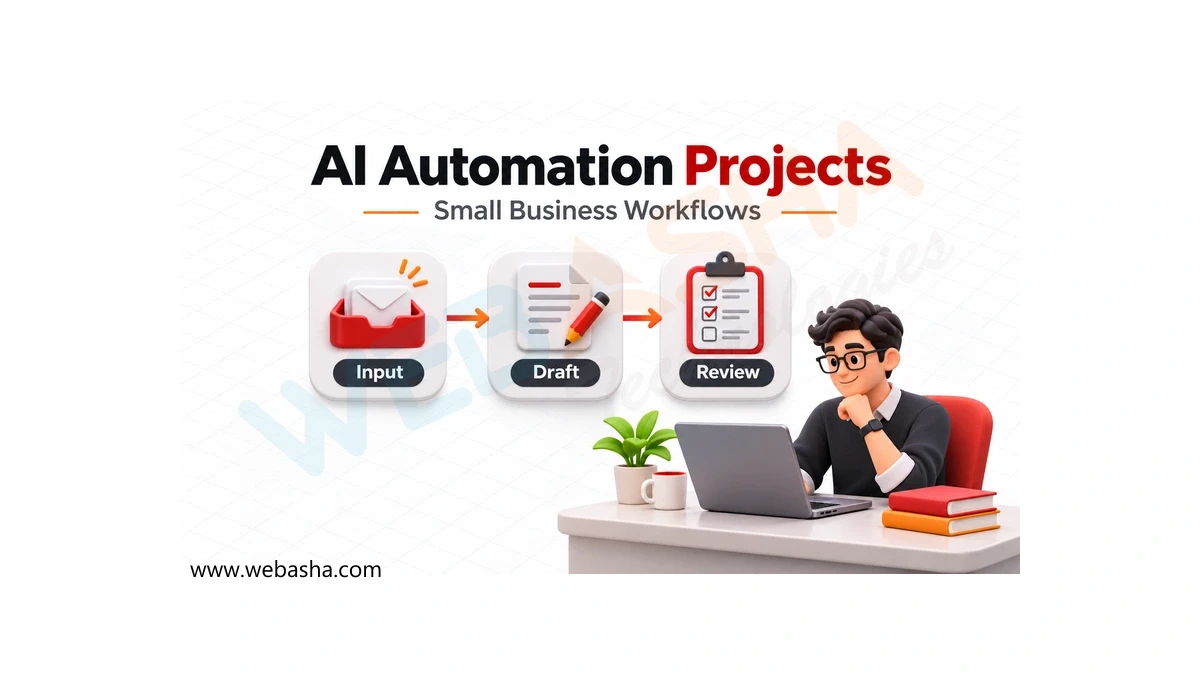
Start AI automation projects for small business with a recurring task whose output a person can check: sorting enquiries, drafting replies or extracting fields from a document. Define the input, review step and failure route before connecting live systems. Measure useful completed work alongside the time spent correcting it.
Start AI automation projects for small business with a recurring task whose output a person can check: sorting enquiries, drafting replies or extracting fields from a document. Define the input, review step and failure route before connecting live systems. Measure useful completed work alongside the time spent correcting it.
The projects below are editorial pilot briefs for owners, operations teams and learners. They describe what to build and how to judge it; no customer inbox, accounting system or model workflow was connected or tested for this article. Product documentation was checked on 17 November 2026.
Plan a pilot you can inspect
- Choose a task with a clear owner and available source material.
- Use ordinary rules for fixed checks and AI for a bounded language task.
- Review the exact output before a consequential action.
- Include exceptions and correction effort in the evaluation.
Choose the first project by its output
Write down a task that interrupts the team repeatedly. Then describe a successful result in terms another person could verify. “Produce a draft reply using the approved delivery policy” is easier to assess than “improve customer experience.”
Keep the first pilot inside a small scope, such as one enquiry category or one document layout. Use synthetic examples or material approved for that environment. A business owner should be able to explain where the input comes from, who reviews the result and how the manual process resumes if the workflow stops.
| Project | Reviewable output | Keep outside the first pilot |
|---|---|---|
| Enquiry routing | Suggested category and supporting text | Automatic commitments to customers |
| Support reply drafting | Draft with an approved policy reference | Unreviewed refunds or account changes |
| Document extraction | Fields linked to their source page | Payments or supplier bank-detail changes |
| Meeting notes | Draft actions linked to supplied notes | Unconfirmed tasks assigned as final |
| Content adaptation | Draft based on approved source copy | Automatic public publishing |
| Internal FAQ assistant | Answer with a source and review date | Unrestricted access to private records |
Choose one row and nominate its reviewer. If the team cannot agree on a correct output, clarify the process before selecting a model or automation platform.
Separate fixed rules from the AI task
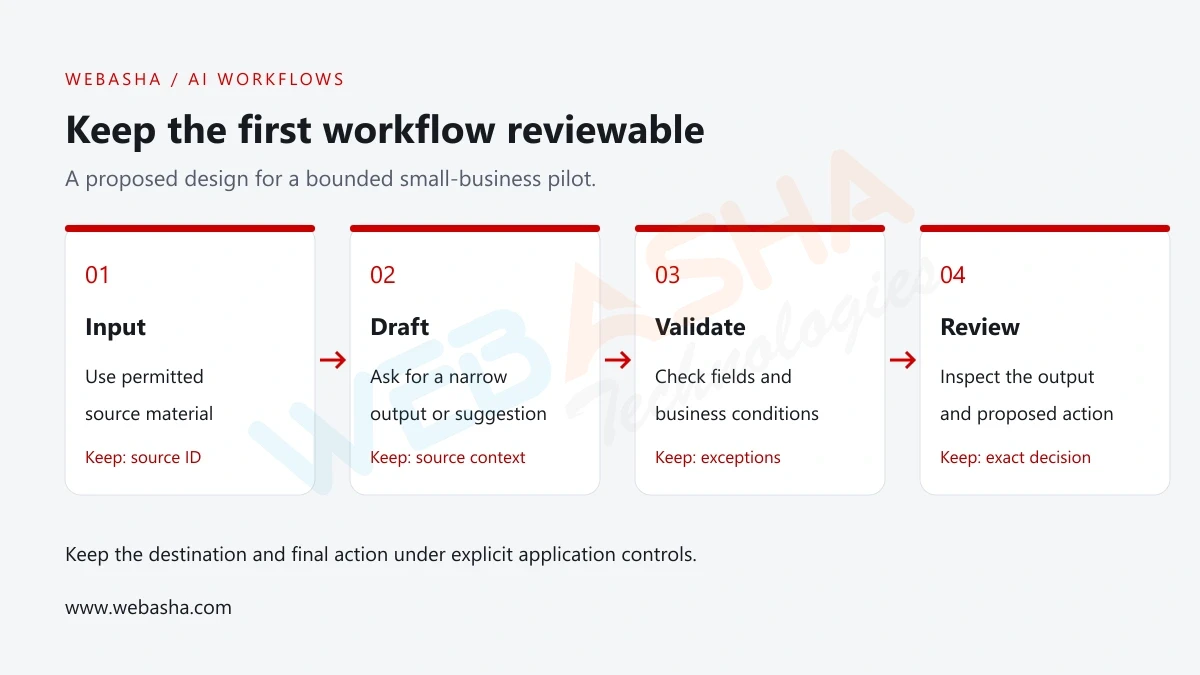
A proposed workflow can have five stages: receive permitted input, check required fields, ask the model for a narrow output, validate the result and present it for review. The final action belongs in a separate step with an explicit destination.
For example, use an ordinary rule to check that an enquiry has a reference number. Ask AI to suggest a topic from a short permitted list. Keep recipient selection and the decision to send a message under application controls rather than letting text in the enquiry determine them.
The WebAsha guide to generative and predictive AI provides background when deciding whether a task needs text generation, a prediction or a simple rule.
Project 1: sort enquiries and prepare a handover
Use a small set of fictional customer messages with categories such as delivery question, product information and other. Ask the model to return a suggested category, a short reason and the text supporting that choice. Allow an unknown category so an ambiguous message has somewhere to go.
The reviewer checks the original message beside the suggestion. A message about a delayed order and a damaged item may need two topics or manual handling. Record those exceptions instead of forcing every case into one category.
For the first version, produce a review table without sending messages or altering customer records. Compare the suggestions with labels agreed by the task owner. Review wrong routes separately: a missed urgent concern and a harmless category mismatch have different consequences.
Useful output: a routing suggestion with a source reference and reviewer decision. A later integration should preserve the original request identifier so retries can be recognised.
Project 2: draft a support reply from approved material
Provide an approved policy excerpt and a fictional enquiry. Ask for a draft that answers only what the supplied material supports, lists any missing detail and identifies the policy source. If the excerpt says nothing about a requested exception, the draft should leave that decision with the responsible person.
Keep the original enquiry and policy version visible during review. Check names, dates, promised actions and tone. A fluent reply can still contain an unsupported delivery commitment.
n8n documents selective human review for tools connected to an AI Agent. A configured review can pause a proposed tool call for approval or denial, with the requested tool and parameters shown to the reviewer. Availability and setup should be checked in the environment being used. [1]
Useful output: an editable draft and its source reference. Review the recipient and final text together before sending; an approval for an earlier draft should not silently authorise changed content.
Project 3: extract document fields into a review table
Start with fictional order forms or invoices in one layout. Extract a document identifier, date, supplier name and total into a proposed record. Keep a link to the source page or region so the reviewer can compare each value with the original.
Check required fields, date format and numeric consistency using explicit rules. Leave unreadable or absent values empty and explain the exception. Do not let a plausible-looking value replace missing evidence.
n8n’s Structured Output Parser can return fields defined by a JSON Schema. When generating a schema from a JSON example, the documentation says every field is treated as mandatory. Schema conformance alone does not establish that the extracted value matches the source. [3]
Useful output: a candidate record with field-level review. Keep payment execution and supplier bank-detail changes outside this pilot. The exercise tests extraction and checking, without authorising financial actions.
Three more projects for a small team
Meeting notes with confirmed actions
Begin with approved written notes to avoid introducing recording and transcription into the same pilot. Draft a summary and possible action items, each linked to the relevant passage. Ask the meeting owner to confirm the wording, owner and due date before creating tasks.
Content adaptation from approved copy
Turn a supplied product description into a draft newsletter paragraph or social caption. Preserve the original factual claims and mark unsupported additions for removal. The editor checks wording, permissions and publication destination before anything is posted.
An internal FAQ assistant with source references
Use a small set of approved documents and questions. Return an answer with a document reference, or say that the available material does not answer the question. Test an outdated policy and two conflicting passages. A useful fallback routes the question to the document owner.
These projects can form practical AI projects for a learning portfolio. Record the material you used and what you tested; a proposed design and a completed integration are different achievements. The WebAsha generative AI engineering roadmap gives broader learning context.
Make review, data access and failures visible
Give a pilot access only to the sources and destinations it needs. Keep secrets in the platform’s credential mechanism and review what input, output and execution records it retains. Confirm the provider’s applicable data terms before supplying business material.
Incoming documents and emails are untrusted content. OWASP describes indirect prompt injection through external material and recommends layered controls, including clear separation, output validation, least privilege and human review. No single prompt instruction is a complete security boundary. [4]
For failures, define who receives the exception, which record they inspect and whether processing should stop. n8n supports error workflows for failed executions and documents differences in the data available when a trigger fails. An error notification is useful only if someone owns the follow-up. [2]
Before retrying a write, check whether the first attempt already succeeded. Store the source identifier and action status so duplicate records or messages can be detected. If the destination has changed since review, recheck the proposed action.
Run a small pilot with explicit test cases
- Document the existing manual task and its owner.
- Choose a permitted sample that includes ordinary and difficult cases.
- Write expected outputs with the reviewer before assessing generated results.
- Run in a draft or read-only mode and retain enough context to investigate differences.
- Review each output, including rejected and incomplete cases.
- Change one part of the design, then repeat the cases affected by that change.
- Decide whether to revise, stop or expand the pilot with its owner.
| Case | Expected handling |
|---|---|
| Missing required field | Stop or request the missing value; do not invent it. |
| Ambiguous enquiry | Use the review queue or an unknown category. |
| Outdated source | Show the source version and ask for an approved replacement. |
| External text asks to change the workflow | Treat it as source content; preserve the application boundary. |
| Duplicate trigger | Recognise the prior request before another write. |
| Reviewer denies an action | Do not execute the denied action. |
| Destination unavailable | Preserve status and route the exception to its owner. |
NIST presents its AI RMF Playbook as a voluntary companion for incorporating trustworthiness considerations through AI design, development, deployment and use. It can inform a broader review; completing this pilot checklist does not establish certification or compliance. [5]
Measure handling time and output quality
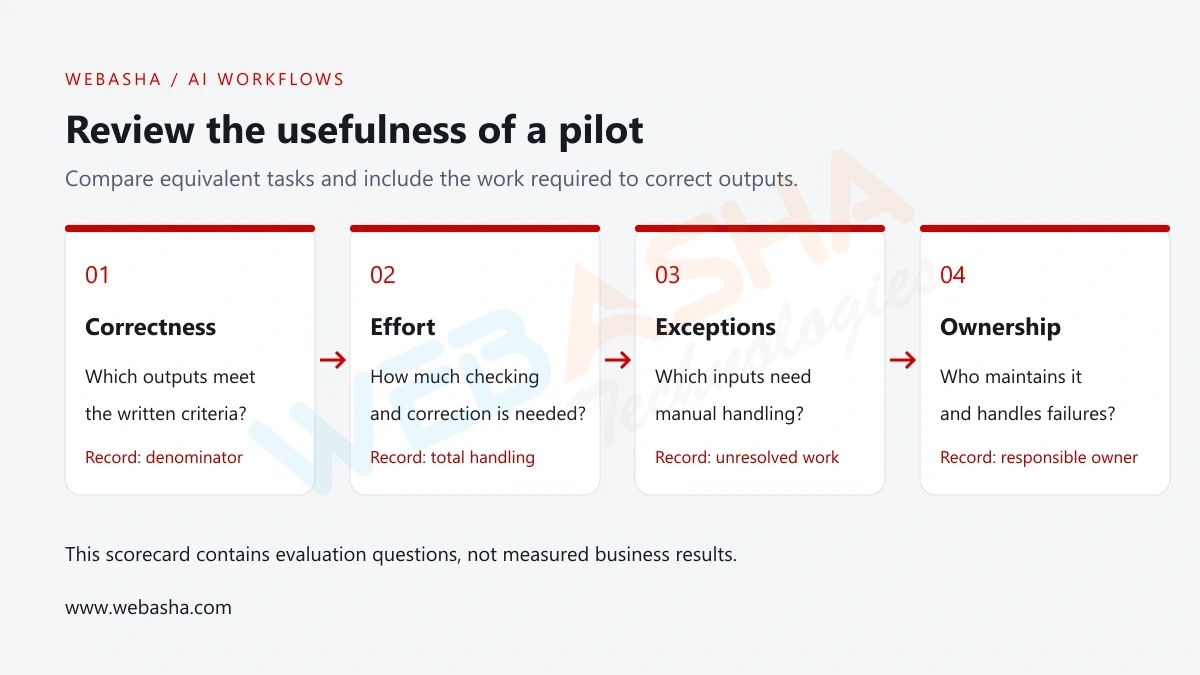
Compare the pilot with the same manual task using equivalent case types. Track total handling time, reviewer corrections, incomplete cases and exceptions. Include setup and maintenance work in the project record so a shorter draft step does not hide a longer review process.
| Measure | What to record |
|---|---|
| Correctness | Outputs accepted under the task owner’s written criteria. |
| Correction effort | Time spent checking and changing each result. |
| Coverage | Inputs completed, rejected and sent for manual handling. |
| Duplicates or unintended actions | What occurred and which control needs changing. |
| Source traceability | Whether the reviewer can locate the supporting material. |
| Operational ownership | Who maintains the workflow and handles an outage. |
Record both counts and denominators. “Eight accepted drafts out of ten reviewed examples” is more interpretable than an acceptance percentage without context. This is an illustrative reporting format, not a result measured for this article.
Expand only when the observed benefit justifies the remaining work and the owner accepts the scope. A small sample can reveal obvious failures, but it cannot prove reliability for every future input.
Build the skills needed to maintain the workflow
A useful generative AI learning path combines clear task descriptions with data preparation, basic integration concepts and evaluation. Practise following one record from input to output, explaining a validation failure and changing a workflow without losing its source history.
For AI engineering skills, learn how the selected platform handles credentials, execution logs and errors. Coding becomes useful when a required transformation or integration exceeds the visual builder’s supported features. Choose that work from the project’s needs.
The WebAsha discussion of generative AI ethical concerns offers background for reviewing data use and accountability. Keep the business owner involved when defining acceptable outputs.
Discuss Generative AI training with WebAsha Technologies. Contact WebAsha with a workflow brief and the skills you want to practise.
Official references
Frequently Asked Questions
What's Your Reaction?
 Like
0
 Dislike
0
 Love
0
 Funny
0
 Wow
0
 Sad
0
 Angry
0

With a passion for staying on the cutting edge of technology trends, I am dedicated to delivering content that not only informs but also inspires. Whether you need in-depth analysis pieces, informative guides, or thought-provoking opinion pieces, I craft content that resonates with tech enthusiasts and professionals alike.