SOC Analyst Resume for Freshers: Show Your Lab Evidence
Build a SOC analyst resume for freshers around work you can explain: relevant foundations, completed lab tasks and clear investigation notes. Label projects as learning work, connect each skill to evidence and tailor the selection to the role. Use numbers only when you can show what was counted or measured.

Build a SOC analyst resume for freshers around work you can explain: relevant foundations, completed lab tasks and clear investigation notes. Label projects as learning work, connect each skill to evidence and tailor the selection to the role. Use numbers only when you can show what was counted or measured.
This guide offers editorial examples, not a recruiter’s scoring system. The sample wording is illustrative and must be replaced with your own facts. Source guidance was checked on 17 November 2026; no candidate’s resume, application or hiring outcome was tested.
Give the reader a reason to trust each claim
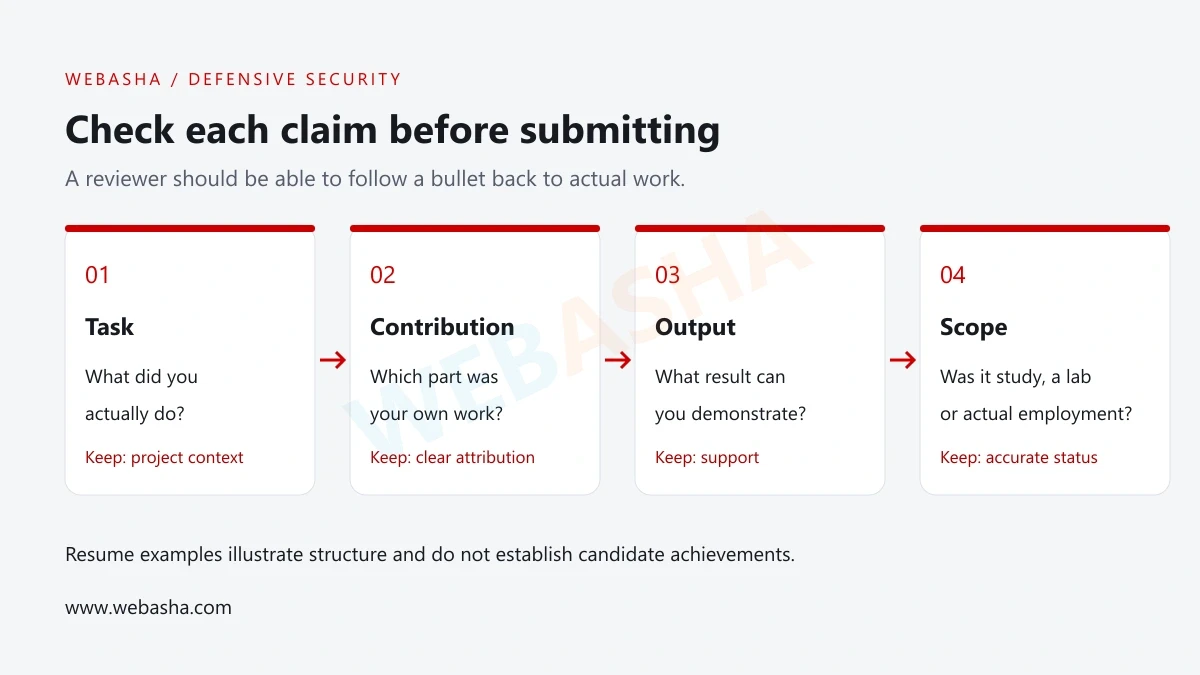
- Describe a task, your contribution and the result you can support.
- Keep training, employment and certification status clear.
- Link to permitted project evidence where useful.
- Check the final file and application instructions before submitting.
Start with the role and your actual evidence
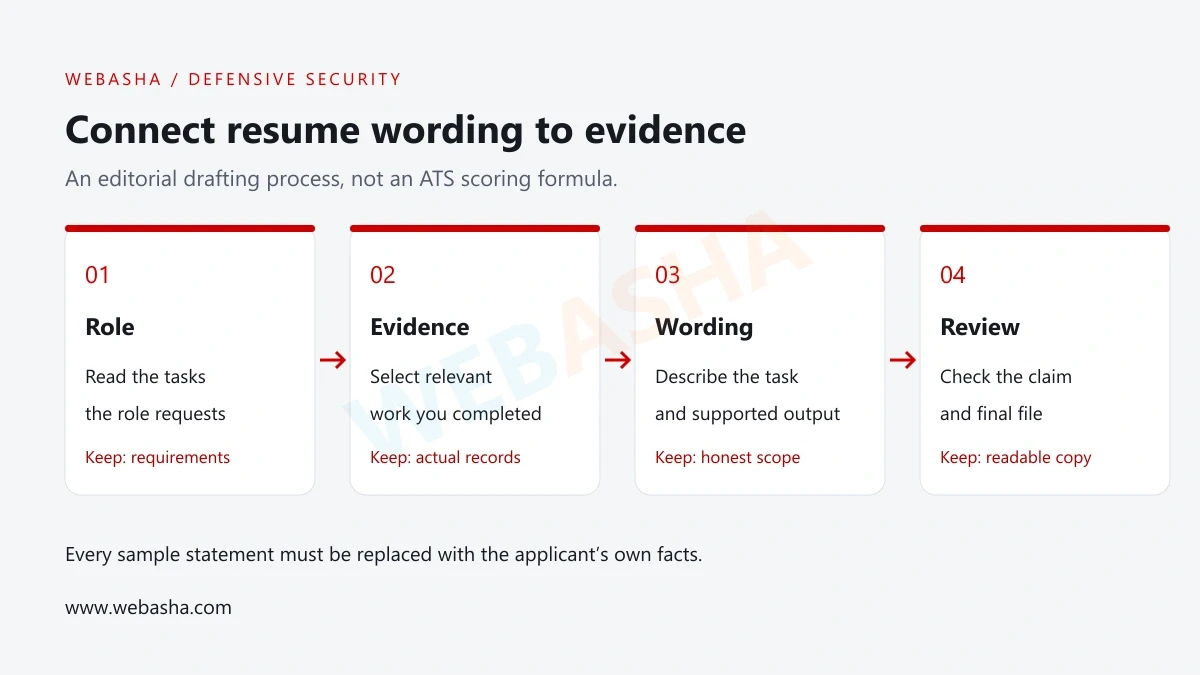
Read the job description and separate the tasks from the product names. If it asks for alert triage, consider which exercise shows you reviewing records, explaining uncertainty and writing a handover. A skills list alone cannot tell that story.
NIST’s NICE Framework describes cybersecurity work through Task, Knowledge and Skill statements. That distinction can help organise a resume review: what did you do, what did you understand and which observable action can you demonstrate? It is not an employer-specific hiring rubric. [2]
| Role requirement | Possible evidence | Accurate scope |
|---|---|---|
| Log analysis | A documented synthetic-log exercise. | Name the dataset and checks you performed. |
| Alert triage | A training case note with a supported decision. | Identify missing context and next action. |
| SIEM familiarity | A query and source-linked results from a permitted lab. | State the actual platform and task. |
| Communication | A concise handover reviewed by a peer or instructor. | Describe the review and your contribution. |
| Endpoint context | A timeline built from supplied process records. | Do not imply a live incident investigation. |
Choose the strongest relevant examples you already have. If a requirement exposes a gap, use it to plan learning rather than adding an unsupported skill to the document.
Choose a structure that makes your work easy to find
Harvard’s career guidance recommends specific, active, fact-based language and a readable, consistent format. It also advises tailoring the resume to the position. Use those principles to decide what deserves space. [1]
| Section | What belongs there |
|---|---|
| Contact and links | Your usable contact details and relevant permitted portfolio links. |
| Profile, if useful | A short description of your current direction and demonstrated learning. |
| Skills | Relevant skills you can explain, with scope clear elsewhere. |
| Lab or academic projects | Completed tasks, contribution, method and supported output. |
| Experience | Actual employment, internship or volunteering with accurate dates and duties. |
| Education and credentials | Actual qualification details and correctly labelled certification status. |
The order can change. If a relevant internship is your strongest evidence, give it prominence. If completed academic projects carry the most relevant work, make them easy to locate. Do not create an empty employment history merely to match a sample.
Write a short profile only if it adds useful context
A profile can explain the direction of your application without making broad claims about expertise. Keep it tied to the evidence elsewhere on the page.
Illustrative wording: “Entry-level cybersecurity learner with completed lab work in authentication-log review and case documentation. Seeking a junior SOC role where those foundations can support supervised security investigation.”
Use that wording only if the work and goal are yours. Replace the tasks with your actual experience. Phrases such as “expert in all SOC tools” need a level of evidence that a short introduction cannot supply.
If the profile merely repeats the section headings, shorten or remove it. Use the space for a concrete task you completed or a link to a permitted write-up.
Turn lab activity into a specific project bullet
Use a simple drafting question: what did you do, on what input, using which method, and what did you produce? You do not need to squeeze every detail into one sentence, but the reader should understand your contribution.
| Vague or unsupported claim | More precise wording |
|---|---|
| Worked on SIEM. | Filtered supplied authentication records in a training SIEM and documented the query window and relevant results. |
| Handled cyberattacks. | Reviewed a synthetic alert case and wrote an escalation note separating observed activity from unresolved context. |
| Expert in Python automation. | Wrote a Python summary of labelled training records and checked counts against the known sample. |
| Secured enterprise endpoints. | Built a timeline from supplied endpoint records and identified missing context affecting the assessment. |
These rewrites illustrate scope, not achievements to copy. If you watched a demonstration rather than performing the task, describe it as study. If you only designed a rule, do not say it was deployed and validated.
After drafting a bullet, open the supporting project. Can you point to the input, your steps and the output? If not, revise the claim or complete the missing work before listing it.
Use measured scope without inventing impact
Numbers can describe the work, but they need a defined basis. A count of supplied records is different from a measured reduction in risk. A detection matching labelled samples is different from a production performance result.
| Claim type | Evidence to check |
|---|---|
| Records reviewed | Which records and time window were included? |
| Cases completed | What counted as one case, and what was your contribution? |
| Rule test results | Which labelled matches and non-matches were evaluated? |
| Time saved | What baseline and repeatable measurement support the comparison? |
| Detection improvement | Which evaluation method and dataset establish the change? |
If you cannot support an impact percentage, use a factual task-and-output statement. “Documented query assumptions and unclassified results” can be meaningful without a dramatic number.
Do not copy a sample’s metrics, client names or project scale. In an interview, you should be able to explain how a number was obtained and what it leaves out.
List skills at a level you can demonstrate
Group related skills so a reader can understand them quickly. For example, separate networking and systems foundations from tools used in a lab. Avoid attaching a long list of products to an unsupported label such as advanced expertise.
For each tool you list, prepare to explain one task you performed and one limitation you encountered. If a role asks for a product you have not used, identify relevant concepts honestly instead of adding the product name.
Keep credentials precise. Use the issuer’s actual credential name and your real status. Course participation, completion and an independently awarded certification are different facts. An exam plan or enrolment should not be presented as an earned credential.
If you have help-desk, academic team or volunteer experience, describe the relevant work you performed. Documentation, troubleshooting and clear escalation can be useful to explain without relabelling the position as a SOC role.
Use an adaptable sample layout
The outline below uses placeholders and illustrative tasks. It contains no candidate identity or invented employment. Replace every applicable field and omit anything you cannot support.
| Heading | Content prompt |
|---|---|
| Name and contact | Your name, relevant location, usable contact details and permitted portfolio link. |
| Profile | One or two short lines describing your actual starting point and target role. |
| Relevant skills | Foundations and tools demonstrated in the projects or experience below. |
| Lab project: authentication review | Dataset context; actual filtering or summary task; checked output; write-up link. |
| Lab project: case handover | Scenario context; your assessment note; limitations and review feedback. |
| Experience, if applicable | Actual role, organisation, dates and relevant responsibilities or results. |
| Education and credentials | Actual institution/issuer, qualification and correctly labelled status. |
Adapt the outline to the role and your strongest evidence. It is not a claim that every employer wants the same section order or that a template will pass every screening system.
Follow the application’s requested file type and naming instructions. Export the finished document, reopen it and inspect the text, links and page breaks. Keep a copy of the version submitted so you can prepare for questions about it.
Review evidence links, wording and readability
Open every portfolio link as a reader would. Confirm that the intended write-up is available and that it does not expose restricted material. The resume should still explain the main task even if a reviewer does not follow the link.
Harvard’s guidance recommends checking whether formatting survives PDF conversion. Treat that as a practical file check, not a guarantee about every applicant-tracking system. [1]
Use ordinary section headings and selectable text where appropriate to the requested format. Do not use hidden text or repeated keywords to imply skills you lack. A plain-text reading-order check can expose obvious export problems, but it cannot predict an employer’s screening result.
Ask a reviewer to select one bullet and question it. Can you describe the input, your actions and the evidence behind the conclusion? Edit vague wording and remove unsupported claims before sending the file.
Connect the resume to your next learning task
If you have no relevant project yet, start with a small permitted exercise and complete its report. The WebAsha beginner cybersecurity guide can help organise foundations. The beginner portfolio guide explains presenting learning evidence.
Use the SOC analyst skills guide to compare tasks with your target direction. Prioritise a gap you can practise and review instead of adding another unverified term to the skills list.
After an interview, note which part of your own project you struggled to explain. Revisit that concept and improve the write-up. Keep the resume consistent with the work as it develops.
Discuss evidence-based SOC preparation with WebAsha
Bring a draft project bullet and its permitted supporting note to a training discussion. Ask how instructors review the technical work and help learners explain its scope accurately.
Ask WebAsha Technologies about SOC analyst training and lab-project review. Contact WebAsha with your starting skills and preparation goals.
Official references
Frequently Asked Questions
What's Your Reaction?
 Like
0
 Dislike
0
 Love
0
 Funny
0
 Wow
0
 Sad
0
 Angry
0

With a passion for staying on the cutting edge of technology trends, I am dedicated to delivering content that not only informs but also inspires. Whether you need in-depth analysis pieces, informative guides, or thought-provoking opinion pieces, I craft content that resonates with tech enthusiasts and professionals alike.