Digital Forensics Interview Questions With Evidence Scenarios
Prepare for digital forensics interview questions by explaining how you would preserve evidence, document its handling and test an interpretation against supporting records. Practise scenarios involving acquisition errors, uncertain timestamps and incomplete logs. A useful answer makes the next authorised step clear and keeps the conclusion within the evidence available.
Prepare for digital forensics interview questions by explaining how you would preserve evidence, document its handling and test an interpretation against supporting records. Practise scenarios involving acquisition errors, uncertain timestamps and incomplete logs. A useful answer makes the next authorised step clear and keeps the conclusion within the evidence available.
This practice set uses synthetic examples and technical guidance checked on 17 November 2026. It is not an employer’s question bank or an operational collection procedure. No device, forensic image or real case was examined while writing it.
Explain the evidence behind the answer
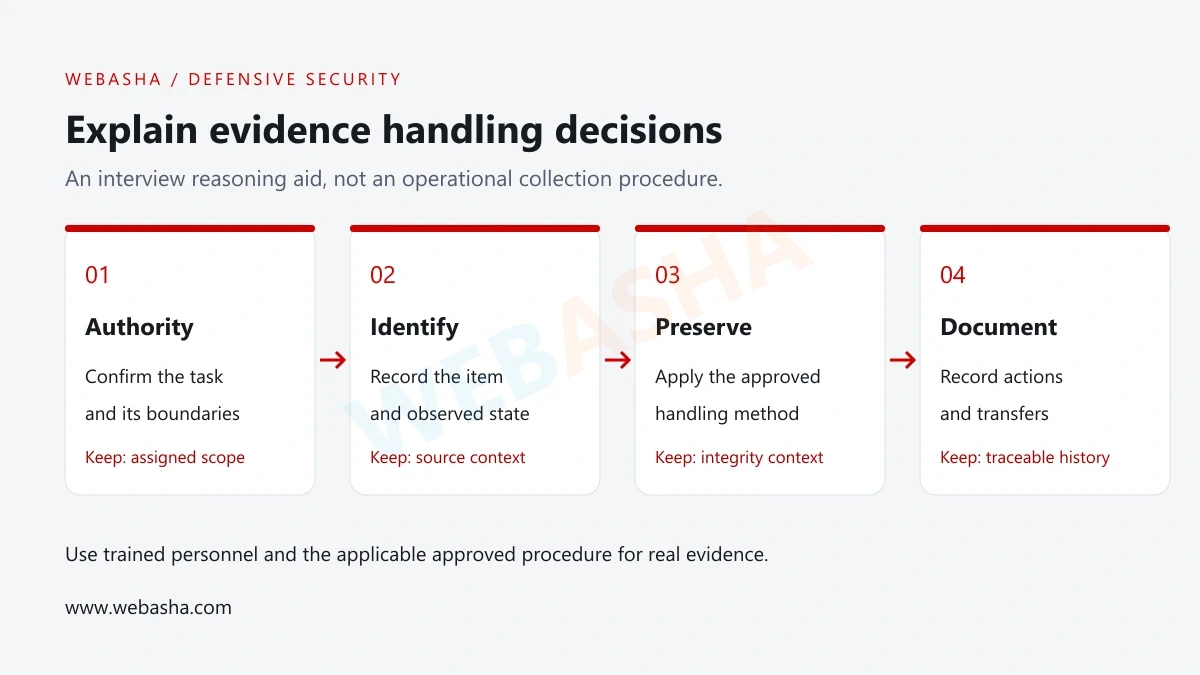
- Confirm the task and authority before collecting data.
- Record handling and acquisition limitations.
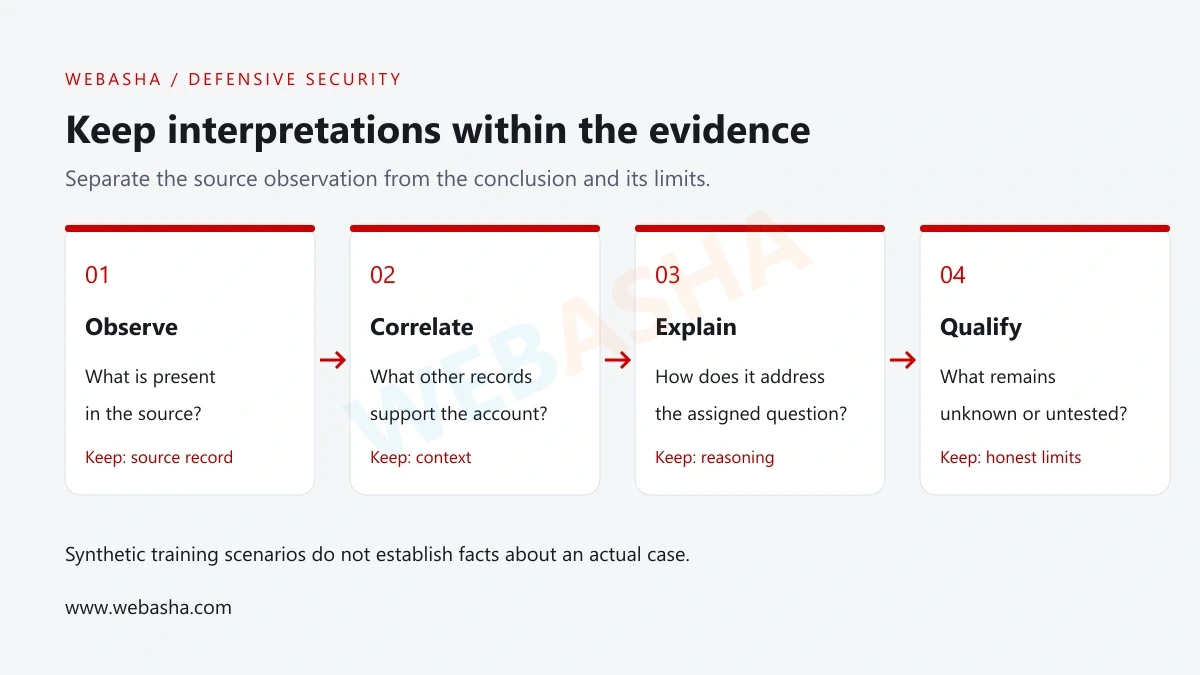
- Distinguish observations from interpretations.
- Describe how a reviewer could check the conclusion.
Explain a forensic process without skipping preservation
1. What is digital forensics?
“It is a disciplined way to collect, examine and analyse digital information, then report what it supports. I would start with an authorised question and preserve the records needed to review my method.” NIST SP 800-86 organises its forensic process around collection, examination, analysis and reporting. [1]
2. How do examination and analysis differ?
“Examination makes relevant data available for review, such as extracting records from an acquired source. Analysis interprets those records in relation to the investigation question. I would keep the extraction method and the reasoning separate so another examiner can follow both.” [1]
Use an example from a permitted exercise you actually completed. If you have only studied the process, say so. Describing a synthetic training case accurately gives the interviewer more useful information than claiming an investigation you did not perform.
Start an evidence scenario with the approved question
3. What would you establish before collecting a device?
“I would confirm the assigned question, scope and authority, then follow the organisation’s collection procedure. I would record the item’s state and identifiers and clarify any condition that could change the collection approach.” SWGDE’s collection guidance calls for coordination about scope and constraints, documentation and review of the applicable authority. [2]
Do not assume that physical access gives permission to examine everything on a device. In an interview, identify what requires clarification rather than proposing to collect unrelated personal information. Specialist or legal decisions should follow the responsible organisation’s process.
4. What would make you stop and escalate?
“I would pause if the requested action exceeds my authority, the source differs from the brief or a condition falls outside the approved method. I would preserve my notes and involve the designated lead before taking an action that could lose or change relevant data.”
Discuss chain of custody as a record of handling
5. What is chain of custody?
“It records evidence identity, receipt and transfers so its handling can be traced. I would use the organisation’s required form and record each transfer when it occurs.” SWGDE says documentation should begin at collection and reflect transfers and people taking possession. [2]
| Field | Example or question |
|---|---|
| Item | TRAIN-015-DRIVE-A; a synthetic identifier. |
| Transfer | Who handed it to whom, and when? |
| Purpose | Why was possession transferred? |
| Condition | What condition and packaging details were recorded? |
| Storage reference | Where is the item held under the approved process? |
This table is a discussion prompt, not a complete custody form. If a transfer entry is missing, identify the gap and follow the correction process. Do not backfill a confident statement from memory as though it were a contemporaneous record.
A well-kept technical record supports review. It does not let an interview candidate promise a court outcome. Applicable decisions belong to the relevant authority and case process.
Explain acquisition choices and verification limits
6. How do physical and logical acquisitions differ?
“A physical acquisition aims at a bitstream copy of storage data; a logical acquisition collects structured data such as files and folders. The appropriate approach depends on the question, source and approved method.” SWGDE discusses both and recommends minimising changes to the source. [3]
7. What does a matching hash establish?
“A hash comparison supports an integrity check for the data compared. I would record which objects were hashed and the algorithm used. It does not independently establish who created the content or fill a gap in the evidence history.” SWGDE describes verification by comparing the acquired-data hash with the acquisition stream or source. [3]
Verification also needs context about acquisition coverage. A matching value for the acquired data does not show that an unreadable region was successfully captured. Check the acquisition logs and explain any unresolved omission. [3]
Avoid a universal rule for live systems
8. Would you immediately power off a running computer?
“I would first apply the approved procedure to the actual circumstances, including data volatility, encryption and operational risk. I would seek qualified guidance where required and document the decision. A universal power-off answer can ignore information that may be lost.”
SWGDE explains that live acquisition can change timestamps, introduce instability and produce inconsistent views as data changes during collection. It calls for prioritising volatile information according to the situation. [3]
9. Does a memory capture show everything that happened?
“I would treat it as one acquired source with its own timing and coverage limits. I would explain the acquisition context and correlate relevant observations with other approved records before making a wider claim.” NIST’s guidance discusses volatile operating-system information as a source, alongside files, network traffic and applications. [1]
This article supplies no live-acquisition commands. A real collection requires a suitable method, trained personnel and the relevant authority.
Handle uncertain timestamps and recovered files carefully
10. How would you build a timeline?
“I would retain each source’s original timestamp and record how it was interpreted. I would check the clock context and time zone, explain any normalisation and correlate events using more than a displayed time alone.” NIST SP 800-86 discusses correlating sources and accounting for clock differences. [1]
For example, two records displayed one hour apart might use different time-zone conventions. That is a hypothesis to check, not proof of an hour-long delay. Keep the source value available so a reviewer can revisit the conversion.
11. Can a recovered deleted file prove a person performed an action?
“I would explain the recovery context, completeness and related records before attributing an action. A recovered object alone may leave questions about origin, timing and user activity.” NIST’s scientific foundation review warns that deleted-file recovery may include extraneous material, and artifact meaning can change as software evolves. [4]
Read tool output in the context of the relevant software and source. If the interpretation depends on an assumption you have not checked, label it explicitly.
Practise two evidence scenarios
Scenario: an acquisition log reports unreadable regions
You receive a training image, a verification result and a log showing acquisition errors. A colleague asks you to write that the entire original device was preserved.
A useful answer declines that unsupported conclusion. Identify the acquired object and reported gaps, retain the error record and ask the lead how those gaps affect the assigned question. Distinguish a verified acquired dataset from a claim about complete source coverage. Do not silently replace the first record if an approved repeat acquisition is later performed.
Scenario: a download record appears near a suspicious event
A synthetic browser record shows a download entry close to a sample security alert. The question is whether a named person intentionally executed the file.
The record supports a narrower observation about the recorded download. Intent and execution require additional evidence and context. Explain which approved corroborating sources would help answer the question, whether relevant records are missing, and which alternative explanations remain open. Avoid turning time proximity into attribution.
Present findings so another reviewer can follow them
12. What belongs in a forensic report?
“I would identify the task, sources, methods and relevant results, then explain the reasoning and limitations behind each conclusion. A reviewer should be able to distinguish what I observed from what I inferred.” NIST’s reporting phase addresses communicating results and documenting limitations. [1]
| Part | Review question |
|---|---|
| Task | What question was assigned? |
| Source record | Which acquired items and relevant identifiers were used? |
| Method | What process and tool context produced the result? |
| Observation | What does the source actually contain? |
| Interpretation | How does that observation bear on the question? |
| Limits | What was missing, uncertain or not examined? |
Give a nontechnical explanation without removing qualifications. “The record contains this account identifier” and “this person performed the action” are different claims. If your evidence establishes only the former, the report should preserve that boundary.
When another examiner disagrees, compare the source records, method and assumptions. Document a correction clearly instead of hiding the earlier uncertainty. Peer discussion is useful when it improves the traceability of the conclusion.
Use a small, permitted exercise for interview practice
Choose a synthetic dataset with a known learning question. Keep a short handling record, source notes and an interpretation log. Ask a partner to challenge one assumption and explain what additional record would change your view.
For entry-level context, see the WebAsha beginner cybersecurity guide. Organise permitted practice using the beginner portfolio guide. The SOC analyst skills guide offers related incident-triage context.
If a question names an unfamiliar tool, explain the evidence task you understand and identify what you would need to verify about that tool. Do not claim product experience you lack. A concise answer with a clear limitation gives the interviewer something concrete to assess.
Discuss digital forensics learning with WebAsha
Bring a sanitised training report or a synthetic evidence scenario to a course discussion. Ask how preservation, acquisition limitations and interpretation are reviewed during supervised practice.
Ask WebAsha Technologies about digital forensics training and evidence-reporting practice. Contact WebAsha with your starting skills and learning goals.
Official references
Frequently Asked Questions
What's Your Reaction?
 Like
0
 Dislike
0
 Love
0
 Funny
0
 Wow
0
 Sad
0
 Angry
0

With a passion for staying on the cutting edge of technology trends, I am dedicated to delivering content that not only informs but also inspires. Whether you need in-depth analysis pieces, informative guides, or thought-provoking opinion pieces, I craft content that resonates with tech enthusiasts and professionals alike.