Web Application Penetration Testing Interview Questions and Scenarios
Prepare for web application penetration testing interview questions by explaining a security control, applying it to an authorised scenario and identifying the evidence you would review. Practise access control, injection prevention, browser security and session handling, then connect each answer to remediation and retesting. Use examples from work you can honestly explain.
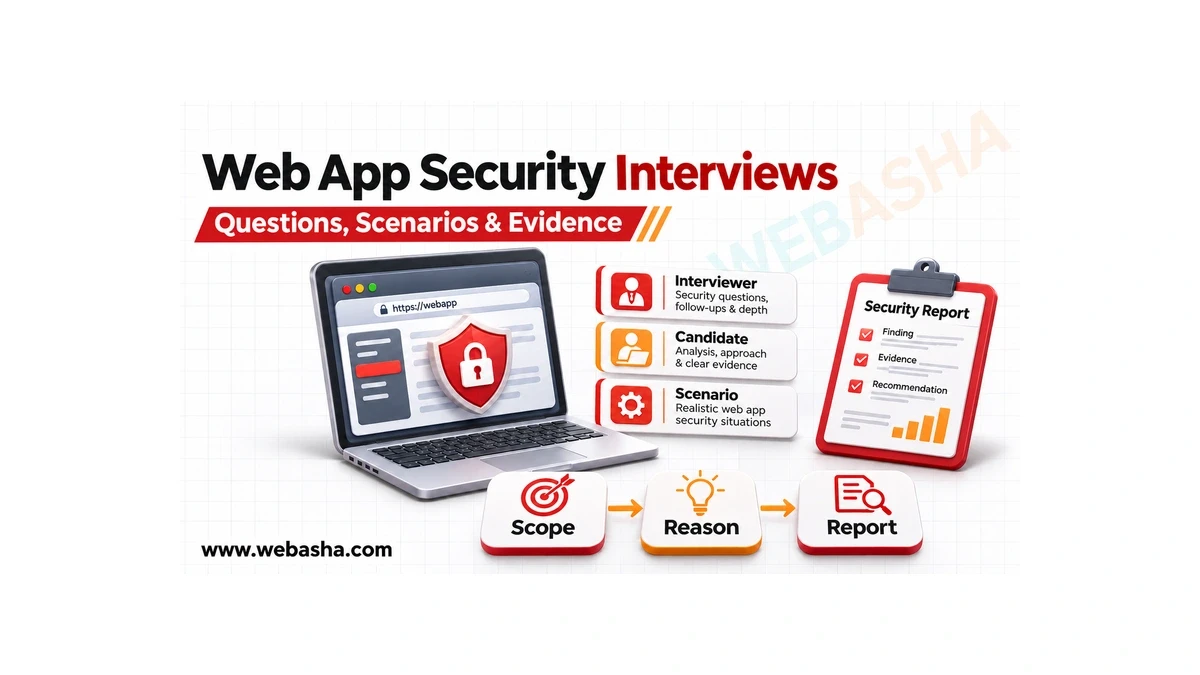
Prepare for web application penetration testing interview questions by explaining a security control, applying it to an authorised scenario and identifying the evidence you would review. Practise access control, injection prevention, browser security and session handling, then connect each answer to remediation and retesting. Use examples from work you can honestly explain.
The questions and sample answers below are editorial practice aids, not an employer’s assessment script. Scenarios use synthetic records and approved lab contexts. No application was tested while preparing this article.
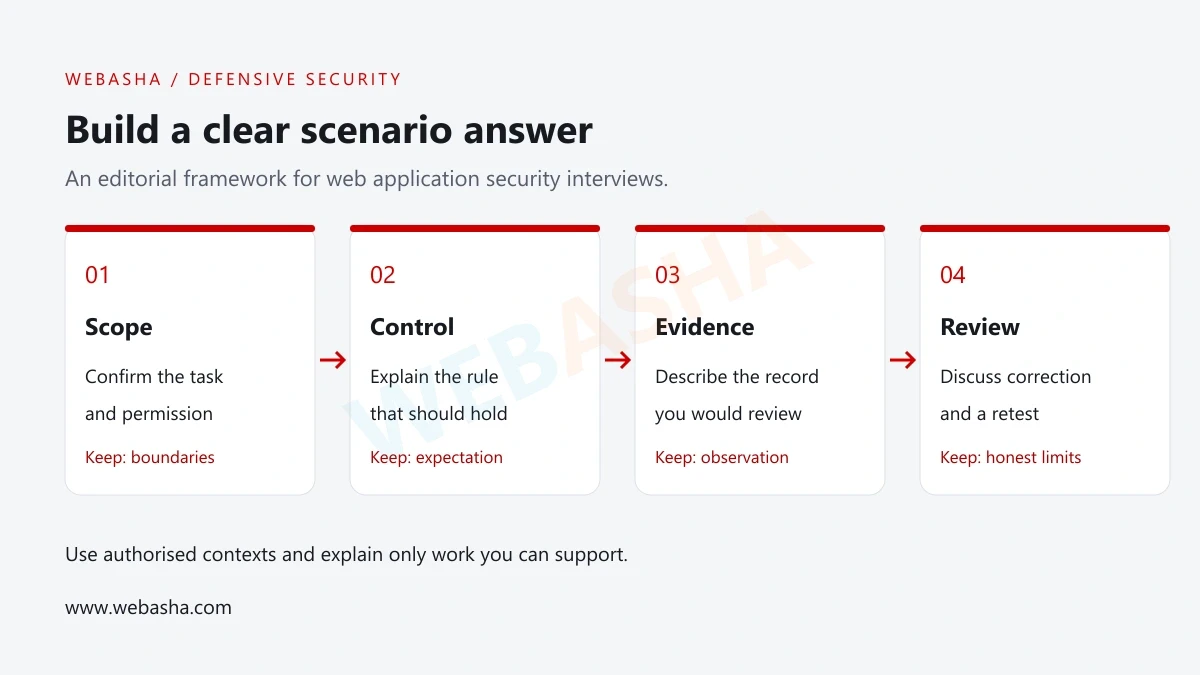
Make your reasoning visible
- Clarify permission and scope before describing a test.
- Connect the expected control to an observation.
- Separate a suspected issue from a demonstrated finding.
- Explain how a correction would be checked.
Start with scope and a clear assessment question
1. How would you begin a web application assessment?
“I would confirm the approved application, environments, roles, testing window and restrictions with the owner. I would establish the contact and stop conditions, then map the workflows that matter to the assessment. Before running a tool, I would know which question its output should help answer.”
This answer gives a reviewer a practical starting point. Add details from an engagement or lab you actually completed, including a limitation you had to respect. Do not invent client experience to make the answer sound stronger.
2. How would you use a testing guide?
“I would use a guide to organise coverage and record what was checked, excluded or unresolved. I would adapt it to the application rather than treating completion of a checklist as proof that the system is secure.” OWASP’s Web Security Testing Guide provides a structured web-testing resource. [1]
Explain the difference between tools and conclusions
3. A scanner reports a high-severity issue. What happens next?
“I would inspect the evidence, affected component and assumptions behind the alert. Within the approved scope, I would check whether the relevant condition exists and whether the stated impact follows. If the record is insufficient, I would label the result as unconfirmed and identify the next safe check.”
A scanner label does not establish the application’s actual exposure. Explain the difference between a tool observation, your interpretation and any consequence that remains untested. The sample answer should describe your method without claiming that every alert requires a risky demonstration.
4. What would you do if a test affects availability?
“I would follow the agreed stop procedure, preserve the permitted evidence and notify the designated contact. I would record what happened and wait for the owner’s direction before continuing the affected work.” Avoid improvising an increasingly disruptive test to finish a checklist.
Practise authentication and authorisation questions
5. What is the difference between authentication and authorisation?
“Authentication establishes an identity; authorisation decides whether that identity may perform an action on a resource. A successful login does not establish access to every record. The server should enforce the relevant permissions on each request.” OWASP recommends denying access by default and checking permissions consistently. [2]
6. How would you discuss an object-level access-control concern?
“I would first confirm the intended relationship between the account, object and action. Using approved test identities and synthetic objects, I would compare expected and observed access. I would record the exact context and avoid retrieving unrelated real-user data.”
| Identity | Synthetic record | Expected read access |
|---|---|---|
| Customer A | A-owned order | Allowed |
| Customer A | B-owned order | Denied |
| Support role | Order assigned under approved policy | Depends on the documented support rule |
| Unauthenticated session | Private order | Denied |
The support row is deliberately unresolved until the policy is known. Job titles alone cannot define every permitted action. Discuss ownership, tenancy and business rules with the application owner. Hard-to-guess identifiers do not replace an access decision. [2]
Answer injection questions through prevention and evidence
7. How would you explain SQL injection prevention?
“SQL injection occurs when untrusted input changes the intended query structure. I would review whether values are bound through parameterised queries rather than assembled into SQL text. Dynamic identifiers need a controlled mapping, because value parameters do not cover every query element.” [3]
Follow up with how the correction would be reviewed in the actual code path. A safe outer database call does not establish that dynamically constructed SQL inside a stored procedure is safe. OWASP’s guidance includes reviewing both application query construction and procedure internals. [3]
8. Is input validation enough to prevent cross-site scripting?
“I would check how untrusted content reaches the browser and the context in which it is rendered. Appropriate output encoding and safe rendering APIs matter; deliberately supported HTML needs an appropriate sanitisation approach. A single input filter does not cover every output context.” [4]
Use a harmless rendering example in an approved lab to explain the distinction between displaying text and interpreting markup. This interview guide supplies no executable payloads.
Distinguish browser controls and their limits
9. How would you explain cross-site request forgery?
“CSRF concerns unwanted requests made using a user’s authenticated browser context. I would review which actions change state and which anti-CSRF protections the application uses. I would check the chosen framework’s supported mechanism and how the server verifies it.” [5]
SameSite cookie behaviour can contribute to defence, but it is not a universal substitute for the application’s CSRF protection. Explain the deployment assumptions before calling it sufficient. Review state-changing actions and any same-site trust relationships relevant to the design. [5]
10. Does HttpOnly make cross-site scripting harmless?
“HttpOnly restricts script access to the cookie through browser APIs. It does not stop all actions a script could perform within the page’s context. I would address the rendering weakness and review the session controls separately.” [6]
Explain session behaviour with a specific lifecycle
11. What would you review about session management?
“I would trace how a session is created, handled after login or a privilege change, and ended. I would review cookie attributes, expiry and server-side invalidation against the application’s requirements, using approved accounts and records.” OWASP’s session guidance discusses regeneration following privilege changes and session termination. [6]
For a follow-up about logout, explain the expected result first: the relevant session should no longer authorise protected activity after termination. Record the observed server behaviour in an approved test context. A visual redirect alone is limited evidence about invalidation.
12. What if the application behaves differently for two roles?
“I would confirm the documented permissions and compare the same action under the relevant identities. A difference can be correct by design. I would report a finding only when evidence shows that an intended boundary is missing or incorrectly enforced.”
Work through two interview scenarios
Scenario: a customer can see another synthetic order
Assume a training application with two approved customer accounts and separate synthetic orders. The stated rule is that each customer may view only their own order. Your evidence shows one account receiving the other account’s private order details.
A useful answer identifies an ownership-boundary concern, describes the approved evidence and limits the claim to the behaviour observed. Recommend server-side ownership or relationship checks for the relevant operation. Retest the intended allowed case and denied case after correction, without expanding into unrelated records.
Scenario: a refund workflow skips a review step
The application owner says refunds above an internal threshold require approval. An approved test record appears to reach completion without the expected approval state. Before naming a flaw, clarify which role performed the action, which workflow version applies and whether the record was actually finalised.
Describe the missing business invariant: the condition that should remain true throughout the workflow. A transport response or changed page label alone may not prove that a refund was processed. Use the owner’s approved records to establish the result. These scenarios are invented practice cases, not incident reports.
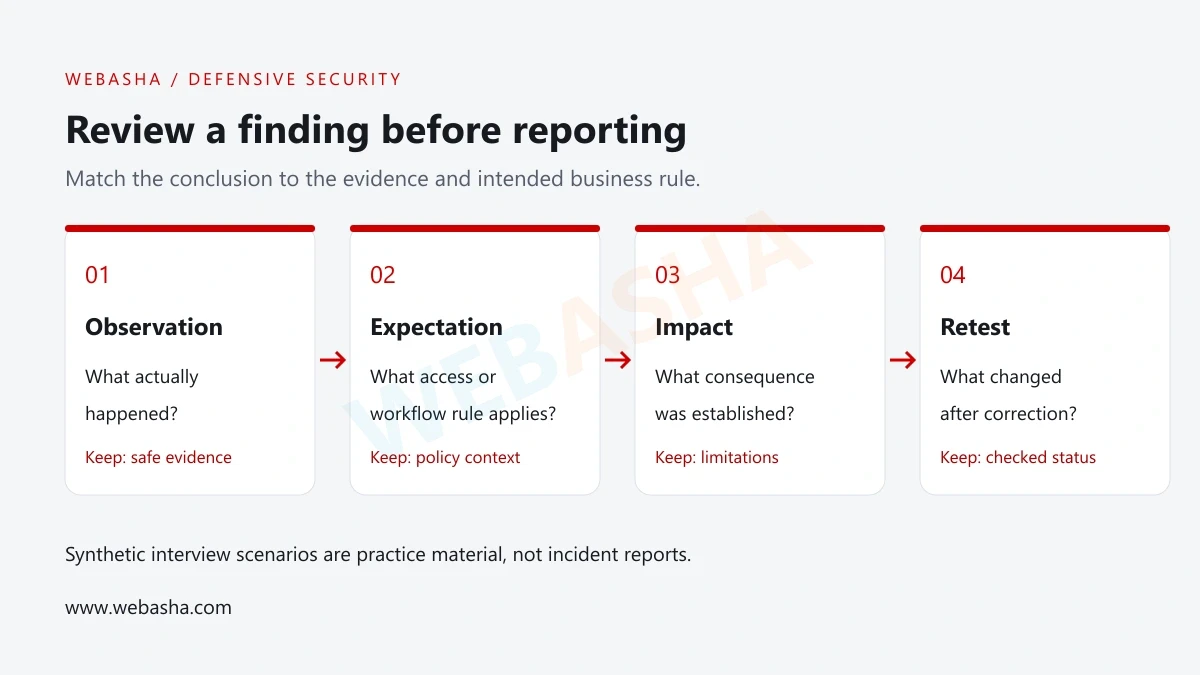
Turn an observation into a useful report
| Field | What a reader needs |
|---|---|
| Expected rule | The access or workflow condition that should hold. |
| Observed behaviour | What occurred in the approved context. |
| Evidence | Enough safe detail to understand and review the result. |
| Impact | The demonstrated consequence, with assumptions labelled. |
| Correction | A proposal addressing the root control failure. |
| Retest status | What was checked after correction and what remains open. |
Use severity to communicate risk in context. Explain affected data or actions, required privileges, scope and known limitations. If a scoring method is required, use the agreed method and provide the inputs behind the result. Do not select a dramatic label merely because it appears in a scanner.
A retest should examine the reported condition and relevant legitimate behaviour. If the correction blocks the unauthorised case but also prevents a permitted customer action, record both outcomes. Keep secrets and private data out of the final report unless the agreed handling process explicitly requires them.
Prepare answers using your own evidence
Pick one question and give a brief answer without notes. Then ask a partner to change an assumption: the user role, the rendering context or the workflow state. Explain what changes in your reasoning. Where you are unsure, name the missing information and the official reference you would consult.
For foundation review, see the WebAsha beginner cybersecurity guide. Use the beginner portfolio guide to organise permitted learning evidence. If you are comparing defensive work, the SOC analyst skills guide helps separate that role’s tasks from application assessment work.
Common preparation problems include memorising a definition without an example, treating a tool result as proof and overstating impact. Correct them by revisiting the expected control and supporting evidence. An honest partial answer with a clear next question is more useful than an invented explanation.
Discuss practical interview preparation with WebAsha
Bring a permitted project summary or a sanitised practice finding to a training discussion. Ask how reasoning, reporting and defensive remediation are reviewed, and which supervised labs support that work.
Ask WebAsha Technologies about ethical hacking and web application security training. Contact WebAsha with your starting level and interview preparation goals.
Official references
Frequently Asked Questions
What's Your Reaction?
 Like
0
 Dislike
0
 Love
0
 Funny
0
 Wow
0
 Sad
0
 Angry
0

With a passion for staying on the cutting edge of technology trends, I am dedicated to delivering content that not only informs but also inspires. Whether you need in-depth analysis pieces, informative guides, or thought-provoking opinion pieces, I craft content that resonates with tech enthusiasts and professionals alike.