Penetration Tester Career Roadmap for Beginners in India
A realistic, stage-by-stage roadmap into penetration testing in India - the order to learn skills, which certifications matter, how to build a legal lab, and which first roles actually lead there.
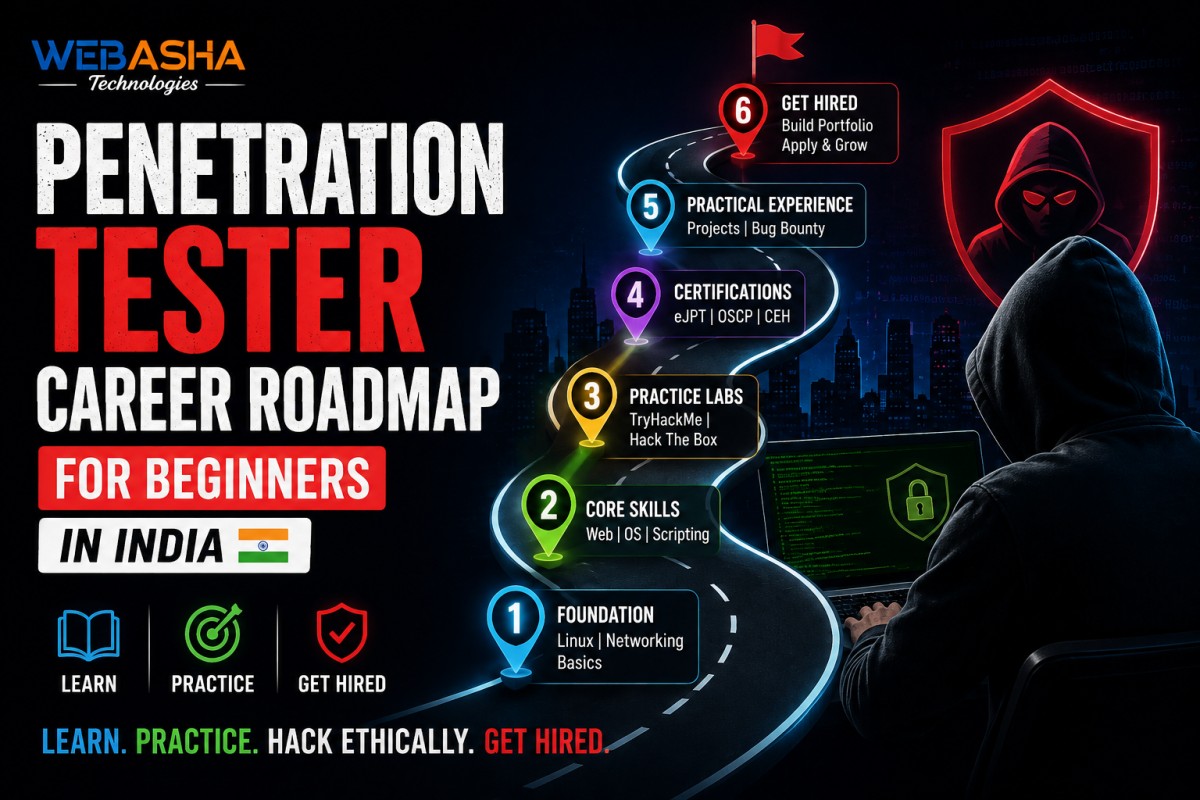
Most penetration testing roadmaps skip the uncomfortable part: junior pentest roles are scarce, and almost nobody walks into one directly. This roadmap is written around that reality - what to learn in what order, what to build, and which realistic first jobs lead to offensive security work.
Table of Contents
- How Do You Become a Penetration Tester?
- What Skills Do You Need First?
- Which Certifications Are Worth It?
- How Do You Build a Legal Practice Lab?
- What Does the Realistic Career Path Look Like?
- What Should Your Portfolio Contain?
- What Does a Penetration Test Report Contain?
- How Do You Practise Legally and Build Evidence?
- Which Areas of Penetration Testing Can You Specialise In?
How Do You Become a Penetration Tester?
Build networking and Linux fundamentals first, learn scripting, then study web and network exploitation in a legal home lab, earn a recognised certification, and build a documented portfolio of findings. Most people enter through a related role such as SOC analyst or system administrator before moving into offensive testing.
The skills stack in a specific order because each layer depends on the one below. Attempting exploitation before understanding TCP/IP and Linux produces someone who can run tools but cannot explain results, which interviews expose immediately.
What Skills Do You Need First?
Networking such as TCP/IP, DNS and HTTP, plus Linux administration and basic scripting in Python or Bash, are the non-negotiable foundations. Web application fundamentals come next, since most real engagements involve web applications rather than exotic binary exploitation.
- Networking - protocols, ports, routing, how packets actually move
- Linux - the platform most tooling runs on
- Scripting - Python and Bash to automate and adapt tools
- Web fundamentals - HTTP, sessions, authentication, the OWASP Top 10
- Windows and Active Directory - most corporate environments run on it
Which Certifications Are Worth It?
CEH is widely recognised by Indian HR filters and works well as an entry credential. OSCP carries more weight with technical interviewers because it is a hands-on practical exam. A sensible sequence is fundamentals first, CEH for visibility, then OSCP once you have real lab hours behind you.
Certifications open doors; they do not replace demonstrable ability. Candidates who can walk an interviewer through a finding they discovered themselves consistently outperform those who only hold exam badges.
WebAsha runs CEH certification training for the entry stage of this path.
How Do You Build a Legal Practice Lab?
Use deliberately vulnerable environments built for practice: intentionally insecure virtual machines, containerised web application targets, and legal online platforms. Never test systems you do not own or lack written authorisation for. In India, unauthorised access is an offence under the Information Technology Act regardless of intent.
A workable home lab is a hypervisor, a Kali or Parrot attacker VM, and a mix of deliberately vulnerable Linux and Windows targets. Add a small Active Directory setup once the basics are comfortable, since AD attack paths appear in most enterprise engagements.
What Does the Realistic Career Path Look Like?
Most Indian penetration testers arrive via an adjacent role: SOC analyst, system or network administrator, or application security tester. These build the defensive and infrastructure context that makes offensive work meaningful, and they are far easier to obtain as a first job.
| Stage | Typical Duration | Focus |
|---|---|---|
| Fundamentals | 3-6 months | Networking, Linux, scripting |
| Practice and certification | 6-12 months | Lab hours, CEH, then OSCP |
| Entry role | 1-2 years | SOC, sysadmin or appsec exposure |
| Junior pentester | - | Scoped testing under supervision |
Timelines vary widely with prior IT experience and hours invested. Treat this as a shape, not a schedule.
What Should Your Portfolio Contain?
Write up findings the way a professional report does: scope, method, evidence, impact and remediation. Two or three well-documented write-ups from legal lab targets demonstrate more capability than a long list of tools you have installed.
Reporting is genuinely half the job. A tester who finds a critical flaw but cannot explain its business impact delivers far less value than one who documents a moderate issue precisely.
What Does a Penetration Test Report Contain?
A professional report contains an executive summary for management, the agreed scope and methodology, each finding with severity, evidence and reproduction steps, and clear remediation guidance. The report is the deliverable clients pay for, not the exploitation itself.
| Section | Audience | Purpose |
|---|---|---|
| Executive summary | Management | Business risk in plain language |
| Scope and method | Technical and legal | What was tested and how |
| Findings | Engineers | Evidence, severity, reproduction |
| Remediation | Engineers | Specific, actionable fixes |
Writing ability is a genuine differentiator in this field. A tester who explains business impact clearly is far more valuable than one who finds more issues but documents them poorly, because unread findings never get fixed.
How Do You Practise Legally and Build Evidence?
Use deliberately vulnerable virtual machines, legal online practice platforms and your own isolated home lab. Document each exercise as though it were a client engagement, because those write-ups become the portfolio that substitutes for professional experience at entry level.
- Isolated lab - keep practice targets off your production network entirely
- Legal platforms - only test systems explicitly designated for practice
- Document as you go - reconstruct steps later and detail is always lost
- Include failures - what you tried that did not work shows real methodology
- Redact nothing real - never publish findings from systems you were not authorised to test
A public repository containing three well-written lab reports demonstrates methodology, persistence and communication simultaneously. That combination is exactly what hiring managers screen for and what most applicants lack.
Which Areas of Penetration Testing Can You Specialise In?
Common specialisations are web application testing, network and infrastructure testing, Active Directory and internal assessment, mobile application testing, cloud configuration review, and red teaming. Web application testing has the broadest demand and is the usual starting specialisation.
| Specialisation | Core Focus | Demand Note |
|---|---|---|
| Web applications | Injection, authentication, access control flaws | Broadest demand, usual entry point |
| Internal network | Active Directory, lateral movement | Common in enterprise engagements |
| Mobile | Application and API weaknesses on devices | Growing steadily |
| Cloud | Misconfiguration, identity and permissions | Increasingly requested |
| Red teaming | Full-scope simulated intrusion | Senior, requires broad experience |
Red teaming appeals to newcomers but sits at the far end of the experience curve. It requires competence across every other specialisation plus operational discipline, so treat it as a destination rather than a starting point.
Cloud security testing is currently among the scarcest skill sets, because it requires understanding both traditional attack techniques and how cloud identity and permission models differ from on-premises equivalents.
Talk to a WebAsha training advisor about batches, syllabus and current fees.
Penetration Testing Career: FAQs
What's Your Reaction?
 Like
0
Like
0
 Dislike
0
Dislike
0
 Love
0
Love
0
 Funny
0
Funny
0
 Wow
0
Wow
0
 Sad
0
Sad
0
 Angry
0
Angry
0

With a passion for staying on the cutting edge of technology trends, I am dedicated to delivering content that not only informs but also inspires. Whether you need in-depth analysis pieces, informative guides, or thought-provoking opinion pieces, I craft content that resonates with tech enthusiasts and professionals alike.











![Top 10 Famous Ethical Hackers in India [Updated 2026]](https://www.webasha.com/blog/uploads/images/202608/image_140x98_da23f65c290cfbf1237d77aec58a2f0f.jpg)