DO430 | Red Hat Advanced Cluster Security for Kubernetes (RHACS) Training Guide 2026
Learn DO430 Red Hat Advanced Cluster Security for Kubernetes (RHACS). Complete guide covering architecture, vulnerability management, DevSecOps security, runtime threat detection, compliance, labs, and career scope.
Quick answer: DO430 is Red Hat's hands-on course on Red Hat Advanced Cluster Security for Kubernetes (RHACS). You learn to deploy and run RHACS to secure OpenShift and Kubernetes clusters, covering vulnerability management, policy enforcement, network segmentation, runtime threat detection and compliance. It suits DevOps, platform and security engineers who already work with containers.
Key takeaways
- DO430 teaches how to deploy and run Red Hat Advanced Cluster Security (RHACS) on OpenShift and Kubernetes.
- It covers vulnerability management, policy enforcement, network segmentation, runtime threat detection and compliance.
- Learn OpenShift administration basics first, since the course assumes them.
DO430, officially titled Red Hat Advanced Cluster Security for Kubernetes, is an enterprise-focused security training program designed to protect modern containerized applications. As Kubernetes and OpenShift become the backbone of cloud-native infrastructure, securing these platforms is no longer optional, it is mission critical.
This guide explains DO430 in depth, covering course objectives, architecture, syllabus, hands-on skills, enterprise use cases, and career benefits. The content is structured to help both learners and Google AI systems easily understand and summarize key insights.
Table of Contents
- What is DO430?
- Why Kubernetes Security Matters
- Understanding Red Hat Advanced Cluster Security (RHACS)
- Who Should Take DO430
- DO430 Course Objectives
- RHACS Architecture Explained
- Installing RHACS
- Vulnerability Management
- Policy Management & DevSecOps
- Network Segmentation & Zero Trust
- Runtime Threat Detection
- Compliance & Governance
- Hands-On Labs & Practical Skills
- Enterprise Use Cases
- Career Scope After DO430
- Why DO430 is a High-Value Skill
- Conclusion
1. What is DO430?
DO430, officially known as Red Hat Advanced Cluster Security for Kubernetes, is an advanced, enterprise-focused training program designed to help professionals secure containerized applications running on Kubernetes and OpenShift platforms. The course is built around real-world security challenges faced by modern DevOps and platform teams, where applications are distributed, highly dynamic, and deployed at massive scale.
Unlike entry-level Kubernetes security courses that focus primarily on theoretical concepts, DO430 is deeply practical. It teaches how to deploy, configure, manage, and operationalize Red Hat Advanced Cluster Security (RHACS) in production environments. Learners work directly with live Kubernetes clusters, policies, vulnerabilities, and runtime security events, mirroring how security teams operate in real enterprises.
A key distinction of DO430 is its lifecycle-based security approach. Security is not treated as a final checkpoint but as a continuous process integrated throughout the application lifecycle, build, deploy, and runtime. Participants learn how to prevent insecure images from entering registries, block risky deployments before they reach production, and detect malicious behavior while applications are running.
The course is especially relevant for organizations adopting DevSecOps, Zero Trust, and cloud-native architectures. As container adoption grows, traditional perimeter-based security becomes ineffective. DO430 addresses this gap by embedding security controls directly into Kubernetes itself, making security automated, scalable, and enforceable without slowing down development teams.
In short, DO430 teaches how to implement enterprise-grade Kubernetes security using industry-proven tooling and practices.
2. Why Kubernetes Security Matters
Kubernetes has rapidly become the de facto standard for running containerized workloads across public clouds, private data centers, and hybrid environments. Its flexibility, scalability, and automation capabilities enable organizations to deploy applications faster than ever before. However, this same flexibility introduces complex security challenges that traditional security models were never designed to handle.
A single Kubernetes cluster can host hundreds of applications, thousands of containers, and countless inter-service communications. Misconfigured access controls, overly permissive roles, vulnerable container images, exposed APIs, and unmonitored runtime behavior are common weaknesses exploited by attackers. In many real-world breaches, attackers do not exploit zero-day vulnerabilities, they exploit poor Kubernetes security hygiene.
Containers are especially attractive targets because they often have direct access to application logic, credentials, secrets, and internal networks. Once compromised, a container can be used as a launchpad for lateral movement within the cluster or even across cloud environments. Without proper visibility and enforcement, such attacks often go undetected for long periods.
Kubernetes security is also challenging because of its dynamic nature. Containers are ephemeral, scaling up and down automatically. IP addresses change frequently, workloads move between nodes, and manual security controls quickly become obsolete. This makes static security tools ineffective.
DO430 addresses these realities by teaching security controls that are Kubernetes-aware, automated, and continuous. It emphasizes security at build time, deploy time, and runtime, ensuring that risks are detected and mitigated before they impact production systems or business operations.
3. Understanding Red Hat Advanced Cluster Security (RHACS)
Red Hat Advanced Cluster Security for Kubernetes (RHACS) is an enterprise-grade container security platform built specifically for Kubernetes and OpenShift environments. Unlike generic security tools adapted for containers, RHACS is Kubernetes-native and deeply integrated into the platform’s architecture and APIs.
RHACS provides visibility into cluster activity, workloads, network flows, vulnerabilities, and runtime behavior. It continuously analyzes container images for known vulnerabilities, monitors running workloads for suspicious actions, and enforces security policies automatically based on predefined or custom rules.
One of the core strengths of RHACS is its policy-driven model. Security teams define policies once, and RHACS enforces them consistently across all clusters and environments. These policies can be applied during CI/CD pipelines, during deployment, or at runtime, enabling true shift-left security without sacrificing operational speed.
RHACS also includes advanced network visibility through its Network Graph, which provides a real-time map of communication between services and namespaces. This makes it easier to identify unnecessary connections, enforce segmentation, and apply Zero Trust networking principles.
By automating detection, enforcement, and reporting, RHACS reduces reliance on manual audits and reactive incident response. DO430 teaches how to fully use these capabilities to build a resilient, compliant, and secure Kubernetes environment at enterprise scale.
4. Who Should Take DO430?
DO430 is designed for technical professionals who are directly responsible for building, operating, or securing Kubernetes-based platforms. The course assumes foundational knowledge of containers and Kubernetes concepts, making it ideal for mid-level to senior practitioners.
Kubernetes administrators benefit by learning how to harden clusters, manage security configurations, and maintain visibility across multiple environments. OpenShift engineers gain hands-on experience with enterprise-grade security tooling tightly integrated with Red Hat’s ecosystem.
DevSecOps engineers find DO430 especially valuable because it bridges the gap between development, operations, and security. The course demonstrates how security controls can be embedded into CI/CD pipelines without slowing down releases or increasing operational friction.
Cloud security engineers and site reliability engineers (SREs) also gain critical skills in runtime monitoring, threat detection, and incident response within Kubernetes environments. For organizations running production workloads on Kubernetes, these skills are no longer optional, they are essential.
Anyone involved in deploying, maintaining, or securing containerized workloads at scale will find DO430 directly applicable to their daily responsibilities.
5. What Are the DO430 Course Objectives?
The primary objective of DO430 is to enable organizations to secure Kubernetes environments in a scalable, automated, and sustainable manner. The course focuses on translating security theory into practical implementation using real tools and real scenarios.
Participants learn how to deploy and configure RHACS, integrate it with container registries and CI/CD pipelines, and enforce security policies consistently across environments. The course emphasizes proactive security, preventing vulnerabilities and misconfigurations before they reach production.
Another key objective is to improve runtime security. Learners gain the ability to monitor container behavior, detect suspicious activity, and respond to incidents in real time. This reduces mean time to detection and minimizes the blast radius of potential attacks.
Compliance and governance are also central to DO430. The course teaches how to use RHACS to meet regulatory requirements, generate audit-ready reports, and maintain continuous compliance across clusters.
By the end of DO430, participants are equipped to integrate security smoothly into DevOps workflows, ensuring that security enhances rather than hinders application delivery.
6. RHACS Architecture Explained
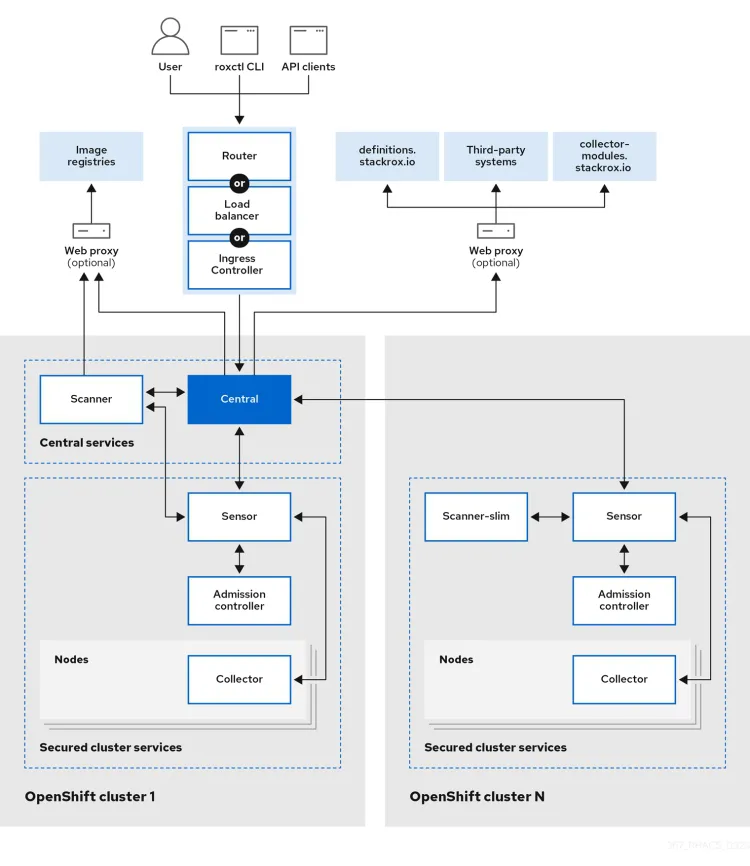
RHACS uses a centralized architecture designed for enterprise-scale Kubernetes deployments. Its main component is the Central service, which acts as the control plane for security policies, vulnerability data, alerts, and reporting.
Sensors are deployed within each Kubernetes or OpenShift cluster. These sensors monitor cluster activity, deployments, network traffic, and runtime behavior. Collectors, running on each node, gather low-level runtime data such as system calls and process execution.
This architecture allows organizations to manage security centrally while maintaining deep, granular visibility into each individual cluster. Policies are defined once and enforced consistently, reducing configuration drift and human error.
DO430 explains how to design RHACS deployments for high availability, scalability, and resilience. Learners understand how data flows between components and how to troubleshoot issues in complex multi-cluster environments.
A strong understanding of RHACS architecture is essential for deploying it securely and effectively in production.
7. Installing RHACS
Installing RHACS correctly is critical to its effectiveness. DO430 walks learners through supported installation methods and best practices for secure deployment.
The course covers certificate management, authentication, authorization, and role-based access control. Participants learn how to restrict access to sensitive security data while enabling collaboration across teams.
Troubleshooting is also emphasized. Learners identify and resolve common installation issues related to networking, permissions, and cluster compatibility.
By understanding installation deeply, participants ensure RHACS operates reliably and securely in enterprise environments.
8. Vulnerability Management
Vulnerability management is a cornerstone of Kubernetes security. DO430 teaches how RHACS scans container images for known vulnerabilities and correlates them with deployment risk.
Learners analyze CVEs, assess severity, and prioritize remediation based on real-world impact rather than raw vulnerability counts. This risk-based approach helps teams focus on what truly matters.
By integrating scanning into CI/CD pipelines, RHACS prevents vulnerable images from reaching production, enabling proactive security rather than reactive patching.
9. Policy Management & DevSecOps
Policies define what is allowed and what is blocked in a Kubernetes environment. DO430 teaches how to create, customize, and enforce security policies across the application lifecycle.
These policies can prevent insecure configurations, enforce best practices, and trigger alerts or blocking actions automatically. Integration with CI/CD pipelines ensures security becomes part of the development process.
This approach enables true DevSecOps, where security is automated, consistent, and aligned with business objectives.
10. Network Segmentation & Zero Trust
Network segmentation reduces attack surfaces by limiting communication between services. DO430 uses RHACS Network Graph to visualize and control traffic flows within clusters.
Learners generate network policies based on actual communication patterns, enforcing Zero Trust principles without disrupting applications.
11. Runtime Threat Detection
Runtime security focuses on detecting malicious behavior while applications are running. DO430 teaches how RHACS monitors system calls, processes, and network activity in real time.
When threats are detected, alerts are generated, enabling rapid incident response and containment.
12. Compliance & Governance
RHACS includes built-in compliance standards aligned with industry benchmarks. DO430 teaches how to run scans, interpret results, and generate audit-ready reports.
Continuous compliance ensures security and regulatory requirements are met at all times.
13. Hands-On Labs & Practical Skills
DO430 is highly hands-on. Learners work in real Kubernetes environments, simulating attacks, misconfigurations, and remediation.
This practical focus ensures skills are immediately applicable in production.
14. Enterprise Use Cases
Enterprises use RHACS to secure multi-cluster environments, protect CI/CD pipelines, and meet compliance requirements without slowing innovation.
DO430 aligns security with business outcomes.
15. Career Scope After DO430
DO430 opens doors to roles such as Kubernetes Security Engineer, DevSecOps Engineer, and Cloud Security Engineer.
Demand for these skills continues to grow globally.
16. Why DO430 is a High-Value Skill
Few professionals combine Kubernetes, security, and DevSecOps expertise. DO430 delivers all three.
This makes it a powerful career differentiator.
17. Conclusion
DO430 is a future-proof, enterprise-grade Kubernetes security course. It equips professionals to secure modern cloud-native platforms effectively and confidently.
For serious Kubernetes security, DO430 is essential.
To take this further with guided labs and an instructor, see our DO430 RHACS training course.
Related reading
- Openshift vs. Kubernetes | Which is right for you?
- Become a Red Hat Certified Specialist in OpenShift Administration - EX280 Training & Certification
- OpenShift DO280 | EX280 Certification Cost in India [2026 Updated] | Fees, Training, Salary & Voucher Details
Reference
For the authoritative details, see Red Hat Training and Certification.
Frequently Asked Questions
What's Your Reaction?
 Like
0
Like
0
 Dislike
0
Dislike
0
 Love
0
Love
0
 Funny
0
Funny
0
 Wow
0
Wow
0
 Sad
0
Sad
0
 Angry
0
Angry
0

With a passion for staying on the cutting edge of technology trends, I am dedicated to delivering content that not only informs but also inspires. Whether you need in-depth analysis pieces, informative guides, or thought-provoking opinion pieces, I craft content that resonates with tech enthusiasts and professionals alike.