
Red Hat Certified Specialist in OpenShift Networking (EX282): Complete Certification Guide for 2026
Learn everything about the Red Hat Certified Specialist in OpenShift Networking EX282 in 2026, including exam objectives, prerequisites, topics, preparation, and tips.
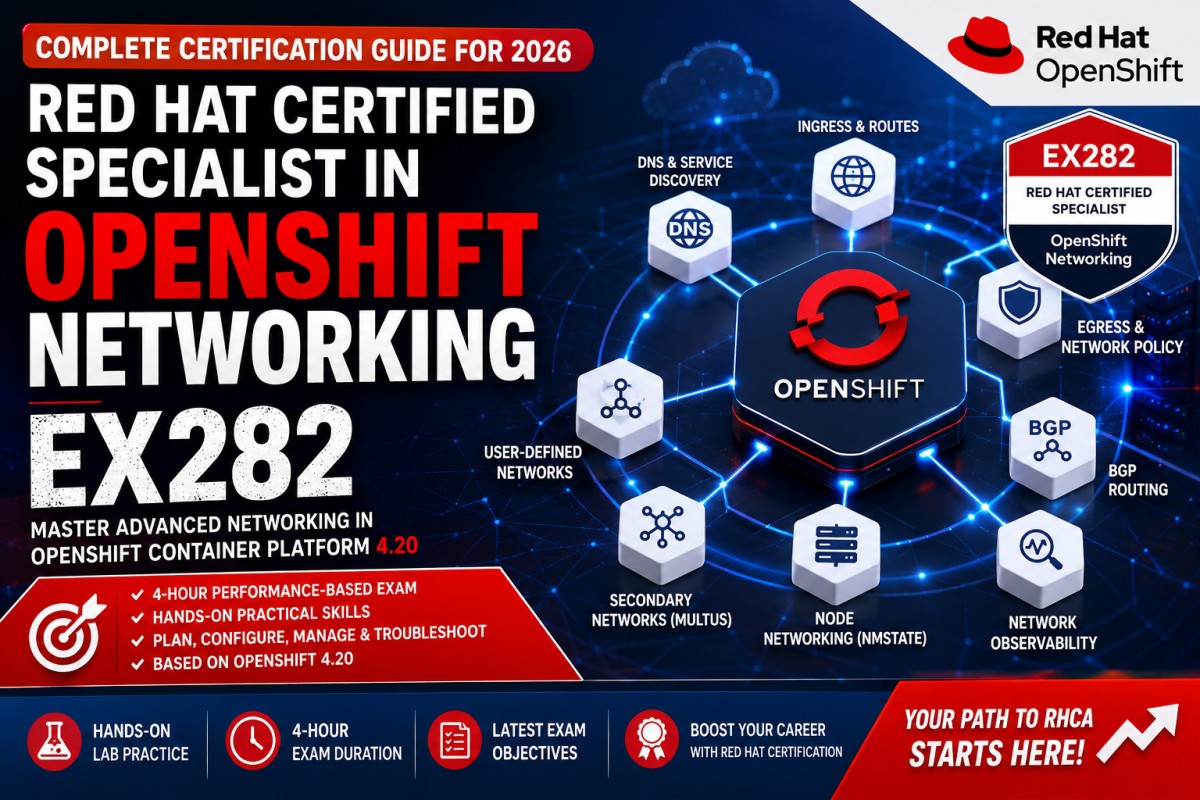
This complete EX282 certification guide explains the exam prerequisites, key objectives, networking technologies you should understand, preparation strategy, hands-on skills, and practical tips for approaching the exam. It is intended for network engineers, OpenShift administrators, SREs, infrastructure architects, and DevOps professionals who work with enterprise Kubernetes networking.The Red Hat Certified Specialist in OpenShift Networking (EX282) is a performance-based certification exam designed for professionals who need practical skills to plan, configure, manage, and troubleshoot networking in Red Hat OpenShift Container Platform. For 2026, Red Hat states that EX282 is based on OpenShift Container Platform 4.20.
What Is the Red Hat Certified Specialist in OpenShift Networking EX282?
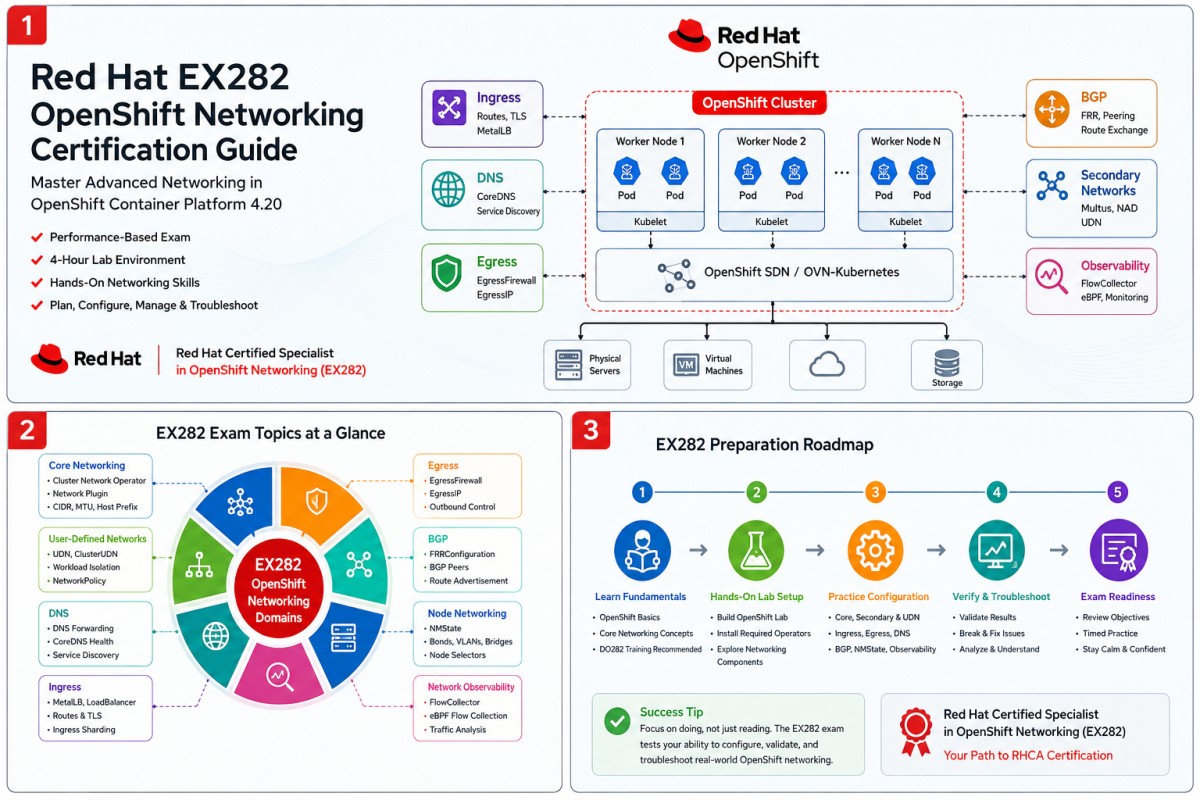
EX282 is the Red Hat Certified Specialist in OpenShift Networking exam. It validates your ability to work with networking components in a Red Hat OpenShift Container Platform environment rather than simply testing theoretical networking knowledge.The certification focuses on practical administration and implementation. Candidates are expected to perform tasks involving core OpenShift networking, secondary networks, user-defined networks, DNS, ingress, egress, BGP routing, node networking, and network observability.
Passing the exam earns the Red Hat Certified Specialist in OpenShift Networking credential and can also contribute toward the Red Hat Certified Architect (RHCA) certification path.
Who Should Take the EX282 Certification?
- Cluster network engineers: Professionals responsible for designing, implementing, and maintaining OpenShift networking infrastructure.
- OpenShift platform administrators: Administrators managing network isolation, ingress, egress, and multi-tenant environments.
- Site reliability engineers: Engineers who troubleshoot connectivity problems and implement network observability.
- Infrastructure architects: Architects working with advanced networking, secondary networks, BGP, and node configuration.
- DevOps engineers: Engineers who expose applications using routes, load balancers, and ingress controller configurations.
Because EX282 is performance-based, practical experience is especially important. Candidates should be comfortable using OpenShift command-line tools and investigating real networking problems instead of relying only on memorized definitions.
EX282 Prerequisites
Red Hat recommends Configuring and Managing Red Hat OpenShift Networking (DO282) or equivalent practical experience as preparation for EX282.The prerequisite should be viewed as a skills recommendation rather than a substitute for hands-on practice. If you already administer OpenShift networking in production or a realistic laboratory environment, your experience can help bridge the gap. If your OpenShift networking experience is limited, completing the relevant training and labs can provide a more structured preparation path.
EX282 Exam Format in 2026
The EX282 exam consists of a single four-hour section. It is a performance-based examination, meaning candidates must configure and implement networking components and demonstrate that their work meets the required objectives.This format makes EX282 different from a traditional multiple-choice certification exam. Preparation should therefore focus on performing tasks repeatedly in an OpenShift environment rather than simply reading documentation or watching training videos.
Red Hat also states that internet access is not provided during the exam and candidates cannot bring hard-copy or electronic documentation into the examination environment. Product documentation that is provided with the product may be available during the exam.
EX282 Exam Objectives and Topics
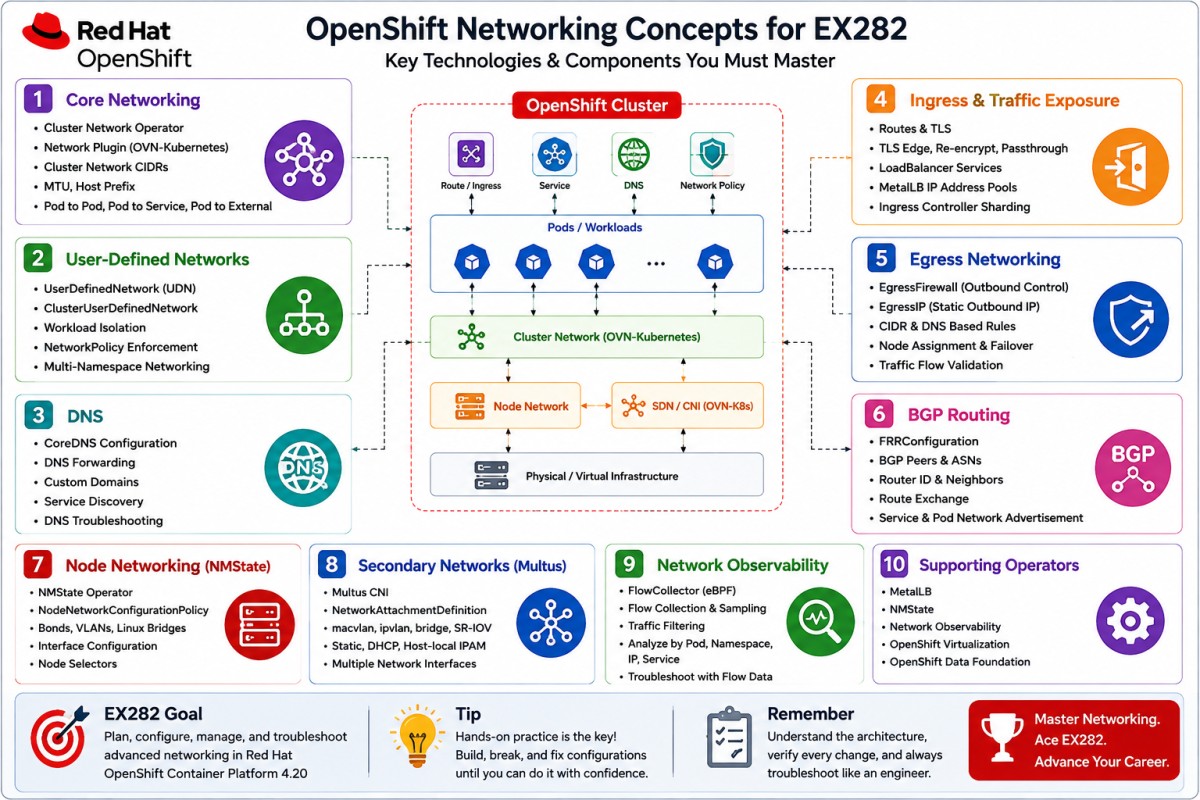
The current EX282 objectives cover several major areas of OpenShift networking. Understanding the purpose of each area and practicing its configuration is a strong foundation for exam preparation.| EX282 Topic | Key Skills to Understand |
|---|---|
| Core networking | Cluster Network Operator, network plugin settings, CIDRs, MTU, host prefix, Multus and secondary networks |
| User-defined networks | UDN, ClusterUserDefinedNetwork, workload isolation and NetworkPolicy |
| DNS | DNS forwarding, CoreDNS health, service discovery and troubleshooting |
| Ingress | MetalLB, LoadBalancer services, TLS routes and ingress controller sharding |
| Egress | EgressFirewall, EgressIP, outbound rules and node assignment |
| BGP | FRRConfiguration, BGP neighbors, ASNs, route exchange and advertisements |
| Node networking | NMState, bonds, VLANs, Linux bridges and node selectors |
| Network observability | FlowCollector, eBPF flow collection, filtering and traffic analysis |
1. Master Core OpenShift Networking
Start your preparation with the fundamentals of OpenShift networking. You should know how to inspect the Cluster Network Operator configuration and identify important settings such as network CIDRs, MTU, host prefix, and the active network plugin.You should also become comfortable with Multus CNI and NetworkAttachmentDefinition resources. EX282 preparation should include creating and validating additional network interfaces and understanding when a workload needs connectivity through a secondary network.
Practice different secondary network configurations, including macvlan, ipvlan, and bridge CNI plugins. Also understand IP address management options such as static addressing, host-local addressing, and DHCP.
2. Understand User-Defined Networks and Network Isolation
User-defined networking is an important part of the current EX282 objectives. You should understand how to create namespace-scoped UserDefinedNetwork resources as well as ClusterUserDefinedNetwork resources that can span multiple namespaces.Hands-on practice should include deploying workloads on user-defined networks, checking connectivity, and verifying isolation from the default cluster network. You should also understand how NetworkPolicy resources can be applied to control traffic.
Do not stop at successful configuration. Practice troubleshooting failed connectivity and isolation scenarios because performance-based exams reward the ability to diagnose and correct configuration problems.
3. Prepare for OpenShift DNS Tasks
DNS is another important EX282 subject. You should know how OpenShift DNS supports internal service discovery and how to troubleshoot name-resolution failures.Practice configuring DNS forwarding for custom domains and verifying the health and configuration of CoreDNS pods. From inside a pod, practice resolving Kubernetes service names using the familiar service naming structure, including names such as service.namespace.svc.cluster.local.
A useful troubleshooting approach is to determine whether the problem exists at the application, pod, service, DNS, or external-network level. This helps prevent you from changing networking configuration unnecessarily.
4. Learn Ingress, Routes, TLS, and Load Balancers
Application ingress is a major OpenShift networking skill. For EX282, candidates should understand how applications can be exposed through OpenShift routes and LoadBalancer services.Pay particular attention to TLS termination methods. You should understand the differences between edge termination, re-encryption, and passthrough, including how traffic is handled between the client, router, and application.
The current objectives also include MetalLB LoadBalancer services with IP address pools and ingress controller sharding using route selectors and labels. Practice these configurations until you can implement and verify them without relying heavily on step-by-step instructions.
5. Study OpenShift Egress Networking
Egress controls outbound traffic from workloads and namespaces. EX282 preparation should include both traffic filtering and source-IP management.
Learn how to create EgressFirewall resources and configure allow or deny rules using CIDR ranges and DNS names. You should also understand EgressIP resources and how static source IP addresses can be assigned to namespaces.
Practice identifying appropriate nodes for EgressIP assignment and understand how node labels support failover. The goal is not merely to know the resource names but to understand the traffic path and verify the resulting behavior.
6. Build Practical BGP Knowledge
BGP is one of the advanced networking areas included in the EX282 objectives. Candidates should be prepared to configure native BGP routing using FRRConfiguration resources.
Your practice should include defining BGP peers, autonomous system numbers, router IDs, and neighbor relationships. You should also verify whether BGP sessions are established and whether the expected routes are being exchanged.
Another important skill is understanding route advertisement. Practice scenarios involving service and pod network prefixes being advertised to external BGP peers.
7. Learn Node Networking with NMState
Node networking extends beyond Kubernetes resources. EX282 includes tasks involving the Kubernetes NMState operator and NodeNetworkConfigurationPolicy resources.
Practice configuring node interfaces, bonded interfaces, VLAN sub-interfaces, and Linux bridges. You should also understand how node selectors determine where a network configuration is applied.
For environments involving virtual machines, learn how NMState-managed bridges can be referenced through NetworkAttachmentDefinitions to connect virtual machines to external provider networks.
8. Practice Network Observability
Network observability is another current EX282 objective. Candidates should understand how network flow information can be collected and analyzed.
Practice configuring FlowCollector resources and become familiar with eBPF-based network flow collection. Pay attention to parameters such as sampling, cache size, enabled features, and resource limits.
You should also practice filtering and analyzing flows by namespace, pod, service, or IP address. The objective is to turn flow data into useful troubleshooting information rather than simply collecting telemetry.
What Operators Are Available During EX282?
Red Hat states that candidates receive a cluster with several operators and their dependencies preinstalled. The listed components include Red Hat OpenShift Virtualization, Red Hat OpenShift Data Foundation, Kubernetes NMState, Loki, MetalLB, and Network Observability.
This is useful preparation information because it indicates that candidates should understand how the networking-related components interact with an OpenShift environment. However, you should always verify the current official objectives before taking the exam because Red Hat reserves the right to modify exam objectives and announces changes in advance.
How to Prepare for the EX282 Exam
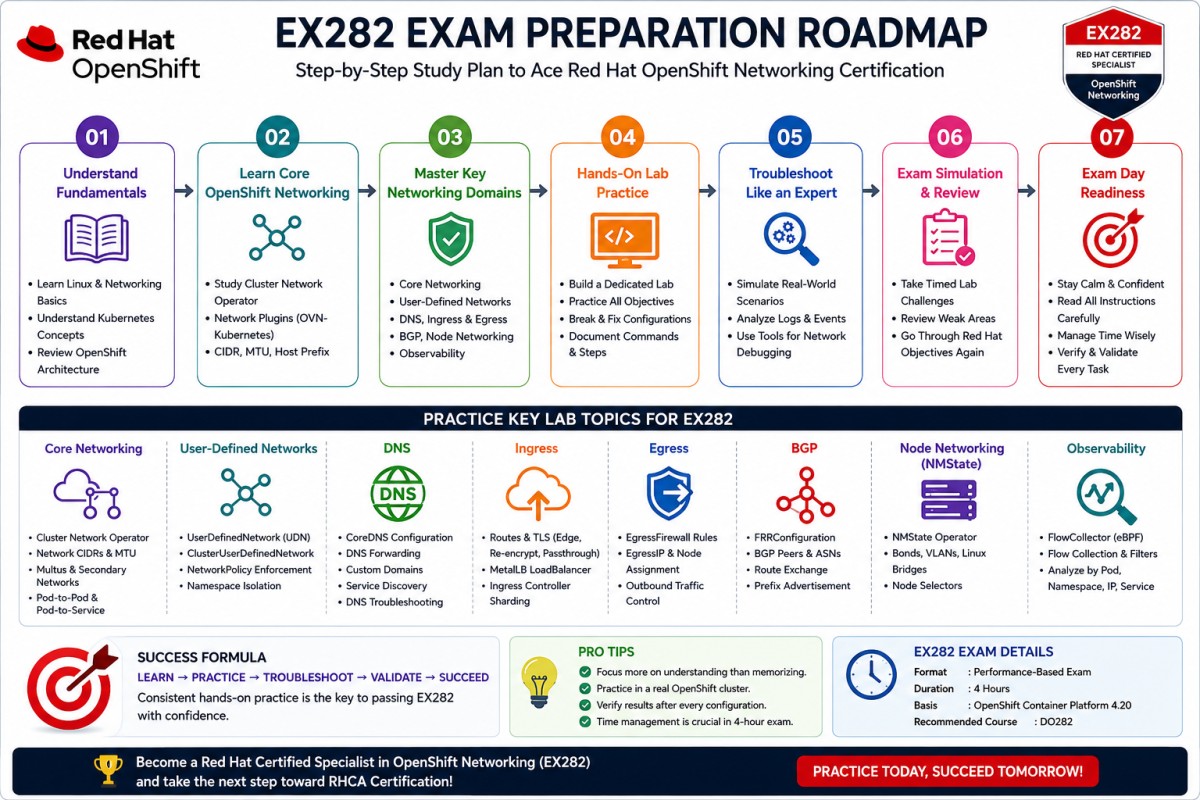
Step 1: Learn OpenShift Networking Fundamentals
Make sure you understand pods, services, routes, network policies, DNS, ingress, egress, CNI concepts, and basic OpenShift administration before moving into advanced networking.
Step 2: Follow DO282 or Equivalent Training
If you do not already have strong OpenShift networking experience, use Red Hat's Configuring and Managing Red Hat OpenShift Networking course as a structured learning path.
Step 3: Build a Hands-On Lab
Spend substantial time working directly with an OpenShift cluster. Create resources, modify them, break configurations intentionally, and troubleshoot the resulting problems.
Step 4: Practice Without Copying Instructions
After completing guided labs, repeat the same tasks from memory. The objective is to develop operational fluency rather than memorizing commands.
Step 5: Practice Troubleshooting
Create realistic failures involving DNS, network policies, routes, secondary interfaces, egress, BGP, or node networking. Then diagnose them systematically.
Step 6: Use the Official Objectives as Your Checklist
Before the exam, compare your skills against every published objective. If you cannot confidently perform an objective in a lab, treat it as a study gap.
EX282 Preparation Checklist
- Understand OpenShift core networking.
- Inspect Cluster Network Operator configuration.
- Understand CIDR, MTU, and host-prefix settings.
- Configure Multus and NetworkAttachmentDefinition resources.
- Practice macvlan, ipvlan, and bridge secondary networks.
- Understand static, host-local, and DHCP IP address management.
- Create and troubleshoot UserDefinedNetwork resources.
- Understand ClusterUserDefinedNetwork resources.
- Apply and troubleshoot NetworkPolicy resources.
- Configure and troubleshoot OpenShift DNS.
- Understand TLS route termination methods.
- Practice MetalLB LoadBalancer services.
- Configure ingress controller sharding.
- Configure EgressFirewall and EgressIP.
- Understand native BGP configuration and route exchange.
- Practice NMState node networking.
- Configure bonds, VLANs, and Linux bridges.
- Understand network observability and FlowCollector.
- Practice eBPF-based flow troubleshooting.
- Complete timed hands-on practice sessions.
Common EX282 Preparation Mistakes
Relying Only on Theory
Reading about OpenShift networking is useful, but it cannot replace hands-on configuration. EX282 evaluates practical performance, so your preparation should reflect that.
Memorizing Commands Without Understanding Resources
Memorizing individual commands is less useful than understanding what each resource does, how resources interact, and how to verify whether a configuration works.
Ignoring Troubleshooting
A working configuration is only part of real-world network administration. Practice investigating incorrect routes, failed DNS resolution, blocked traffic, missing interfaces, and unsuccessful BGP sessions.
Studying an Outdated Exam Version
OpenShift evolves, and certification objectives can change. Always check the current Red Hat exam page and published objectives shortly before your exam rather than relying on an old study guide.
Is EX282 Difficult?
The difficulty of EX282 depends heavily on your practical OpenShift networking experience. Professionals who regularly configure networking, troubleshoot Kubernetes connectivity, and work with enterprise infrastructure will generally have a stronger foundation than candidates who have only studied the concepts.
The four-hour performance-based format also means that speed and troubleshooting discipline matter. A good preparation strategy is therefore to combine technical knowledge with repeated timed practice.
EX282 vs. Traditional Multiple-Choice Certification Exams
One of the most important things to understand about EX282 is that it is not primarily a memorization test. Instead, candidates must perform practical tasks in an OpenShift environment.
| Area | EX282 Approach |
|---|---|
| Knowledge | Understand OpenShift networking concepts and resources |
| Configuration | Implement networking features in a live environment |
| Troubleshooting | Identify and resolve networking problems |
| Verification | Confirm that configurations produce the expected behavior |
| Time management | Complete multiple practical tasks within the four-hour session |
Final EX282 Study Strategy for 2026
The best approach to the Red Hat Certified Specialist in OpenShift Networking exam is to study by capability rather than by isolated commands. Begin with core OpenShift networking, then progressively work through secondary networks, user-defined networks, DNS, ingress, egress, BGP, NMState, and observability.
For every topic, use the same learning cycle: understand the architecture, configure the resource, verify the result, intentionally introduce a problem, and troubleshoot it. This approach closely matches the practical nature of the certification.
Most importantly, use the official Red Hat objectives as your final checklist. The current Red Hat page identifies OpenShift Container Platform 4.20 as the exam basis and provides the detailed skills candidates are expected to perform. Because Red Hat may update objectives, confirm the official requirements before scheduling your exam.
Frequently Asked Questions About EX282
What is Red Hat EX282?
EX282 is the Red Hat Certified Specialist in OpenShift Networking exam. It tests practical skills for planning, deploying, managing, and troubleshooting OpenShift networking components.
What version of OpenShift is EX282 based on in 2026?
According to the current Red Hat certification page, EX282 is based on Red Hat OpenShift Container Platform 4.20.
How long is the EX282 exam?
The exam consists of one four-hour section.
Is EX282 a performance-based exam?
Yes. EX282 is a performance-based evaluation in which candidates perform practical networking tasks in an OpenShift environment.
What is the recommended prerequisite for EX282?
Red Hat recommends Configuring and Managing Red Hat OpenShift Networking (DO282) or equivalent experience.
What topics are covered in EX282?
Major areas include core networking, secondary networks, user-defined networks, DNS, ingress, egress, native BGP routing, NMState node networking, and network observability.
Does EX282 include BGP?
Yes. The current objectives include native BGP routing, including FRRConfiguration, BGP neighbors, ASNs, router IDs, session verification, route exchange, and network prefix advertisement.
Does EX282 cover Multus?
Yes. The objectives include configuring additional network interfaces using Multus CNI and NetworkAttachmentDefinition resources, along with secondary networks using several CNI plugins.
Does passing EX282 contribute toward RHCA?
Red Hat states that the Red Hat Certified Specialist in OpenShift Networking credential also counts toward earning Red Hat Certified Architect (RHCA).
What is the best way to prepare for EX282?
Combine the official objectives with structured training and extensive hands-on OpenShift networking practice. Focus on configuration, verification, and troubleshooting instead of relying solely on theory or memorization.
Conclusion
The Red Hat Certified Specialist in OpenShift Networking (EX282) is a practical certification for professionals who need advanced networking skills in OpenShift. Its 2026 objectives cover a broad set of capabilities, from core networking and Multus to user-defined networks, DNS, ingress, egress, BGP, NMState, and network observability.
If you are preparing for EX282, prioritize hands-on work. Build an OpenShift lab, practice each official objective, troubleshoot intentionally broken configurations, and use timed exercises to improve your execution speed. Most importantly, verify the latest objectives on Red Hat's official certification page before taking the exam because certification requirements can change.
What's Your Reaction?
 Like
0
Like
0
 Dislike
0
Dislike
0
 Love
0
Love
0
 Funny
0
Funny
0
 Wow
0
Wow
0
 Sad
0
Sad
0
 Angry
0
Angry
0

With a passion for staying on the cutting edge of technology trends, I am dedicated to delivering content that not only informs but also inspires. Whether you need in-depth analysis pieces, informative guides, or thought-provoking opinion pieces, I craft content that resonates with tech enthusiasts and professionals alike.


![Top 50+ Must-Know Linux Commands for Beginners [2026 Updated Cheat Sheet]](https://webasha-blog.s3.ap-south-1.amazonaws.com/uploads/images/202506/image_750x415_6856662f4638c.webp)










![Top 10 Famous Ethical Hackers in India [Updated 2026]](https://www.webasha.com/blog/uploads/images/202608/image_140x98_da23f65c290cfbf1237d77aec58a2f0f.jpg)