Best DevOps Engineer Course in Pune: Training, Fees, Syllabus, Certification & Career Guide
A practical guide to choosing the best DevOps engineer course in Pune - what a strong course must cover, the full toolchain from Linux to Kubernetes and Terraform, realistic salaries, and how WebAsha's DevOps Master Program is structured.
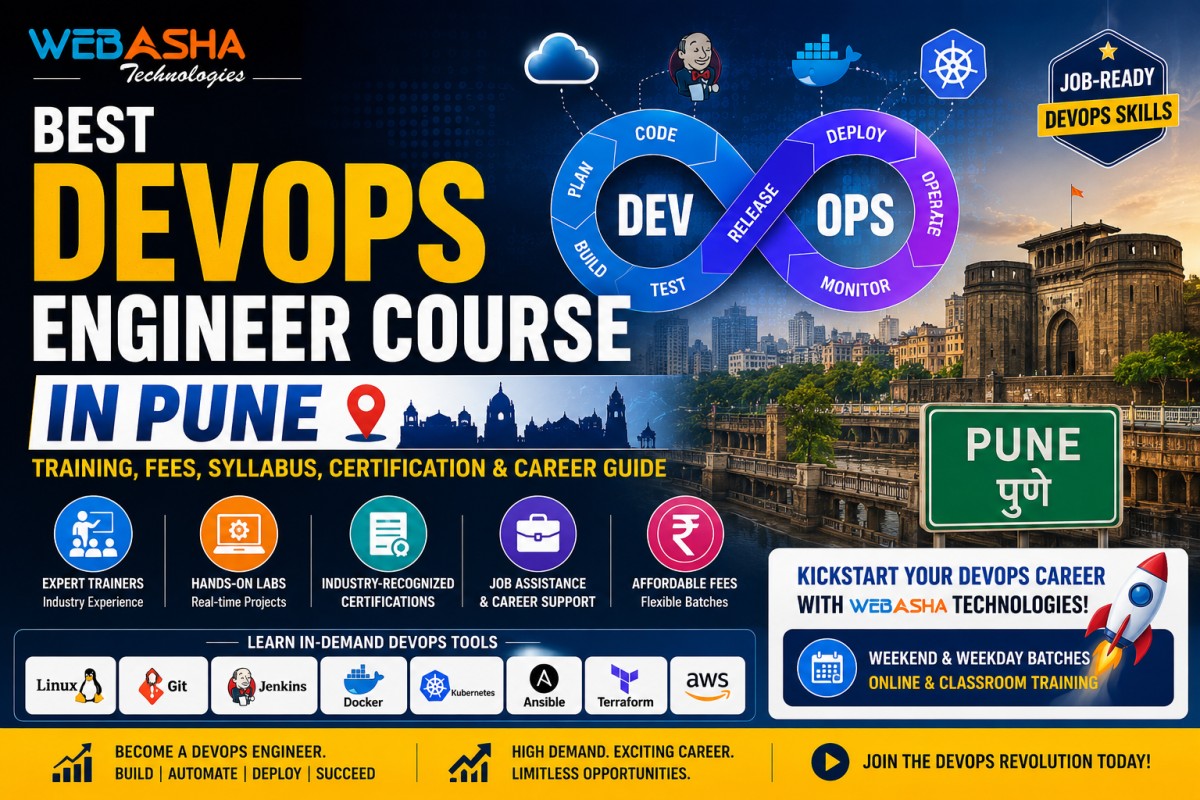
If you are comparing DevOps courses in Pune, the honest answer is that the "best" course is the one that makes you employable: deep hands-on labs across the full toolchain, real projects you can defend in an interview, instructors who work with these tools, and structured career support. This guide gives you an objective checklist for judging any institute, a tool-by-tool syllabus of what a serious DevOps program must cover, verified details of the WebAsha Technologies DevOps Master Program in Pune, realistic salary data with sources, and a step-by-step career roadmap - so you can make an informed decision rather than a rushed one.
Table of Contents
- What Is a DevOps Engineer?
- Why Learn DevOps in Pune?
- How to Choose the Best DevOps Training Institute in Pune
- What Is the Best DevOps Engineer Course in Pune?
- Why Choose WebAsha Technologies?
- DevOps Course Syllabus and Tools
- The DevOps Lifecycle: Where Each Tool Fits
- Hands-On Projects and Labs
- DevOps Certification Path
- Eligibility: Who Can Join?
- Course Duration and Fees
- DevOps Career Opportunities and Job Roles
- DevOps Engineer Salary in Pune
- DevOps Career Roadmap
- WebAsha vs Self-Learning vs Generic Online Courses
- How to Enroll
What Is a DevOps Engineer?
A DevOps engineer automates how software is built, tested, released and operated. Instead of developers writing code and a separate operations team deploying it manually, a DevOps engineer builds pipelines and infrastructure that take code from a Git commit to a running, monitored production system with minimal human intervention.
In practice, the role combines four skill areas:
- Systems: Linux administration and shell scripting - the foundation everything else runs on
- Automation: CI/CD pipelines (Jenkins), configuration management (Ansible) and infrastructure as code (Terraform)
- Containers and orchestration: Docker for packaging applications, Kubernetes for running them at scale
- Cloud and observability: AWS or Azure for infrastructure, Prometheus and Grafana for monitoring what is actually happening
That breadth is exactly why a structured course matters: each tool is learnable alone, but employers hire people who can connect them into one working delivery pipeline.
Why Learn DevOps in Pune?
Pune is one of India's strongest markets for DevOps roles. The city combines large IT services companies, global capability centres, product startups and a substantial automotive and manufacturing IT sector - all of which run cloud infrastructure that someone has to automate and operate. Industry salary data consistently places Pune among the top-paying Indian cities for DevOps engineers, alongside Bangalore and Hyderabad. For learners, that means local classroom options, a dense hiring market for freshers and switchers, and meetups and communities where the tools you study are used in production every day.
How to Choose the Best DevOps Training Institute in Pune
Before looking at any single institute, judge every option - including WebAsha - against the same objective checklist:
- ✓ Hands-on labs, not slide decks - you should be typing commands in week one
- ✓ Full toolchain coverage - Linux through Git, Jenkins, Docker, Kubernetes, Ansible, Terraform and monitoring, not just two or three tools
- ✓ Cloud exposure - real AWS or Azure work, because that is where DevOps runs in 2026
- ✓ Real projects - end-to-end pipelines you can demonstrate in interviews
- ✓ Instructors who practise - ask who teaches and what they have built
- ✓ Certification preparation - alignment with recognised industry certifications
- ✓ Career support - resume help, mock interviews, referrals
- ✓ Transparent fees and flexible batches - weekday, weekend and online options with clear pricing
If an institute cannot answer these questions directly, that is your answer.
What Is the Best DevOps Engineer Course in Pune?
The best DevOps course in Pune is one that teaches the complete toolchain hands-on - Linux, Git, Jenkins, Docker, Kubernetes, Ansible, Terraform, monitoring and cloud - through real projects, with instructor support and structured career assistance. WebAsha Technologies' DevOps Master Program is built on exactly this model: a job-oriented, lab-driven program available in classroom and online formats in Pune.
Rather than asking you to take that on faith, the rest of this guide lays out the verified syllabus, formats, certification alignment and career support so you can evaluate it against the checklist above - and against any other institute you are considering.
Talk to a DevOps training advisor at WebAsha for the latest batch dates and fees, or browse the DevOps Master Program syllabus.
Why Choose WebAsha Technologies for DevOps Training in Pune?
Based on the current, published details of the DevOps Master Program:
- Complete toolchain in one program: Linux and shell scripting, Git and GitHub, Jenkins CI/CD, Docker, Kubernetes, Ansible, Terraform, Prometheus and Grafana, and AWS/Azure cloud modules
- Lab-first methodology: hands-on exercises throughout, with cloud lab access around the clock so you can practise outside class hours
- Real projects: the program includes real-time projects that mirror production delivery pipelines
- Flexible formats: weekday, weekend and fast-track batches; classroom in Pune or live online, including evening sessions
- Certification-oriented: the curriculum prepares you for recognised certifications such as CKA (Certified Kubernetes Administrator), HashiCorp Terraform Associate and Docker DCA, alongside WebAsha's own program certificate
- Career support: resume building, mock interviews and job referrals through WebAsha's hiring network
WebAsha also runs adjacent programs that stack naturally with DevOps - RHCSA Linux training for the systems foundation, a dedicated Git and GitHub course, and specialised AWS DevOps and Azure DevOps tracks for cloud-specific depth.
DevOps Course Syllabus and Tools
A serious DevOps syllabus maps tools to the skills employers test for. This is the module structure of the WebAsha program:
| Module | Topics Covered | Practical Skill You Gain |
|---|---|---|
| Linux & Shell Scripting | Administration, users, permissions, processes, bash scripting | Operate and automate the systems everything runs on |
| Git & GitHub | Version control, branching, merging, pull requests | Collaborate on code the way real teams do |
| Jenkins | CI/CD pipelines, jobs, integrations | Automate build, test and deployment |
| Docker | Images, containers, registries, Dockerfiles | Package applications to run anywhere |
| Kubernetes | Pods, deployments, services, scaling | Run containerised applications in production |
| Ansible | Playbooks, roles, inventory | Configure fleets of servers repeatably |
| Terraform | Infrastructure as code, providers, state | Provision cloud infrastructure from code |
| Prometheus & Grafana | Metrics, alerting, dashboards | See and measure what production is doing |
| AWS / Azure | Core cloud services for DevOps workflows | Deploy real pipelines on real cloud |
The DevOps Lifecycle: Where Each Tool Fits
DevOps is usually drawn as a loop: Plan → Code → Build → Test → Release → Deploy → Operate → Monitor - and back to Plan. The tools you study each own a stage:
- Code: Git and GitHub hold the source and the history
- Build & Test: Jenkins runs the pipeline on every commit
- Release & Deploy: Docker packages the application; Kubernetes runs it; Ansible and Terraform prepare the infrastructure it lands on
- Operate & Monitor: Prometheus collects metrics, Grafana makes them visible, and what you learn feeds the next planning cycle
Understanding the loop matters more than memorising any one tool - interviewers probe whether you can connect the stages.
Hands-On Projects and Labs
Reading about pipelines does not create job skills; building them does. In the WebAsha program you work through exercises such as building a Jenkins CI/CD pipeline end-to-end, containerising an application with Docker, deploying it on Kubernetes, provisioning infrastructure with Terraform, automating configuration with Ansible, and wiring Prometheus and Grafana monitoring over the top - with cloud lab access available round the clock for practice between sessions. These are the projects you will be asked about in interviews, so treat them as portfolio pieces, not homework.
Talk to a DevOps training advisor at WebAsha for the latest batch dates and fees, or browse the DevOps Master Program syllabus.
DevOps Certification Path
Certifications do not replace skills, but they get resumes past filters. The program's curriculum aligns with the certifications employers actually recognise:
- CKA - Certified Kubernetes Administrator (Cloud Native Computing Foundation): the strongest signal for Kubernetes skills
- HashiCorp Terraform Associate: validates infrastructure-as-code fundamentals
- Docker DCA: container fundamentals
- Cloud certifications (AWS/Azure): pair well with the cloud modules
- WebAsha DevOps Master Program certificate on completion
A sensible order for most learners: program certificate first, then Terraform Associate, then CKA once you have real Kubernetes practice behind you.
Eligibility: Who Can Join a DevOps Course?
There is no mandatory prerequisite for joining - the program starts from Linux foundations. It is designed for freshers, B.Tech/B.E. and other graduates, developers, system administrators, QA professionals, cloud engineers and working professionals switching tracks.
Recommended (not mandatory) background: basic computer literacy and comfort with learning command-line tools. Prior Linux exposure helps you move faster - if you want to build that base first, WebAsha's RHCSA Linux course is the natural on-ramp - but the DevOps program itself begins with Linux and shell scripting precisely so beginners are not left behind.
How Long Is the Course, and What Does It Cost?
The DevOps Master Program runs approximately 40 hours of instruction, typically completed in 6-12 weeks depending on the track you choose: weekday, weekend or fast-track, in classroom (Pune) or live online formats, with evening batches available for working professionals.
Fees: pricing varies by batch, mode and current offers, and EMI options are available - so rather than quote a figure that may be outdated by the time you read this, request the latest fee from WebAsha directly. Any institute quoting one fixed price for every format is simplifying; always confirm what your specific batch includes (labs, projects, certification preparation, career support).
DevOps Career Opportunities and Job Roles
DevOps skills open several adjacent roles, not one job title:
- DevOps Engineer - builds and owns delivery pipelines
- Cloud DevOps Engineer - the same, specialised on AWS or Azure
- Site Reliability Engineer (SRE) - reliability, monitoring and incident response focus
- Platform Engineer - builds internal platforms other developers use
- Build/Release Engineer - pipeline and release specialist
- Automation Engineer - Ansible/Terraform-centred automation work
No honest institute guarantees employment - what training changes is whether you can pass the technical rounds. Once you are interview-ready, work through these top 50 DevOps interview questions and answers to pressure-test yourself.
What Is a DevOps Engineer's Salary in Pune?
As of 2026, salary aggregator Cutshort reports an average of around ₹16 lakh per year for DevOps engineers in Pune, with reported figures ranging from roughly ₹9.7 lakh to ₹26 lakh; entry-level DevOps roles across India are commonly reported in the ₹4-9 lakh band (upGrad, 2026). Pune ranks among the top-paying Indian cities for the role alongside Bangalore and Hyderabad.
Treat these as indicative, not promised. Actual pay varies with experience, company type, cloud depth, certifications and negotiation - and aggregator samples skew toward larger companies. Check current figures on Glassdoor or Cutshort for your experience band before setting expectations.
DevOps Career Roadmap: From Zero to DevOps Engineer
Follow the stages in order - each builds on the last:
- Linux - administration and the command line; everything else assumes this
- Networking basics - DNS, ports, HTTP; enough to debug connectivity
- Git - version control and collaborative workflows
- Shell scripting - automate the repetitive things first
- CI/CD with Jenkins - your first pipeline is the real milestone
- Docker - containerise an application you built
- Kubernetes - deploy that container properly
- Ansible - configuration management across multiple machines
- Terraform - recreate your infrastructure from code
- Cloud (AWS/Azure) - move the whole stack onto real cloud
- Monitoring - Prometheus and Grafana over everything you built
- Projects - combine all of it into one demonstrable pipeline
- Interview preparation - mock interviews, resume, the common question sets
Self-paced, this takes most people 6-12 months. A structured course compresses it by sequencing the stages for you and unblocking you when you get stuck - which is where most self-learners quit.
WebAsha vs Self-Learning vs Generic Online Courses
| Factor | WebAsha Instructor-Led | Self-Learning | Generic Recorded Course |
|---|---|---|---|
| Instructor support | Live, ask-anything | None - forums only | Rare or paid extra |
| Hands-on labs | Structured, cloud lab access | You build your own | Varies; often demos only |
| Real projects | Included, interview-ready | Depends on discipline | Usually toy examples |
| Certification preparation | CKA / Terraform / DCA aligned | Self-directed | Sometimes |
| Career support | Resume, mock interviews, referrals | None | None |
| Accountability | Batch schedule keeps you moving | Lowest - most quit mid-way | Low |
| Cost | Moderate - enquire for current fee | Lowest in money, highest in time | Low |
| Flexibility | Weekday / weekend / online / fast-track | Total | Total |
Self-learning genuinely works for disciplined people with time; recorded courses are fine for topping up one tool. Where instructor-led training earns its fee is the combination of sequencing, unblocking and career support - the three places self-learners most often stall.
How to Enroll
Three practical steps:
- Check the syllabus against your goals on the DevOps Master Program page
- Book a free counselling session to match a batch format (weekday/weekend/fast-track, classroom or online) to your schedule
- Confirm current fees and offers - including EMI options - directly with WebAsha
Whichever institute you choose, apply the checklist from this guide first. A DevOps course is an investment of months of your effort - the fee is the smaller part of what you are committing.
Talk to a DevOps training advisor at WebAsha for the latest batch dates and fees, or browse the DevOps Master Program syllabus.
Frequently Asked Questions about DevOps Courses in Pune
What's Your Reaction?
 Like
0
Like
0
 Dislike
0
Dislike
0
 Love
0
Love
0
 Funny
0
Funny
0
 Wow
0
Wow
0
 Sad
0
Sad
0
 Angry
0
Angry
0

With a passion for staying on the cutting edge of technology trends, I am dedicated to delivering content that not only informs but also inspires. Whether you need in-depth analysis pieces, informative guides, or thought-provoking opinion pieces, I craft content that resonates with tech enthusiasts and professionals alike.








![Top 10 Famous Ethical Hackers in India [Updated 2026]](https://www.webasha.com/blog/uploads/images/202608/image_140x98_da23f65c290cfbf1237d77aec58a2f0f.jpg)