OSCP Preparation Roadmap: Prerequisites, Labs and Practice Reports
Prepare for OSCP by checking networking, Windows/Linux and basic scripting skills first, then working through authorised practice with a repeatable method and clear reports. Use OffSec’s current PEN-200 materials and candidate instructions to define the assessment scope. Track what you can demonstrate instead of relying on a fixed study duration.
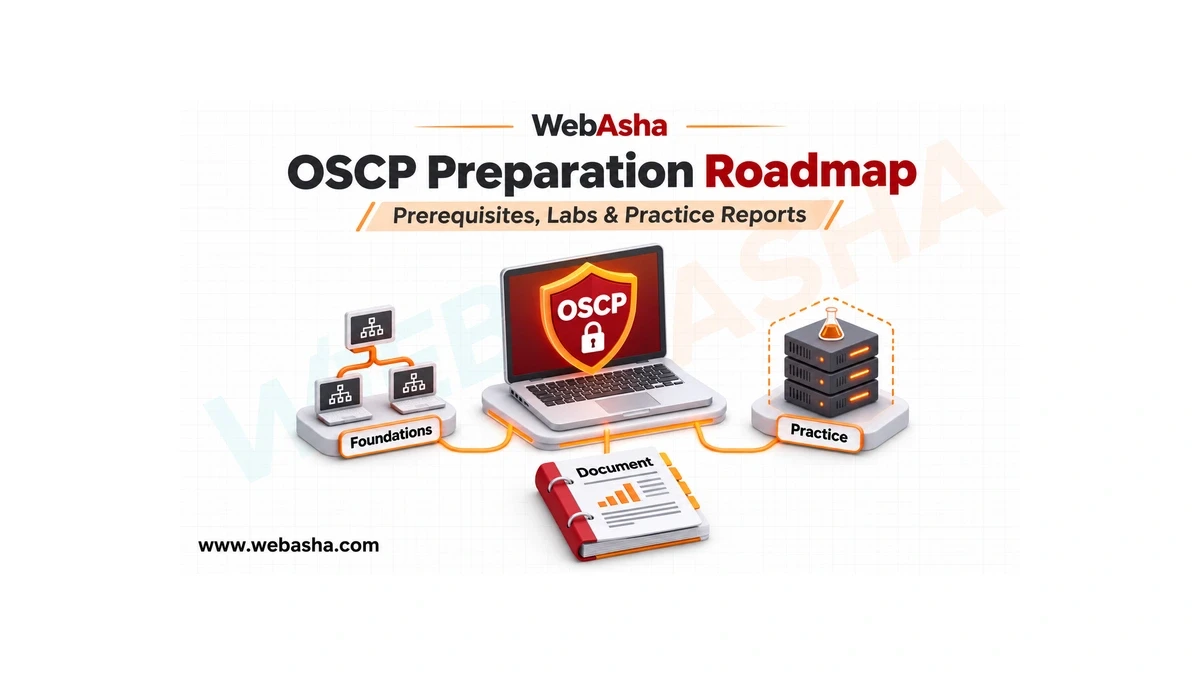
Prepare for OSCP by checking networking, Windows/Linux and basic scripting skills first, then working through authorised practice with a repeatable method and clear reports. Use OffSec’s current PEN-200 materials and candidate instructions to define the assessment scope. Track what you can demonstrate instead of relying on a fixed study duration.
This roadmap is an editorial study plan, not an official exam blueprint or a pass guarantee. OffSec’s current pages use OSCP+ for the examination and distinguish it from the OSCP credential; check the issuer’s terminology and requirements for your booking. [1]
Keep preparation and policy checks together
- Demonstrate foundation skills before expanding lab complexity.
- Record evidence as you practise.
- Rehearse reporting as well as technical work.
- Recheck exam rules and dated changes before booking.
Understand what PEN-200 and the exam represent
OffSec describes PEN-200 as its hands-on penetration-testing course for OSCP+ preparation. Treat the course as a learning resource and the examination as a separate assessment of performance under the issuer’s conditions. [1]
The exam guide checked on 17 November 2026 specifies a proctored practical examination with 23 hours and 45 minutes for the exam and a further 24 hours for documentation upload. Use the live guide and your candidate instructions to confirm the applicable requirements. [2]
Do not infer readiness from completing a certain number of machines or watching every lesson. Preparation should establish that you can reason about unfamiliar permitted tasks, keep reliable notes and produce the required documentation.
Check the prerequisites before planning lab time
The PEN-200 page says there are no formal prerequisites, while strongly recommending TCP/IP networking, reasonable Windows and Linux administration experience, and basic Bash or Python familiarity. Use those recommendations as a starting self-check. [1]
| Area | Small demonstration | Gap to address |
|---|---|---|
| Networking | Explain addressing, services, DNS and a request flow. | Tool output is hard to interpret without protocol context. |
| Linux | Navigate files, inspect permissions and explain an account’s access. | A command succeeds without understanding why. |
| Windows | Explain identities, services, permissions and relevant logs. | System context is unfamiliar. |
| Scripting | Read a small dataset and handle a basic error case. | Automation cannot be explained or verified. |
| Documentation | Record a task, input, output and limitation. | A result cannot be reconstructed from the notes. |
If several rows are unfamiliar, strengthen foundations before committing most of your available time to a complex lab. The WebAsha beginner cybersecurity guide can help organise that review.
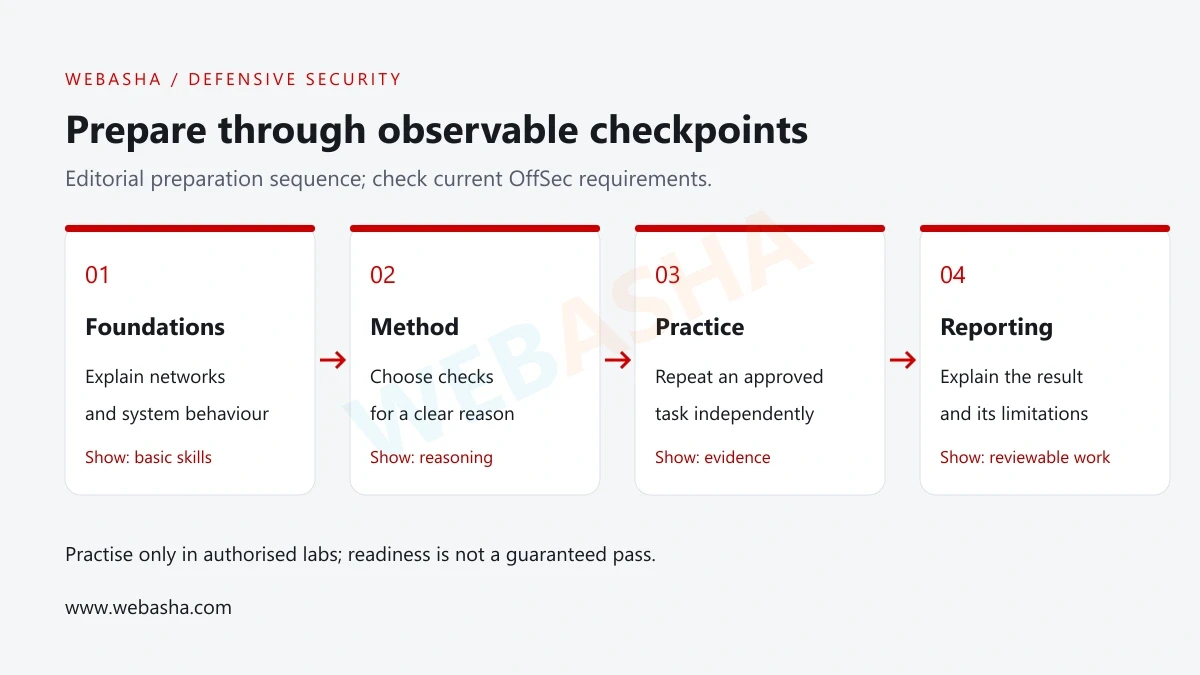
Build a phased OSCP preparation roadmap
| Phase | Focus | Evidence of progress |
|---|---|---|
| Foundation review | Close gaps in the prerequisite checklist. | Short explanations and reproducible small exercises. |
| Course study | Map official objectives to your learning notes. | A topic record with unresolved questions. |
| Guided practice | Work through permitted exercises and inspect the reasoning. | Notes explaining each meaningful result. |
| Independent repetition | Repeat a suitable task with reduced reliance on a walkthrough. | A recorded approach, failed attempts and verified outcome. |
| Timed rehearsal | Practise planning, breaks and evidence handling. | A review of where time was used and what was missed. |
| Report rehearsal | Produce and review a complete practice report. | A readable document with traceable evidence and limitations. |
Choose a pace that fits your starting skills and available study hours. This sequence does not require every learner to spend the same number of weeks in each phase. If an independent task exposes a foundation gap, return to that topic and test the correction.
Keep one primary study record rather than accumulating several conflicting checklists. Use the issuer’s syllabus and candidate materials to identify scope; use third-party stories as personal experiences, not exam policy.
Use labs to practise a repeatable method
Begin each authorised exercise with the task brief and environment boundaries. Record what is known, what you are trying to establish and which observations would support or contradict your working idea. Choose the next check based on that evidence.
When a step fails, preserve the error and investigate the assumptions behind it. A wrong path, misunderstood service or unsuitable input can explain a failure. Repeatedly running the same action without a changed reason does not add useful evidence.
Use only the provider’s authorised resources and allowed methods. This article contains no exploitation commands and has not tested an exam or lab target. Ask for help through permitted training channels when you are studying, and distinguish those channels from the stricter conditions of an examination.
Progress check: explain why you chose the next step, what the result means and what it does not establish. If you can reproduce an outcome only by copying a sequence, identify the concept behind the next unexplained step.
Make evidence collection a normal part of practice
Record the lab identifier, relevant environment details, time, objective and observations. Keep supporting material linked to the note where you interpreted it. Avoid leaving important evidence until the final minutes of a practice session.
A useful note separates an observation from a conclusion. For example, “the approved test identity received this result” describes evidence; “all users can do this” needs broader testing. Keep the scope of the claim matched to the checks actually performed.
Do not publish confidential exam content or restricted lab walkthroughs. Check the provider’s disclosure rules before turning any exercise into a portfolio post. The WebAsha beginner portfolio guide discusses presenting permitted evidence.
Write practice reports before exam day
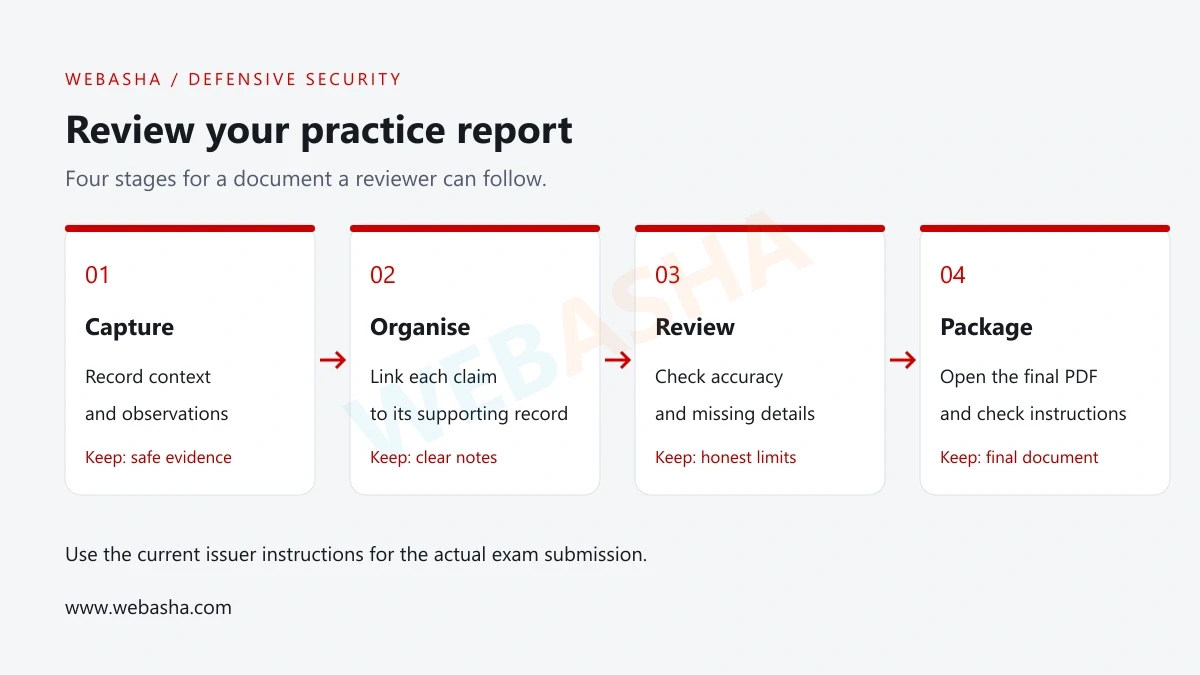
OffSec’s reporting page requires an exam penetration-test report in PDF format, with screenshots and descriptions demonstrating objectives and results. It provides report templates and encourages learners to use them. Start with the issuer’s current requirements when rehearsing the document. [3]
| Check | Question for the reviewer |
|---|---|
| Scope | Is the permitted environment identified? |
| Reproduction | Can the recorded method be followed from the supplied context? |
| Evidence | Does each material claim have the required supporting record? |
| Result | Does the description match the evidence? |
| Limitations | Are incomplete or untested conditions labelled honestly? |
| Packaging | Does the final document open and follow the current required submission format? |
Use a practice document to find missing notes, unclear screenshots and unsupported claims. Correct them while the exercise is still available. A report written from memory alone can hide the point where evidence stopped and assumptions began.
Check the scheduled scoring change and resource rules
The FAQ describes a scaled range of 100–500 with 400 as the passing scaled score. It explains that raw-point conversion depends on the exam set, so a single raw-point target should not be used as a universal pass calculation after the change. [4]
The exam guide also explicitly prohibits using LLMs and AI chatbots during the exam. Its wording distinguishes such use from the mere presence of built-in AI features. Read the full live policy and candidate instructions; do not infer permission from a forum account. [2]
Recheck the exam guide, scoring FAQ, candidate handbook and reporting requirements before booking and again before your session. If a detail is ambiguous, obtain clarification from OffSec through its official support route.
Evaluate readiness using your own evidence
Review a recent independent exercise. Can you explain the route you took, verify important outcomes and produce a complete report without reconstructing missing records? Which part depended on help, and what have you since practised independently?
Use a gap log with the topic, observed difficulty, practice task and next review. A timed rehearsal can reveal documentation or environment problems as well as technical ones. Treat that feedback as the next study task, not a prediction of your exam result.
Foundation and reporting skills also apply beyond a specific exam. If you are comparing a SOC direction, use the SOC analyst skills guide to assess which tasks fit that role.
Discuss preparation support with WebAsha
Bring a specific prerequisite gap or practice-report example to a training discussion. Ask how supervised labs, reasoning review and documentation feedback are organised. Confirm any exam-related package entitlements separately from the teaching plan.
Ask WebAsha Technologies about ethical hacking foundation and lab-reporting support. Contact WebAsha with your starting skills and preparation goals.
Official references
Frequently Asked Questions
What's Your Reaction?
 Like
0
 Dislike
0
 Love
0
 Funny
0
 Wow
0
 Sad
0
 Angry
0

With a passion for staying on the cutting edge of technology trends, I am dedicated to delivering content that not only informs but also inspires. Whether you need in-depth analysis pieces, informative guides, or thought-provoking opinion pieces, I craft content that resonates with tech enthusiasts and professionals alike.