Social Engineering Techniques: How Attacks Work and How to Stop Them
Social engineering is manipulating people into giving away information, money or access, instead of breaking in through technology. Common techniques include phishing emails, spear phishing aimed at one person, phone calls (vishing), SMS (smishing), pretexting with a made-up story, impersonating a boss or supplier, and flooding someone with login approval requests until they accept one.
Topic: Cyber Threats, Scams & Online Safety in Cybersecurity & Ethical Hacking · Explainer
Also covers: Cybersecurity Foundations
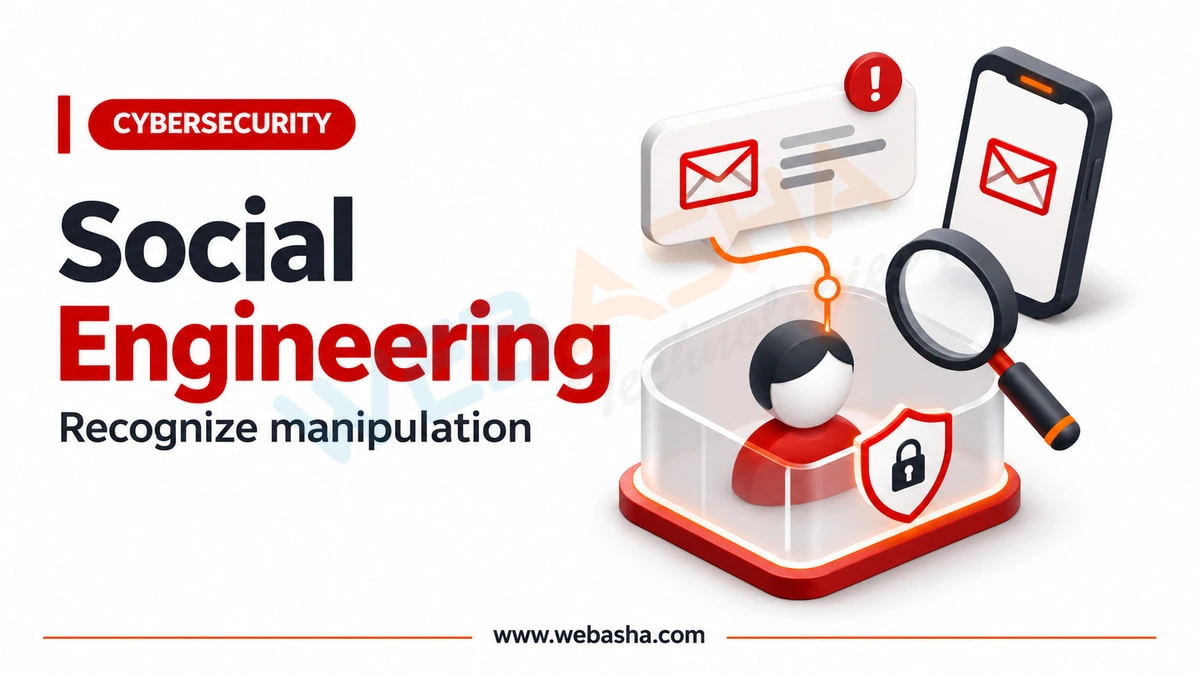
Quick answer: Social engineering is manipulating people into giving away information, money or access, instead of breaking in through technology. Common techniques include phishing emails, spear phishing aimed at one person, phone calls (vishing), SMS (smishing), pretexting with a made-up story, impersonating a boss or supplier, and flooding someone with login approval requests until they accept one. It works because it exploits trust, urgency, authority and helpfulness. The defences are verification habits and processes that do not rely on any one person spotting the trick.
Key takeaways
- Attackers target people because people can approve what technology would block.
- Nearly every attack uses urgency, authority, fear or a reward to cut thinking short.
- Verify through a channel you already trust, never one supplied in the message.
- Process controls such as call-backs and two-person approval stop attacks that training misses.
- If you fall for one, report it immediately. Speed limits the damage.
Table of Contents
- What Is Social Engineering in Cybersecurity?
- Why Does Social Engineering Work?
- What Are the Main Techniques?
- How Does a Realistic Attack Unfold?
- How Can You Examine a Suspicious Email?
- How Do You Defend Against Social Engineering?
- What Makes Awareness Training Effective?
- How Is Social Engineering Tested Professionally?
- What Should You Do If You Fall for an Attack?
- References
What Is Social Engineering in Cybersecurity?
It is the human side of attack: persuading someone to do something that helps the attacker, such as clicking a link, entering a password, approving a login, sharing a one-time password, paying an invoice or letting someone into a building. The attacker exploits ordinary behaviour, such as wanting to help, responding to authority and acting quickly under pressure, rather than a flaw in software.
It often starts an attack that then becomes technical. A stolen password from a phishing page leads to a mailbox, the mailbox leads to more targets, and so on.
Why Does Social Engineering Work?
- Urgency: your account will be blocked in one hour.
- Authority: a message apparently from a director, the bank or the police.
- Fear: a parcel held by customs, a legal notice, a so-called digital arrest.
- Reward: a prize, a refund, a job offer.
- Helpfulness and trust: a caller from IT support who just needs to verify something.
Each one pushes people to act before they think. Recognising the pressure is often the most useful skill of all.
What Are the Main Techniques?
| Technique | How it works | MITRE ATT&CK |
|---|---|---|
| Phishing | Bulk emails with malicious links or attachments | T1566 Phishing |
| Spear phishing | A message tailored to one person using researched details | T1566 Phishing |
| Credential harvesting | Fake login pages that collect passwords and codes | T1598 Phishing for Information |
| Vishing | Phone calls impersonating banks, support or officials | T1566 and T1598, by goal |
| Smishing and messaging apps | SMS or WhatsApp messages with links or requests | T1566 Phishing |
| MFA fatigue | Repeated login approval prompts until the user accepts one | T1621 MFA Request Generation |
| Pretexting | A believable invented scenario to justify a request | Supports all of the above |
| Business email compromise | Impersonating a supplier or executive to redirect payments | Often follows T1566 |
| Baiting and quishing | Infected USB drives, or QR codes leading to fake pages | Varies |
| Tailgating | Following someone through a secure door | Physical, outside ATT&CK |
The ATT&CK entry for phishing and the entry for MFA request generation list real-world groups using each, and the detections and mitigations defenders use.
How Does a Realistic Attack Unfold?
- The attacker studies a company on LinkedIn and its website, and identifies a finance employee and the company's main supplier.
- They register a domain one letter different from the supplier's.
- An email from that domain, written in the supplier's style, says the supplier has changed banks and attaches an updated letter.
- A follow-up call from someone claiming to be the supplier's accountant adds urgency: the next payment is overdue.
- The employee updates the bank details and the next invoice is paid to the attacker.
No malware, no exploit. The control that stops it is simple: confirm any change of bank details by calling the supplier on a number already on file.
How Can You Examine a Suspicious Email?
Mail servers record whether a message passed sender authentication. In most email clients you can view the original message, or the message source, and find the Authentication-Results header:
Authentication-Results: mx.example.com;
   spf=fail smtp.mailfrom=paym3nts-supplier.com;
   dkim=none;
   dmarc=fail header.from=paym3nts-supplier.com
A fail on SPF, DKIM or DMARC is a strong warning sign. A pass only proves the message came from the domain shown, which may be a lookalike, so read the domain letter by letter.
Check whether a domain publishes a DMARC policy, defined in RFC 7489:
dig +short TXT _dmarc.example.comSee where a shortened or suspicious link really goes without opening it in a browser. This follows redirects and prints only the headers:
curl -sIL 'https://short.example/abc123' | grep -i '^location'Do this from a safe machine, and never enter credentials on the destination. Our guide to SPF, DKIM and DMARC explains the records themselves.
How Do You Defend Against Social Engineering?
- Verify out of band. Call back on a known number, or message the person on a channel you already use.
- Two-person approval for payments and bank detail changes above a threshold.
- Phishing-resistant multi-factor authentication, such as security keys or passkeys, which stops stolen passwords and fake login pages working.
- Number matching for push approvals, which defeats MFA fatigue.
- Email authentication with DMARC set to reject on your own domains.
- Never share OTPs. No genuine bank, courier or official needs your one-time password.
- Make reporting easy: one button or one address, and thanks for every report.
What Makes Awareness Training Effective?
Short, frequent and specific beats long and annual. Effective programmes use real examples from your own industry and language, teach the pressure tactics rather than a list of scams, practise the specific verification steps people should take, and measure reporting rates, not just click rates. People who report quickly protect everyone else. Training that shames people who click makes them hide mistakes, which is the opposite of what you need.
How Is Social Engineering Tested Professionally?
With written authorisation from the organisation, agreed scope and an agreed purpose. Testers run simulated phishing campaigns, often with open-source tools such as Gophish, phone pretexting calls, or physical entry tests. The results are reported in aggregate to improve training and processes, not to punish individuals. Without authorisation, the same activity is an offence: impersonation using a computer resource can fall under section 66D of the Information Technology Act, 2000.
What Should You Do If You Fall for an Attack?
- Report it immediately to your IT or security team. Minutes matter.
- Change the password you entered, and any account using the same one, and sign out other sessions.
- If money moved, call your bank at once to try to stop or recall the payment.
- In India, report fraud through the national cybercrime portal, cybercrime.gov.in, or by calling 1930, as soon as possible.
- Watch for follow-up: attackers often return with a second pretext, such as a fake refund offer.
For the AI side of this, see how deepfake and AI-enhanced scams work.
Talk to a WebAsha training advisor about cyber security courses, batches and current fees.
References
- MITRE ATT&CK T1566, Phishing
- MITRE ATT&CK T1598, Phishing for Information
- MITRE ATT&CK T1621, Multi-Factor Authentication Request Generation
- RFC 7489, DMARC
- Gophish
Related reading
Frequently Asked Questions
What's Your Reaction?
 Like
0
 Dislike
0
 Love
0
 Funny
0
 Wow
0
 Sad
0
 Angry
0

I am passionate about technology, invention and big challenging tasks on my to- do list. In terms of the work I am doing also at Bunnyshell, I am most passionate about the technologies that we are using., I'm devoted to delivering content that not only informs but also inspires. Whether you need in- depth analysis pieces, educational attendants, or study- provoking opinion pieces, I draft content that resonates with tech suckers and professionals likewise.