SOC Analyst Course Syllabus: SIEM, EDR and Incident Response
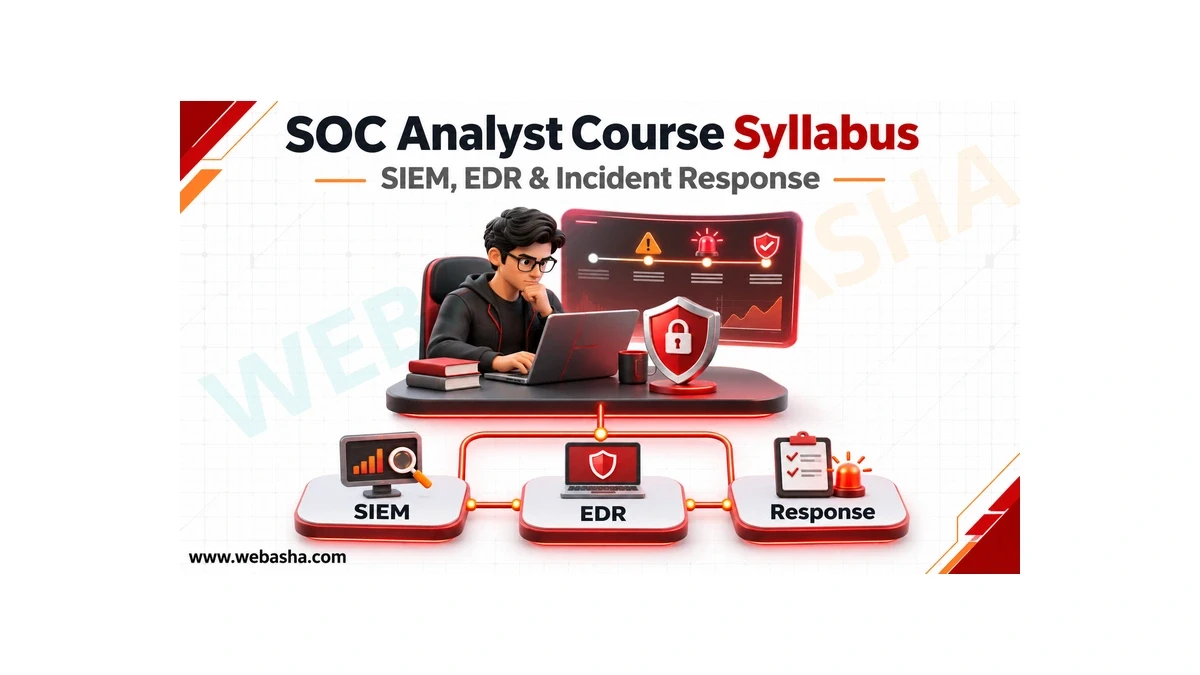
A useful SOC analyst course syllabus should connect log analysis, SIEM investigation, endpoint evidence and incident response through supervised practice. Look for tasks that require you to explain an alert, assess its supporting records and write a clear handover. Judge the syllabus by those learning outputs as well as the tools named.
A useful SOC analyst course syllabus should connect log analysis, SIEM investigation, endpoint evidence and incident response through supervised practice. Look for tasks that require you to explain an alert, assess its supporting records and write a clear handover. Judge the syllabus by those learning outputs as well as the tools named.
This is an editorial guide to evaluating a syllabus, not a verified WebAsha batch curriculum. Confirm the actual modules, lab access and assessment arrangements with the provider. Technical references were checked on 17 November 2026; the proposed exercises below were not performed for this article.
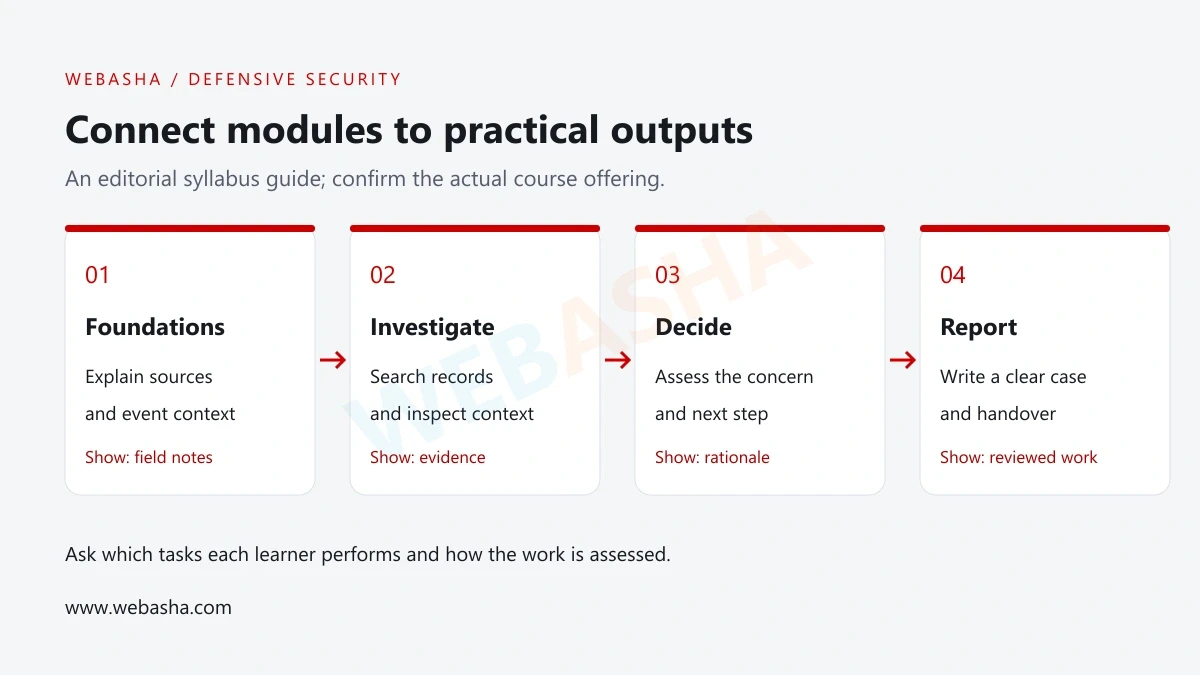
Connect each module to work you can review
- Learn the source and meaning of an event before building detections.
- Use SIEM and endpoint evidence to investigate a defined question.
- Practise escalation and response decisions within assigned authority.
- Finish with a documented case and feedback.
Begin with the foundations behind security events
A security operations center, or SOC, uses people, processes and technology to monitor and investigate security concerns. For a beginner, the first learning task is understanding the environment described by a record: the identity, host, service, action and time.
| Area | What to explain before the lab |
|---|---|
| Networking | Addresses, DNS, common service roles and a request flow. |
| Windows and Linux | Accounts, permissions, processes and services. |
| Web and identity | Authentication, sessions and the difference between identity and permission. |
| Time and logs | Source timestamps, time zones, event fields and missing records. |
| Communication | A short note separating observation, interpretation and next action. |
If these topics are unfamiliar, ask whether the course includes foundation teaching or expects it beforehand. The WebAsha beginner cybersecurity guide can help structure that preparation.
Basic scripting can help organise records later. It should support understanding of the data, rather than hide an unclear assumption behind automated output.
A suggested SOC analyst course syllabus
| Module | Main learning task | Reviewable output |
|---|---|---|
| SOC workflow | Understand assigned roles, queues, escalation and handovers. | A labelled sample workflow. |
| Telemetry foundations | Interpret endpoint, identity, network and application records. | A field dictionary with source context. |
| SIEM investigation | Search, filter, group and correlate relevant records. | A query note and supporting results. |
| Endpoint evidence | Read process and device context from supplied telemetry. | An annotated endpoint timeline. |
| Alert triage | Evaluate the condition and prioritise the next check. | A triage record with limitations. |
| Threat context | Relate a supported observation to relevant behaviour. | An evidence-backed mapping note. |
| Incident response | Discuss escalation, containment and recovery decisions. | A response proposal with authority and consequences. |
| Case reporting | Explain evidence, actions and unresolved questions. | A reviewed capstone report. |
This sequence is a comparison aid, not a mandatory order for every provider. Ask how much of each module involves your own work and how an instructor checks the result. A long list of product names says little about the depth of practice.
What the SIEM module should help you do
Security information and event management, or SIEM, brings security records into an investigation workflow. Microsoft Sentinel is one example: its documentation describes connectors, data normalisation, analytics and incident investigation. [1]
A useful beginner exercise starts with a small supplied dataset and a clear question. The learner identifies relevant fields, chooses a time window, filters the records and explains why the result matters. The instructor should also ask what the query might miss.
Microsoft documents analytics that group related alerts into incidents. A course can use that idea to distinguish a raw event, an alert about a condition and a case that brings related evidence together. The names and grouping behaviour should be checked for the platform actually taught. [1]
Look for query practice, not just dashboard tours. Ask whether learners review parsing errors, duplicate events, time-zone assumptions and source availability. Those questions help explain why an empty result is not automatically proof that nothing happened.
What the EDR module should help you explain
Endpoint detection and response, or EDR, adds device-focused detection and investigation context. Microsoft Defender for Endpoint, for example, documents behavioural telemetry, alerts, incidents and response capabilities. [2]
A suggested exercise is to review supplied endpoint records and describe a process relationship, relevant user context and observed network activity. The goal is to reconstruct what the source shows without inventing events that are absent from it.
Microsoft explicitly says its endpoint detection is not an auditing or logging solution that records every endpoint operation. That is an important limit to discuss: detection telemetry should not be assumed to be a complete history. [2]
Keep investigation practice separate from permission to respond. A proposed isolation or file action should identify the assigned authority, expected effect and possible disruption. Learners should not take production actions merely because a console exposes a button.
Teach alert triage as a reasoned decision
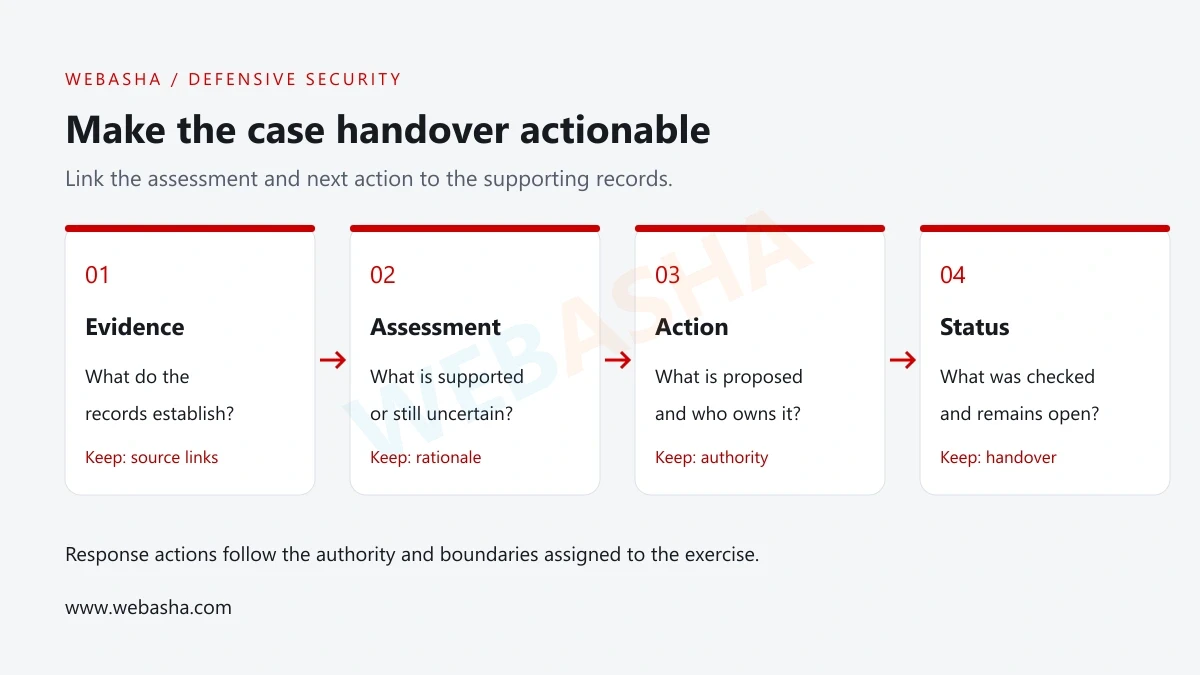
Start with the alert’s triggering condition, source and affected entities. Then examine whether the available records support the concern, which context is missing and which approved next check would help. Record the outcome rather than silently closing a difficult item.
| Field | Question to answer |
|---|---|
| Trigger | What condition caused this alert? |
| Context | Which account, host and time window are relevant? |
| Evidence | Which records support or challenge the concern? |
| Impact | What consequence is established or still uncertain? |
| Decision | What happens next, and who owns it? |
| Limits | Which missing sources or assumptions affect the decision? |
Use both suspicious and benign training cases. For example, repeated authentication failures may need context about account configuration, scheduled jobs and surrounding activity. A pattern alone should not turn into an unsupported attribution.
Ask how the course assesses reasoning when a case remains unresolved. Knowing when to escalate a limited finding is part of useful practice; a lab does not need a dramatic conclusion to teach sound triage.
Use threat context without treating a label as proof
MITRE ATT&CK is a knowledge base of adversary tactics and techniques based on real-world observations. It can give a class a shared vocabulary for discussing behaviour. [4]
In a suggested mapping exercise, identify the specific observation first, then explain whether a technique description fits it. Record the basis and any uncertainty. Mapping an alert to a technique does not independently prove an actor, intent or complete attack chain.
Threat intelligence should provide context that can be checked. Ask learners to distinguish a source statement from an observation in their own dataset. A reputation hit or a summarised feed is useful only when its relevance to the case is explained.
Connect incident response to authority and recovery
NIST SP 800-61 Revision 3, published in April 2025, integrates incident response recommendations with Cybersecurity Framework 2.0 risk-management activities. It supersedes Revision 2 and addresses preparation, detection, response and recovery in that wider context. [3]
A course should help learners discuss what must be established before a disruptive response. In an exercise, propose an action, identify the authorised owner and explain how success and side effects would be checked. Recovery should include verification of the relevant service or control, not just a declaration that the alert disappeared.
Keep evidence handling and operational needs visible. Record the rationale for an approved action and any source limitations it introduces. If the learner lacks authority or the scenario omits a critical assumption, the appropriate output can be a clear escalation request.
Look for connected labs and a reviewable capstone
Suggested lab: authentication triage
Provide synthetic authentication records, a stated time zone and a short environment brief. Ask the learner to describe a pattern, identify missing context and write an escalation or closure rationale. Expected output: the relevant records, query assumptions and a concise triage note.
Suggested lab: endpoint investigation
Provide a safe recorded endpoint scenario with a known learning objective. Ask the learner to link relevant process and device observations, state the limits and propose a permitted next step. Expected output: an annotated timeline and a handover with no invented events.
Suggested capstone: a case across sources
Combine a small set of endpoint, identity and network records. Require a case question, source inventory, investigation notes, supported assessment and response proposal. Include a record that does not fit the initial hypothesis so the learner has to reconsider the explanation.
These are editorial exercise briefs, not claims that WebAsha or a specific product package includes those labs. No training tenant or endpoint was accessed for this article.
Questions to ask before choosing a course
Request a dated syllabus and an example assessment. Confirm the named platform, the lab environment, the access period and the actual prerequisite level. Ask which tasks each learner performs and what feedback they receive on an investigation note.
If AI assistance is included, ask how generated queries and summaries are checked against source records and how private data is handled. The learner should be able to explain the final result independently and follow the assessment’s rules.
Confirm whether a completion certificate and any separate certification entitlement are distinct. Review the exact arrangements rather than inferring them from a course name. This guide makes no claim about a current WebAsha batch’s tool access, duration or assessment terms.
For role context, see the WebAsha SOC analyst skills guide. The beginner portfolio guide can help organise permitted case notes without presenting training as client experience.
Discuss SOC analyst training with WebAsha
Bring your foundation gaps and a sample learning goal to a course discussion. Ask for the actual syllabus and how supervised SIEM, endpoint and case-reporting work is assessed.
Ask WebAsha Technologies about SOC analyst training. Contact WebAsha to confirm the current syllabus and lab arrangements for your starting level.
Official references
Frequently Asked Questions
What's Your Reaction?
 Like
0
 Dislike
0
 Love
0
 Funny
0
 Wow
0
 Sad
0
 Angry
0

With a passion for staying on the cutting edge of technology trends, I am dedicated to delivering content that not only informs but also inspires. Whether you need in-depth analysis pieces, informative guides, or thought-provoking opinion pieces, I craft content that resonates with tech enthusiasts and professionals alike.