SOC Analyst Interview Questions With Alert-Triage Scenarios
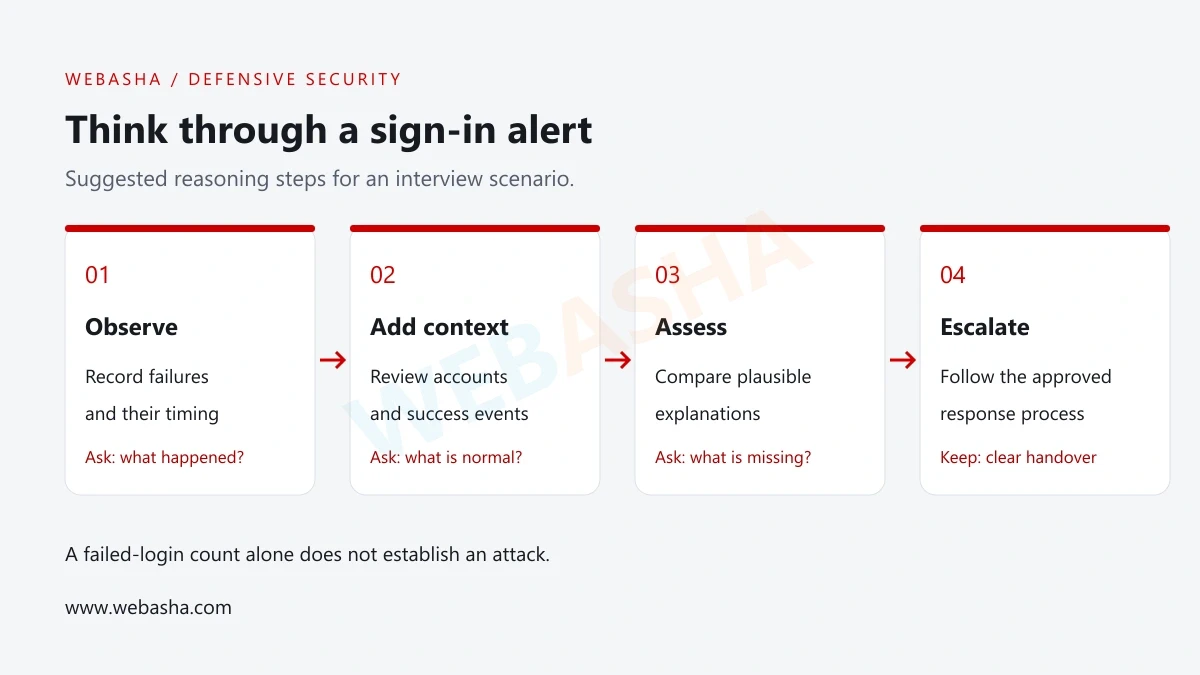
Prepare for SOC analyst interview questions by explaining the alert condition, reviewing relevant evidence and choosing a justified next step. Practise cases with missing context as well as clear findings. A useful answer identifies what is known, what remains uncertain and what the next analyst needs in the handover.
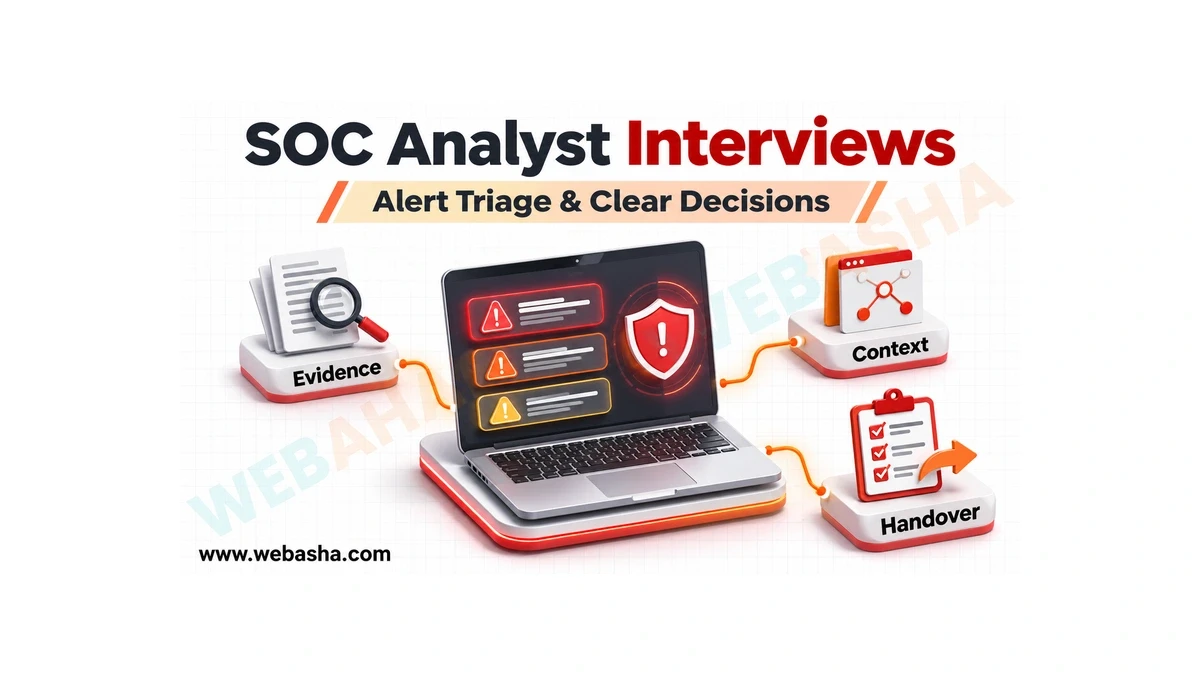
Prepare for SOC analyst interview questions by explaining the alert condition, reviewing relevant evidence and choosing a justified next step. Practise cases with missing context as well as clear findings. A useful answer identifies what is known, what remains uncertain and what the next analyst needs in the handover.
The sample answers and scenarios below are editorial practice material, not a prediction of an employer’s assessment. Technical references were checked on 17 November 2026. All case records are synthetic; no SOC tenant or endpoint was investigated while preparing this article.
Make the decision traceable
- Start with the alert’s actual condition and source.
- Use context to test your explanation.
- Keep proposed response within assigned authority.
- Write a handover another analyst can act on.
Explain the role using a specific workflow
1. What does a SOC analyst do?
“I would review security concerns within my assigned queue, inspect the relevant records and document a supported assessment. Depending on the case and my authority, the next step could be further investigation, escalation or a justified closure.” Add a concrete example from your own permitted learning or work.
2. How do you begin investigating an alert?
“I would identify what generated it, the affected entities and the relevant time window. Then I would inspect the triggering records and choose the next source based on the question still open.” Microsoft’s Sentinel investigation documentation, for example, exposes alert details, entities and timelines to support that review. [1]
Be explicit about which product you know. A general workflow can transfer between tools, while field names, grouping and investigation views vary. Do not turn familiarity with one console into a claim about every SOC platform.
Distinguish an event, an alert and a case
3. What is the difference between an event and an alert?
“An event records an activity or state; an alert calls attention to a condition detected from available information. I would inspect the source and rule before deciding what that condition means.” This is a useful working distinction; confirm the platform’s actual object definitions.
Microsoft Defender for Endpoint documents alerts generated for investigation and their aggregation into incidents. Those incidents give analysts a way to review related concerns together. A case label still needs supporting evidence before it becomes a conclusion about compromise. [2]
4. Does a high-severity alert prove a high-impact breach?
“I would treat severity as an input to prioritisation, then review affected assets, exposure and the evidence. I would distinguish the alert’s label from the impact actually established and follow the team’s escalation criteria.”
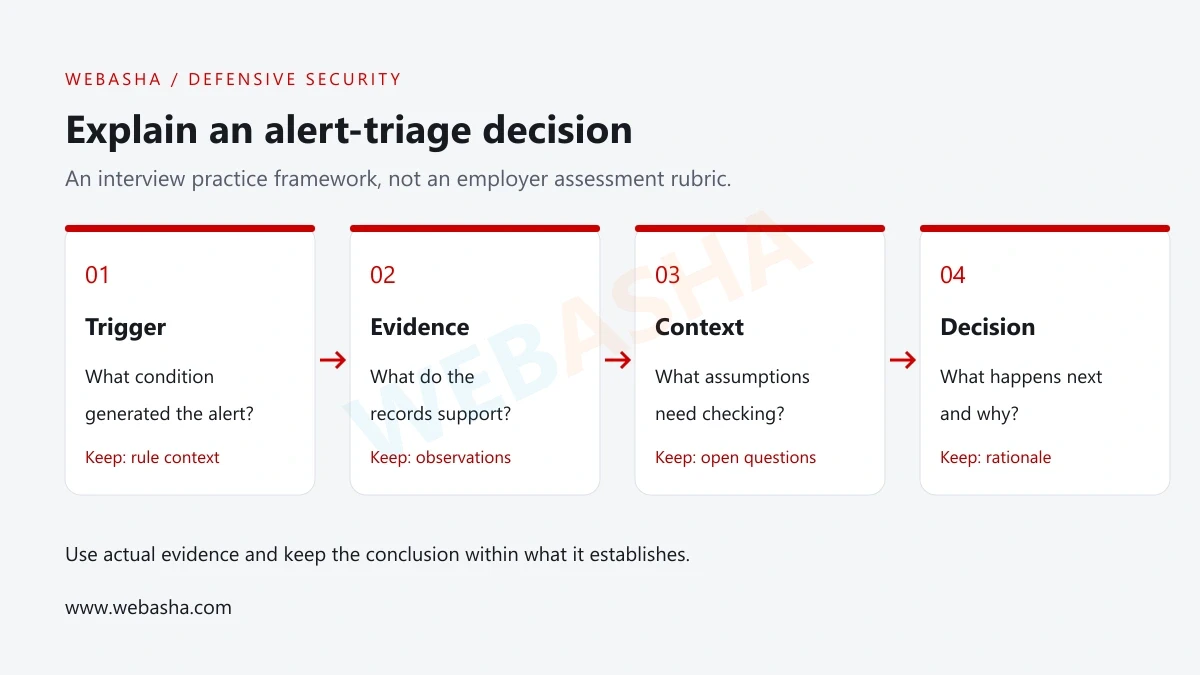
Practise triage with a short decision record
5. What would you include in a triage note?
“I would identify the alert, relevant account or host, time context, checks performed and supported assessment. I would state missing evidence and the next owner or action. The note should explain why I reached the decision.”
| Part | Question |
|---|---|
| Trigger | What condition was detected? |
| Entities | Which identities, devices or addresses are relevant? |
| Time | What source times and query window were used? |
| Evidence | Which records support or challenge the concern? |
| Assessment | What is established, suspected or unresolved? |
| Next step | Who needs to do what, and why? |
6. What if the records do not support the initial hypothesis?
“I would revise the explanation and preserve the observations that changed it. I would avoid selecting only records that fit the alert title. If the remaining uncertainty matters to the case, I would identify an approved check or escalate it clearly.”
This answer is easier to assess when paired with a small example. Describe one assumption, the record that challenged it and the narrower conclusion you could still support.
Scenario: repeated failures followed by a successful login
Assume a synthetic alert shows repeated failures for training account LAB-USER-A, followed by a success. The exercise does not yet identify the source device, account purpose or whether all records share the same clock convention.
7. Would you immediately call this an account takeover?
“The pattern needs investigation, but the supplied facts do not establish a takeover. I would review the relevant identity records, clarify source and time context and look for supporting activity within the permitted scope. I would explain which observation would change the assessment.”
| Available fact | What it supports | Question still open |
|---|---|---|
| Failures are recorded | Some authentication attempts failed. | Are the records related to the same source and condition? |
| A later success is recorded | A successful authentication was logged. | Was it an expected user or service action? |
| Device context is missing | The current record set is incomplete for that question. | Which approved source can supply relevant context? |
A legitimate explanation is also a hypothesis to check, not a reason to close automatically. If the account is sensitive or the potential consequence is urgent, explain the escalation need while keeping the conclusion qualified.
Scenario: a process alert with incomplete endpoint history
A training endpoint alert names a script interpreter. The supplied records include one process relationship and an outbound connection, but no full command context or authorised-change record.
8. Is the interpreter name enough to classify the activity?
“I would review the available parent/child relationship, user, time and related records, then check whether the environment brief provides a legitimate explanation. A common executable name alone does not establish malicious intent. I would state which important context is absent.”
Microsoft explicitly cautions that Defender for Endpoint detection is not an audit or logging solution recording every endpoint operation. A missing record in that product should not be treated as a complete statement about all activity. [2]
Expected practice output: an observation-linked assessment and a request for the missing context. No command execution, malware launch or live response is needed to discuss this scenario.
Prioritise and escalate without improvising authority
9. How would you handle several alerts at once?
“I would apply the team’s prioritisation criteria and consider affected assets, demonstrated activity, potential consequence and time sensitivity. I would identify related cases where supported and communicate anything that needs urgent ownership. I would not rank solely by the number of alerts.”
10. Would you isolate a device immediately?
“I would follow the playbook and assigned authority for the circumstances. If isolation is proposed, I would identify its expected effect, possible disruption and who can approve or perform it. If urgent escalation is needed, the handover should say so clearly.”
NIST SP 800-61 Revision 3 connects incident response to wider cybersecurity risk management under CSF 2.0. That context supports practising preparation, detection, response and recovery together, rather than reducing response to one console action. [3]
Explain threat context and uncertainty
11. How would you use MITRE ATT&CK?
“I would compare a supported observation with the relevant technique description and document why the mapping fits. I would also record what the evidence does not show.” MITRE defines ATT&CK as a knowledge base of adversary tactics and techniques grounded in real-world observations. [4]
A mapping is not independent attribution. Likewise, a reputation result about an address is context to evaluate, not proof that a particular connection caused compromise. Explain the relationship between the source statement and your own case observations.
If asked about an unfamiliar technique, identify what you do understand and which official description you would consult. A precise partial answer is preferable to inventing a chain of activity that the scenario does not contain.
Work through a synthetic escalation note
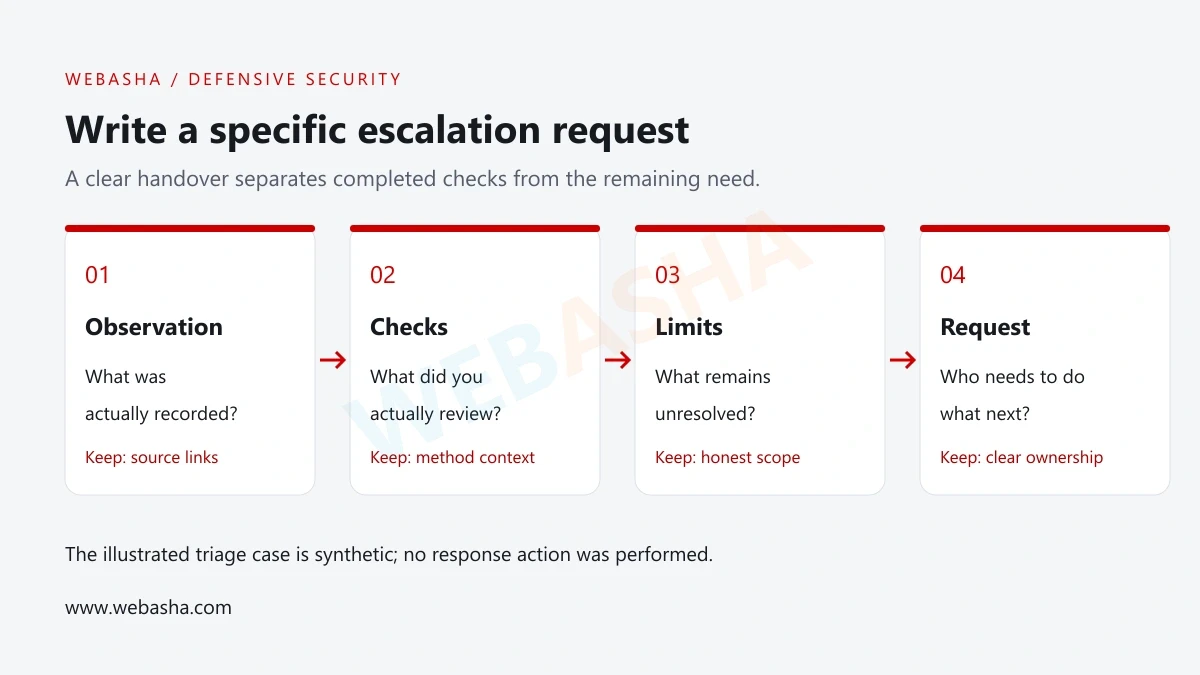
12. What makes an escalation useful?
“It should tell the next analyst what happened, what was checked, what is still open and which decision or action needs attention.” Use identifiers and source references appropriate to the team’s process, and keep unnecessary private data out of the note.
| Field | Example text |
|---|---|
| Case | Training case LAB-AUTH-018; synthetic records. |
| Observation | Repeated failures and a later success are present for LAB-USER-A. |
| Checks | Reviewed the supplied records; clock convention and device context remain unresolved. |
| Assessment | The pattern warrants investigation; takeover is not established from these records alone. |
| Request | Assigned lead to confirm the relevant identity/device context and next permitted check. |
| Action status | No response action performed in this exercise. |
This is an editorial example, not a completed investigation. Its purpose is to show the difference between an observation, a limitation and a request. Avoid pasting a template with empty claims about checks you did not perform.
Prepare with follow-up questions and your own evidence
Answer a question aloud, then change one assumption. What if the account is a service identity? What if the logs use different time zones? What if the endpoint source is unavailable? Explain how the next step changes.
Use the WebAsha beginner cybersecurity guide to revisit foundations and the SOC analyst skills guide for role context. The beginner portfolio guide can help organise permitted case notes accurately.
Common mistakes are reciting product names without identifying the needed record, closing uncertainty as benign and overstating personal experience. Correct them by describing the evidence question and the work you actually completed. If you lack a detail, say what would be needed to resolve it.
Discuss practical SOC interview preparation with WebAsha
Bring a sanitised training triage note or a synthetic case to a course discussion. Ask how instructors review reasoning, source interpretation and handovers during supervised practice.
Ask WebAsha Technologies about SOC analyst training and interview preparation. Contact WebAsha with your starting level and learning goals.
Official references
Frequently Asked Questions
What's Your Reaction?
 Like
0
 Dislike
0
 Love
0
 Funny
0
 Wow
0
 Sad
0
 Angry
0

With a passion for staying on the cutting edge of technology trends, I am dedicated to delivering content that not only informs but also inspires. Whether you need in-depth analysis pieces, informative guides, or thought-provoking opinion pieces, I craft content that resonates with tech enthusiasts and professionals alike.