Cybersecurity Course Syllabus: Fundamentals to Hands-On Practice
A cybersecurity course syllabus should cover networking, operating systems, security principles, identity, cryptography, application security, monitoring and incident response. Each module should include a supervised exercise and a written result you can explain.
A cybersecurity course syllabus should cover networking, operating systems, security principles, identity, cryptography, application security, monitoring and incident response. Each module should include a supervised exercise and a written result you can explain.
Use the outline below to compare training options or organise your own study. It is a suggested learning plan, not a university-approved curriculum or a promise of employment. The practical tasks focus on defensive work in systems you own or are authorised to use.
What to check before enrolling
- Foundations come before specialist tools.
- Every module produces something you can review, such as an access matrix or incident timeline.
- The course explains lab permissions, assessment and feedback.
- The published syllabus matches your starting level and intended role.
What should a cybersecurity course syllabus include?
Start with how systems communicate and how accounts, files and processes work. Then study the controls that protect them and the evidence used to investigate failures. A beginner needs time to practise these foundations before choosing a specialisation.
The NICE Framework describes cybersecurity work through tasks, knowledge and skills. That gives you a useful way to judge a syllabus: ask what work you will be able to demonstrate after each module. [1]
| Module | Core subjects | Defensive exercise | Evidence to keep |
|---|---|---|---|
| 1. Networking | TCP/IP, addressing, DNS, ports and routing | Trace a request in an instructor-supplied packet capture | Annotated traffic diagram |
| 2. Linux and Windows | Files, permissions, services and logs | Review a disposable VM baseline | Configuration checklist |
| 3. Security fundamentals | Confidentiality, integrity, availability, threats and risk | Assess a fictional small business | Asset and risk register |
| 4. Identity and access | Authentication, authorisation, MFA and least privilege | Review access for three fictional users | Access matrix and reasons |
| 5. Cryptography | Encryption, hashing, certificates and key handling | Check file integrity and inspect a sample certificate | Verification notes |
| 6. Network and endpoint defence | Segmentation, firewall rules, patching and backups | Review proposed rules and recovery steps | Control review |
| 7. Application security | Access control, input handling, dependencies and APIs | Review an instructor-provided design | Risk-to-control worksheet |
| 8. SOC and monitoring | Log fields, alerts, correlation and escalation | Triage a synthetic authentication alert | Triage report |
| 9. Incident response | Preparation, investigation, containment and recovery | Run a tabletop exercise with supplied evidence | Incident timeline |
| 10. Cloud, governance and reporting | Shared responsibility, permissions, policy and communication | Review fictional storage access and ownership | Findings and recommendations |
This is an editorial outline. Module order and depth will vary by programme. The UGC document describes an academic syllabus, while short training courses may focus on a narrower set of tasks. [4]
What should you know before starting?
You should be comfortable managing files, installing approved applications and explaining what happens when you open a website. Before the first security lab, check that you can identify an IP address, distinguish a user account from an administrator account, and describe where an application stores logs.
If those tasks are unfamiliar, choose a course with a foundation block. A trainer should explain the concepts and give you a small exercise before moving on. Existing IT experience can shorten this stage, but it should not replace an assessment.
| Can you explain or do this? | If not, practise this first |
|---|---|
| Describe DNS, an IP address and a port | Draw the path from a browser to a web server. |
| Find a file and explain who can read it | Use a practice folder to compare account permissions. |
| Locate a service log | Open a supplied log and identify its timestamps and fields. |
| Write a clear technical note | Describe one observation, its evidence and a next check. |
WebAsha’s published Cyber Security Course lists networking and Linux before security concepts, network and web security, and SOC monitoring. Confirm the detailed lab schedule for the batch you are considering. [5]
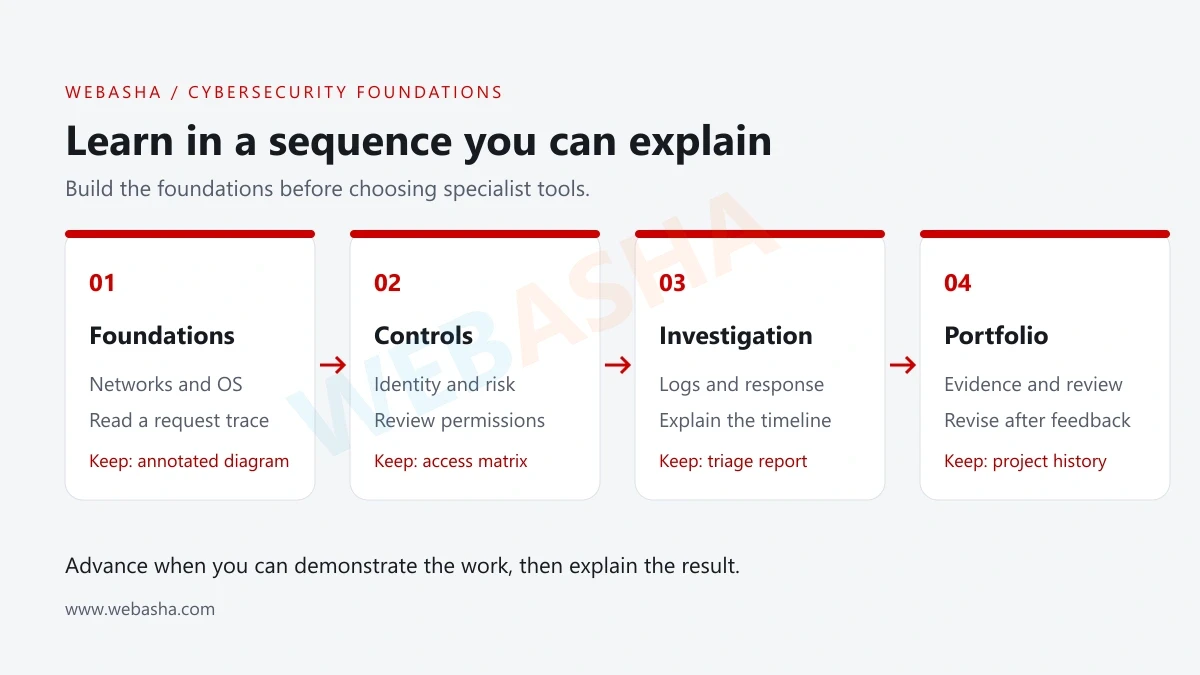
Learn the foundations through small defensive tasks
Networking and operating systems
Learn enough networking to explain the source, destination and purpose of a connection. In a supplied capture, identify a DNS lookup and a TCP connection. Record what the capture shows and what it cannot establish. Avoid capturing traffic from other people’s devices.
On Linux and Windows, practise reading file permissions, service state and logs. Compare a documented baseline with a disposable VM. Your result should explain each difference and whether it needs attention. Changing a setting without recording the previous value makes the exercise difficult to review.
Risk, identity and cryptography
Use a fictional company with employee accounts, a customer application and a backup system. Identify the assets, plausible threats and existing controls. For each risk, write down an owner and a proposed action.
Create an access matrix that shows which roles need to read, edit or approve data. Explain authentication, which establishes identity, separately from authorisation, which determines permitted actions. Use sample files and certificates to practise integrity checks and certificate interpretation without handling real credentials.
NIST’s Cybersecurity Framework provides a way to organise cybersecurity risk management. Use it to connect a technical control to the organisational risk it addresses, rather than treating security as a list of tools. [2]
Core security subjects: what the practice should show
Network, endpoint and application security
Review a network diagram and proposed firewall rules. Explain which service each rule permits, which systems need it and how the decision would be checked. Add endpoint patching and backup restoration to the exercise so prevention and recovery receive attention.
For application security, start with a supplied design or an instructor-prepared code sample. Identify where the application checks identity and permissions, accepts input and handles sensitive data. Describe the risk, recommend a control and propose a verification step.
The OWASP Top 10 is an application-security awareness resource. It can guide discussion of common risks, but a complete syllabus also needs networking, operating systems, monitoring and organisational context. [3]
SOC monitoring and incident response
A security operations centre (SOC) monitors and investigates security events. In an introductory exercise, work with synthetic logs: identify the affected account and host, establish a timeline and explain which additional evidence you need. An alert is a starting point for investigation, so avoid declaring an incident from one unexplained field.
For a tabletop incident, separate observed facts from hypotheses. Recommend containment for the instructor to review, then outline recovery and validation. Keep the source evidence unchanged and record the timezone used in your timeline.
Cloud security and governance
Use a fictional cloud deployment to discuss responsibility for identities, permissions, stored data and logging. A beginner can review a proposed configuration without creating paid resources. Include policy ownership and a short management summary so technical findings lead to a decision.
A hands-on practice task with an acceptance check
Start with a synthetic authentication log. It contains no real users, credentials or network targets. Save it as auth-sample.csv in a practice folder:
timestamp,account,result,host
2026-01-12T09:00:00Z,learner-a,failed,lab-01
2026-01-12T09:01:00Z,learner-a,failed,lab-01
2026-01-12T09:02:00Z,learner-a,success,lab-01
2026-01-12T09:03:00Z,learner-b,failed,lab-01
With Python 3 available, save this script as review_log.py in the same folder. It reads only the sample file:
import csv
from collections import Counter

with open("auth-sample.csv", newline="", encoding="utf-8") as sample:
    failed = Counter(
        row["account"] for row in csv.DictReader(sample)
        if row["result"] == "failed"
    )

for account, count in sorted(failed.items()):
    print(f"{account}: {count} failed sign-ins")
Run python review_log.py from that folder, or use your environment’s Python 3 launcher. The expected output is:
learner-a: 2 failed sign-ins
learner-b: 1 failed sign-ins
These are expected results, not a captured test of your machine. Explain why the counts alone do not prove malicious activity. Then add a short note about the successful sign-in, the missing source-address information and the questions you would ask before escalating.
| Problem | Check |
|---|---|
| Python command unavailable | Use the approved Python 3 environment provided by your trainer. |
| File not found | Confirm both files are in the working directory. |
| Missing column error | Check the CSV header spelling and remove accidental spaces. |
| Different counts | Compare the file with the four supplied records. |
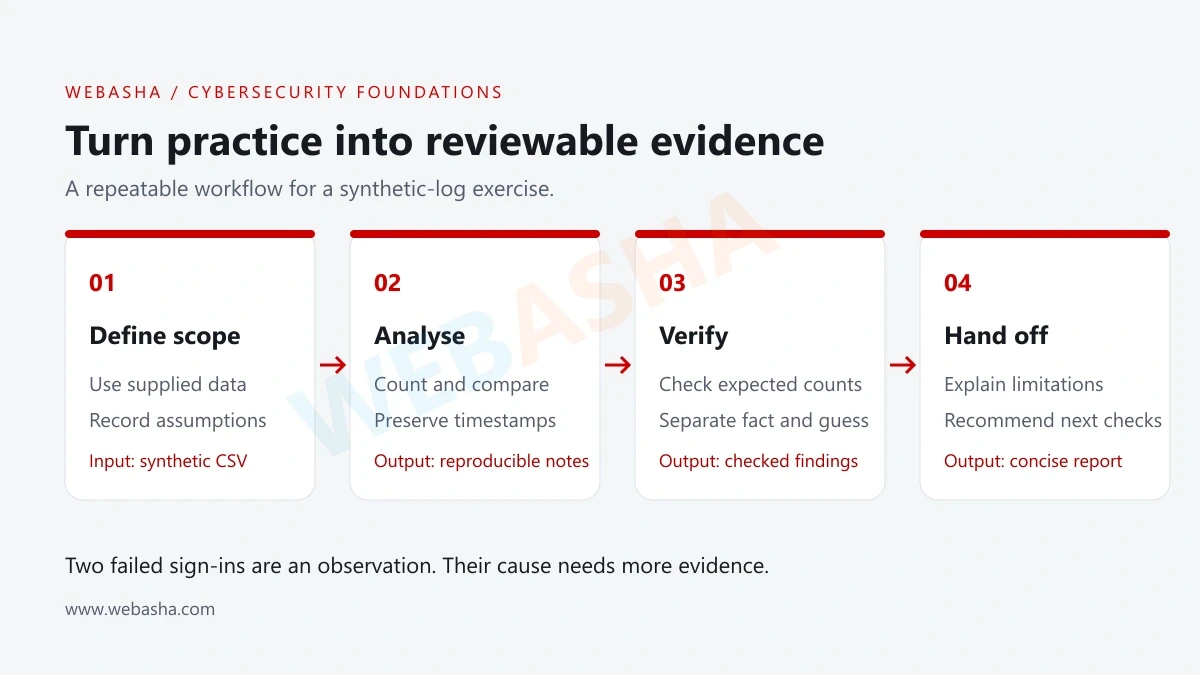
Build a portfolio that shows your reasoning
A useful project lets another person follow your work. Include the scope, source material, steps, findings and limitations. Screenshots can support the explanation, but they should not be the only evidence.
| Project | Deliverables | Review question |
|---|---|---|
| Defensive baseline review | VM inventory, permission review, proposed fixes and verification plan | Can you explain why each proposed change is needed? |
| Authentication alert investigation | Synthetic dataset, reproducible analysis and timeline | Can another learner reproduce the counts and distinguish facts from assumptions? |
| Small-business security tabletop | Asset register, incident scenario, recovery plan and management summary | Who makes each decision, and what evidence supports it? |
Keep real company data and secrets out of public repositories. Label synthetic examples clearly. For a fuller publishing checklist, read WebAsha’s cybersecurity portfolio guide.
Ask the reviewer to return specific feedback: a missing assumption, an unsupported conclusion or a verification step that another person could not follow. Revise the report and retain a short change history.
A sample study plan you can adapt
The following eight-week plan is a suggested self-study sequence, not WebAsha’s published course duration. Allow roughly six to eight hours each week for reading, practice and review. Extend it when a foundation topic needs more repetition.
| Week | Focus | Completion check |
|---|---|---|
| 1 | Networking and traffic | Explain a supplied request trace. |
| 2 | Linux and Windows basics | Submit a baseline checklist with reasons. |
| 3 | Risk, identity and cryptography | Review an access matrix and sample certificate. |
| 4 | Network and endpoint defence | Explain firewall decisions and a restore plan. |
| 5 | Application and cloud security | Submit a design review with verification steps. |
| 6 | Logs and monitoring | Reproduce and explain the sample-log results. |
| 7 | Incident response and reporting | Write a timeline and a scoped escalation note. |
| 8 | Portfolio revision | Respond to feedback and demonstrate the revised project. |
If you already administer systems, test your knowledge with the same deliverables before skipping a topic. If you are starting from scratch, use the beginner cybersecurity course guide to compare starting points.
How to compare cybersecurity courses before enrolling
Ask for the full syllabus, one example assessment and the rules for lab access. A long tool list tells you little about how much practice, feedback or independent work the course includes.
- Which foundations are taught, and how is starting knowledge assessed?
- Which exercises are supervised, and what written work is reviewed?
- Are lab targets isolated and authorised, with synthetic data where appropriate?
- How are findings checked, and can students revise work after feedback?
- What access remains available for practice, and what are its limits?
- Which certification objectives are covered, and which need separate preparation?
A training completion certificate, a university qualification and an independent certification exam are different credentials. Check the awarding organisation and requirements directly before treating them as equivalent.
After the foundations, choose a direction based on the work you enjoy. For monitoring and investigation, continue with the SOC analyst skills and learning-path guide. Application security, cloud defence and governance need additional specialist practice.
Discuss the Cyber Security Course with WebAsha
Ask about the Cyber Security Course at WebAsha Technologies, including its foundation modules, supervised labs and assessment approach. Contact WebAsha with your starting level and the skills you want to practise.
Official references
Frequently Asked Questions
What's Your Reaction?
 Like
0
 Dislike
0
 Love
0
 Funny
0
 Wow
0
 Sad
0
 Angry
0

With a passion for staying on the cutting edge of technology trends, I am dedicated to delivering content that not only informs but also inspires. Whether you need in-depth analysis pieces, informative guides, or thought-provoking opinion pieces, I craft content that resonates with tech enthusiasts and professionals alike.