Generative AI Interview Questions With Practical Scenarios
Prepare for generative AI interview questions by explaining the concept, applying it to a small scenario and describing the evidence you would check. Practise model foundations, retrieval, evaluation and tool-use boundaries, then connect those topics to your own project. State what you have tested and what remains a proposal.
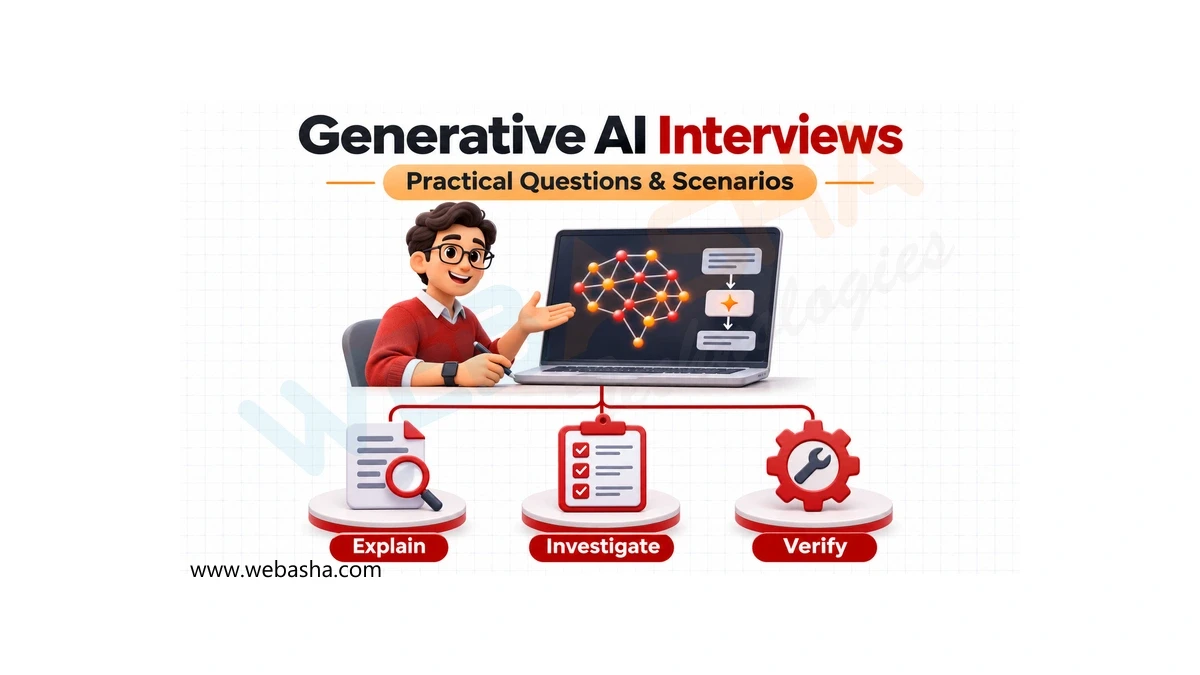
Prepare for generative AI interview questions by explaining the concept, applying it to a small scenario and describing the evidence you would check. Practise model foundations, retrieval, evaluation and tool-use boundaries, then connect those topics to your own project. State what you have tested and what remains a proposal.
This is an editorial practice set for application-focused learners and developers. Employers choose their own assessments, and deeper model research roles need additional preparation. Technical references were checked on 17 November 2026. The scenarios are fictional; no model or application was tested for this article.
Make your reasoning easy to follow
- Answer the question directly before describing an example.
- Identify the source, application stage and missing evidence.
- Explain how you would compare a proposed change.
- Keep lab, team and production contributions accurate.
Choose practice depth from the role
Read the job description and identify the tasks behind the tool names. An application role may need evidence of data preparation, retrieval and integration. A model-development role may ask for mathematical reasoning, training experiments and hardware trade-offs. Prepare for the work described rather than assuming every interview uses the same question bank.
Use the WebAsha generative AI engineering roadmap to organise a broader generative AI learning path. For each required skill, identify an exercise you can explain and one gap that needs revision.
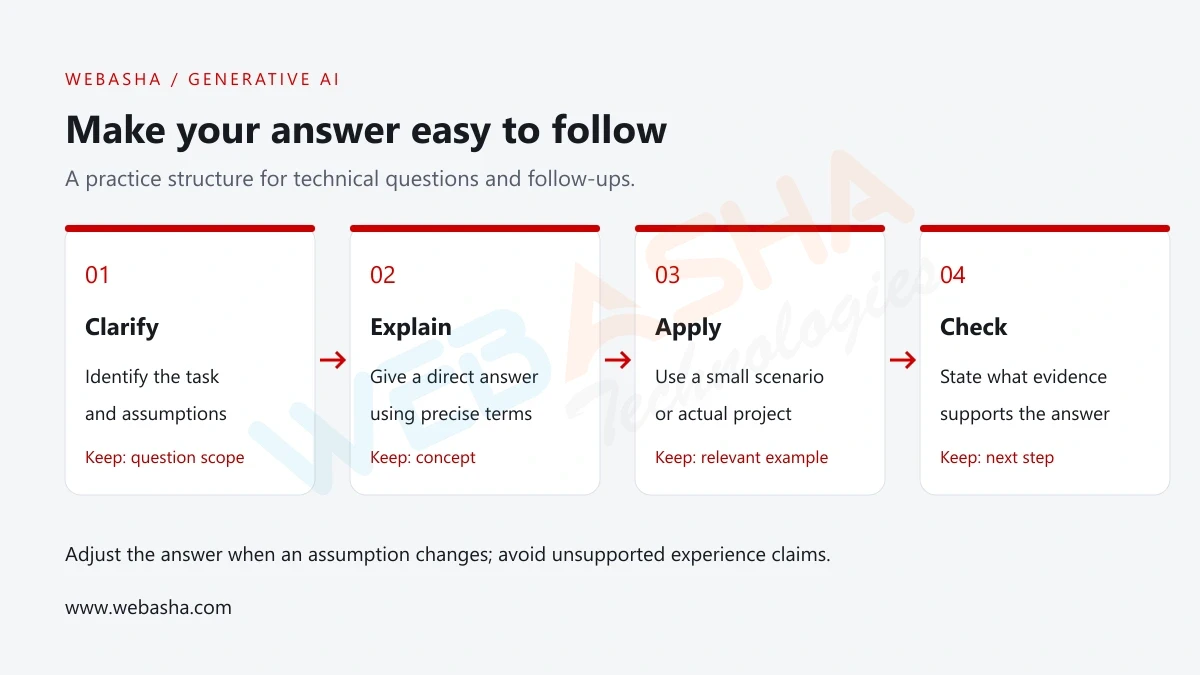
Practise a short answer followed by an example and a check. If the interviewer changes an assumption, update your reasoning. The sample answers below are starting points for practice, not scripts to recite as personal experience.
Foundation questions: model and application boundaries
1. What is the difference between a model and the application around it?
A model processes its inputs and produces output. The application supplies context, handles sources and controls integration with other systems. In an interview, draw the components of the system you actually built so the reviewer can see where each responsibility sits.
Follow-up: if an answer is wrong, which component would you inspect first? Ask what the failure looks like and preserve the input before choosing a fix.
2. How would you explain attention in a Transformer?
Attention layers help represent a token using information from other relevant positions in a sequence. Hugging Face’s introduction explains the idea through relationships between words and distinguishes encoder-only, decoder-only and encoder-decoder model families. [1]
Follow-up: explain the architecture used in your project instead of claiming every generative system has an identical design.
3. How would you investigate an input that is too long?
I would check the selected model’s documented input limits and the actual request assembled by the application. After identifying the necessary material, I would compare a revised input or retrieval approach on relevant cases, preserving source context while reducing unnecessary content.
4. Does a fluent answer establish factual correctness?
No. I would compare the response with the task’s permitted sources and expected behaviour. For a product answer, I would check whether each factual claim is supported and whether missing information was acknowledged. A confident tone is not evidence that the source contains the answer.
Design questions: choose an approach for the problem
5. When would you consider fine-tuning?
Fine-tuning continues training a pretrained model on task- or domain-specific data, as Hugging Face documents. I would first define the behaviour I want to change, identify suitable permitted examples and compare against a baseline before committing to a training approach. [2]
6. A team asks for current policy answers. What would you clarify?
I would ask who owns the approved policies, which users may access them and how updates are handled. I would then evaluate a source-backed answer workflow. Microsoft describes retrieval-augmented generation (RAG) as grounding responses in supplied content and identifies retrieval relevance, token constraints and access control as implementation concerns. [3]
Follow-up: if the source is outdated, a more polished answer does not repair it. Explain how you would locate the approved replacement and retest affected questions.
RAG scenarios: find the failing stage
7. A document assistant gives the wrong policy date. What do you inspect?
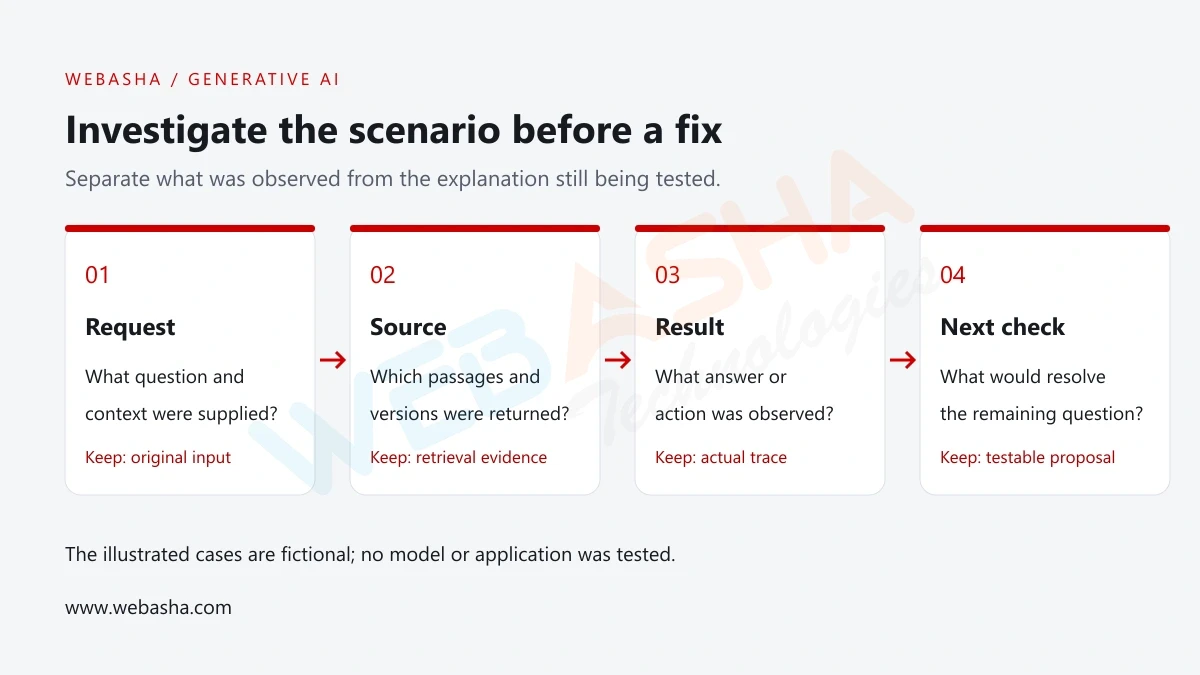
I would preserve the question, retrieved passages, source versions and response. If the retrieved passage contains an obsolete date, I would investigate source refresh and selection. If the passage is correct but the answer changes it, I would examine the generation step and output checks.
8. The right document exists but is not retrieved. What next?
I would confirm it was included and searchable for that user, then inspect how it was split and indexed. I would compare the question with the document wording and test the search method on known cases. I would change one relevant part and record whether the missing passage appears.
9. A user asks something the documents do not answer. What should happen?
The application should provide a qualified fallback suited to its task, such as asking for missing information or routing the question to the source owner. I would include unsupported questions in the evaluation set and inspect whether the answer invents a policy.
Useful follow-up: describe the difference between checking whether relevant material was retrieved and checking whether an answer accurately used it. Keep both traces available in a project walkthrough.
Evaluation scenarios: compare changes with evidence
10. How would you assess a prompt change?
I would define the requirement, preserve representative cases and compare outputs under the old and revised instructions. For a support draft, I would inspect source accuracy, missing information and unsupported commitments. I would review cases that became worse as well as those that improved.
11. Can another model judge the answers?
It can assist within a defined evaluation process, but I would inspect the criteria and disagreements. Google Cloud documents rubric-based evaluation for response qualities such as writing, safety and instruction following. A score needs context about the cases, rubric and review process. [4]
12. Your demo answers five questions correctly. What can you claim?
I can report those five observed cases with their conditions and review method. I cannot turn them into a claim of universal reliability. I would expand the review set to include missing sources, conflicting versions and unusual input before recommending broader use.
| Record | What it establishes |
|---|---|
| Case and source version | The input and context reviewed. |
| Expected behaviour | The requirement used for judgement. |
| Output and review reason | What happened and why it passed or failed. |
| Configuration change | Which difference was assessed. |
| Counts and denominators | The size of the reviewed sample. |
| Remaining failures | The limits of the reported improvement. |
The rows are suggested reporting fields, not measurements collected for this article. Choose criteria that fit the actual task.
Tool-use scenarios: separate a request from execution
13. Does a tool call mean the model ran the operation?
Check the integration. Anthropic distinguishes client tools executed by the application from server tools executed on its infrastructure. For a client tool, the model returns a structured call; the application runs the operation and returns the result. I would identify that boundary in the actual implementation. [5]
14. A reply-sending tool times out. Should you retry immediately?
I would first check whether the original action completed at the destination. A timeout can leave its status uncertain. I would use the request identifier and recorded state to investigate before another write, and route unresolved cases to the responsible operator.
Follow-up: show how the application checks the recipient, approved content and permitted action. A model’s proposed arguments should be inspected under the application’s rules before execution.
Security scenarios: protect input and source boundaries
15. A retrieved document asks the assistant to ignore its task. What do you do?
Treat that text as untrusted source content. OWASP describes indirect prompt injection through external material and recommends layered controls such as separation, validation, least privilege and human review. I would assess the output and tool proposals while preserving the application’s access boundaries. [6]
16. How would you test whether private documents leak?
I would use a controlled environment with fictional users and documents whose permitted access is explicit. I would test retrieval and final answers under those identities, inspect the returned sources and record failures. I would also review logs and retained output for unintended private content.
Explain the tests you actually performed. Do not claim that one filtered phrase or one successful test proves protection against every possible input. The WebAsha discussion of generative AI ethical concerns gives broader context for data use and accountability.
Project questions: describe your contribution accurately
17. Walk me through a generative AI project you completed.
Use your own project and describe its task, permitted inputs, main components and observed results. Explain which part you built and how you assessed it. If it was a tutorial reproduction or shared assignment, credit the source and collaborators.
A possible outline is: “I built a local prototype over a small approved document set. I reviewed retrieved passages beside the answers and recorded unsupported questions. My contribution was the preparation and evaluation flow.” Use that wording only when it accurately describes your work.
18. Tell me about a failure and the change you made.
Choose a real example. Explain the failing case, the evidence that helped locate the problem and the correction you tested. Include a limitation or remaining failure. If you have not completed a project, say so and discuss a clearly labelled design exercise.
Practical AI projects can provide useful interview evidence when the report makes the scope visible. Keep private records, credentials and restricted course solutions out of public demonstrations.
Common answer problems and useful corrections
| Problem | Practice correction |
|---|---|
| Reciting tool names | Explain the task one tool performed and its output. |
| Treating all wrong answers as the same issue | Locate input, retrieval, generation or action evidence. |
| Reporting a percentage without context | Give the reviewed count, denominator and case types. |
| Claiming deployment after a local demo | State the environment and actions actually completed. |
| Offering a broad change before understanding the case | Clarify the requirement and identify a check. |
| Inventing experience to match the role | Describe the gap and relevant work you can support. |
If you do not know a detail, state the gap and identify the documentation or trace you would consult. You can still explain your current understanding without pretending you have used a particular provider or framework.
A practical rehearsal session
Choose one foundation question and a scenario that matches the role. Give a concise answer, then have another person change an assumption: the source is old, the user lacks access or the action status is uncertain. Explain how that change affects the next check.
Keep a short revision list of concepts you could not explain and evidence missing from your project. Use the WebAsha comparison of generative and predictive AI for terminology, then verify implementation details in the provider’s documentation.
Build AI engineering skills through tasks you can demonstrate. Interview preparation works alongside that practice; reading a question list does not establish professional experience or predict an employer’s selection decision.
Discuss Generative AI training with WebAsha Technologies. Contact WebAsha with your starting skills and project-review goals.
Official references
Frequently Asked Questions
What's Your Reaction?
 Like
0
 Dislike
0
 Love
0
 Funny
0
 Wow
0
 Sad
0
 Angry
0

With a passion for staying on the cutting edge of technology trends, I am dedicated to delivering content that not only informs but also inspires. Whether you need in-depth analysis pieces, informative guides, or thought-provoking opinion pieces, I craft content that resonates with tech enthusiasts and professionals alike.