Generative AI Course Syllabus: Skills Beyond Prompting
A useful generative AI course syllabus connects model foundations and prompt design with data preparation, retrieval, evaluation and controlled tool use. Look for labs where you can inspect the source, explain a failure and show how a change was assessed. Match the depth of programming and model training to the kind of application you want to build.
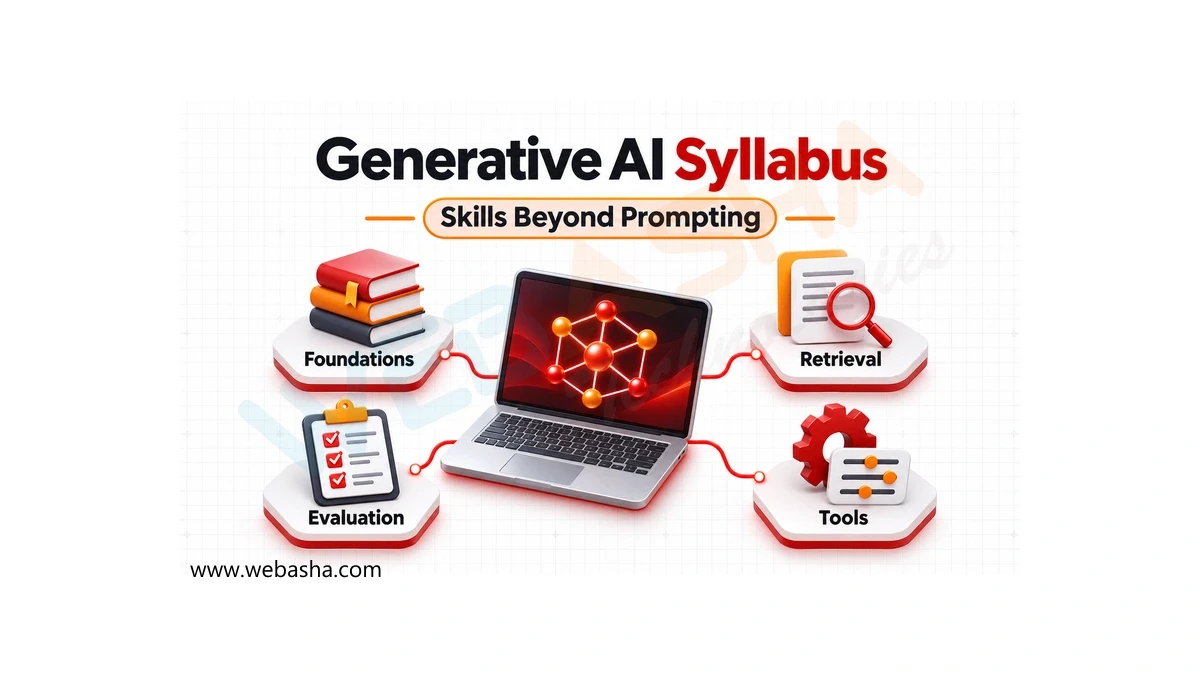
A useful generative AI course syllabus connects model foundations and prompt design with data preparation, retrieval, evaluation and controlled tool use. Look for labs where you can inspect the source, explain a failure and show how a change was assessed. Match the depth of programming and model training to the kind of application you want to build.
Use this editorial curriculum guide to compare training plans and discuss your starting level. It is not a confirmed syllabus, duration or assessment policy for a specific WebAsha batch. Technical sources were checked on 17 November 2026; the lab briefs below were not executed for this article.
Compare skills and evidence
- Check prerequisites against the actual exercises.
- Ask what each module lets you build or explain.
- Evaluate source use and failure handling alongside fluent output.
- Confirm individual work, feedback and capstone requirements.
Choose the depth before comparing course modules
Application users, software builders and model researchers need different amounts of programming and mathematics. A course focused on workplace drafting may begin with approved documents and review criteria. A developer course should let you inspect requests, structured data and application behaviour. A model-training course needs a deeper treatment of datasets, optimisation and experiments.
Read the exercise prerequisites rather than relying on a beginner label. For example, the Hugging Face LLM Course asks for good Python knowledge and recommends taking it after an introductory deep learning course. That is the prerequisite for that named resource, not a universal entry rule for every generative AI programme. [1]
Before enrolling, ask for one sample assignment and its expected starting skills. If the assignment assumes functions, dictionaries or API responses you cannot yet explain, plan foundation practice or choose an introductory route. The WebAsha generative AI engineering roadmap gives broader learning context.
A generative AI course syllabus with observable outputs
| Module | Topics to discuss | Evidence to request |
|---|---|---|
| Foundations | Generative models, large language models (LLMs), tokens and limitations | Explain the path from input to generated output. |
| Data and programming | Python or equivalent integration skills; source preparation | Inspect and transform a small permitted dataset. |
| Prompt design | Instructions, examples, context and output constraints | Compare versions against defined cases. |
| Retrieval | Source preparation, search and grounded answers | Trace an answer to retrieved material. |
| Evaluation | Rubrics, test sets and error analysis | Report outcomes with failure examples. |
| Tool use | Tool schemas, execution and action boundaries | Explain a proposed call and its result. |
| Security and operations | Input trust, credentials, logs and exceptions | Demonstrate a controlled failure and recovery route. |
| Capstone | A bounded application with documented scope | Submit reproducible work and an honest review. |
This map is a suggested way to compare coverage. It does not mean every course must teach every item at the same depth. Ask the provider which topics involve individual practical work, which are demonstrations and which are conceptual introductions.
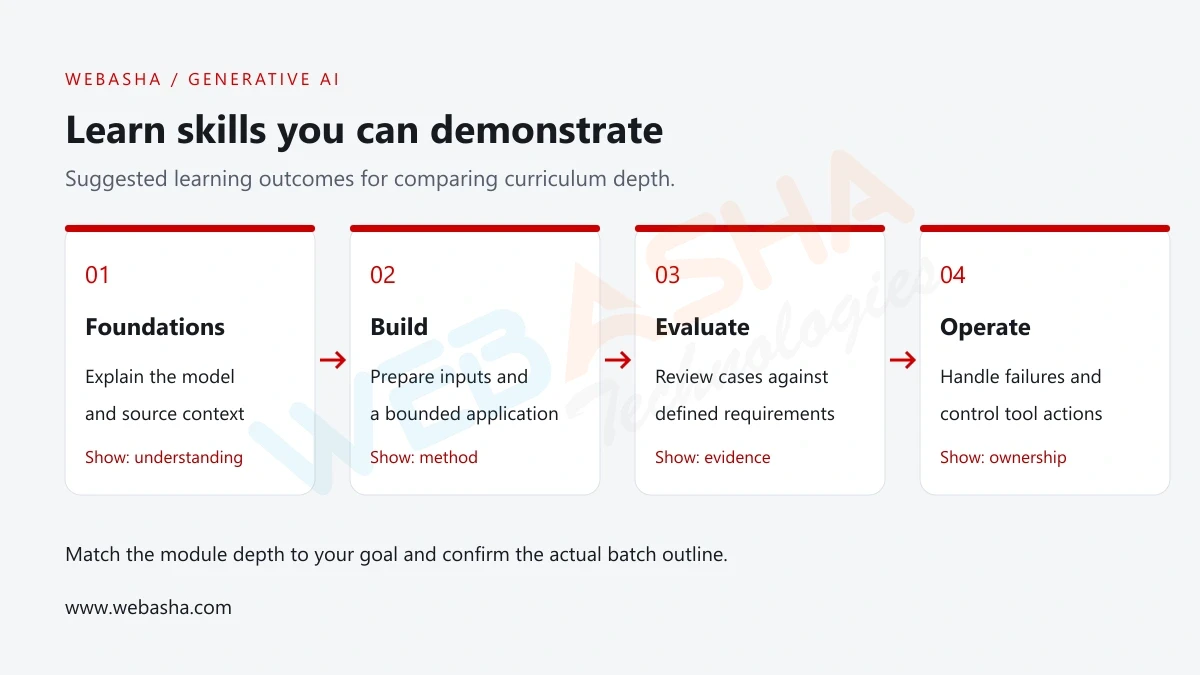
Learn model concepts and data handling together
Start with the difference between a model, an application and a workflow. Learn what the selected model receives, what it generates and which settings the application controls. Explain tokens, context limits and the distinction between using a pretrained model and training or adapting one.
Use a small data exercise to make those ideas concrete. Read a permitted document set, preserve identifiers and note missing or conflicting information. If a source is updated, the application needs a way to distinguish the old material from its replacement.
The Hugging Face course covers Transformers, datasets, tokenizers, model fine-tuning and demos. [1]
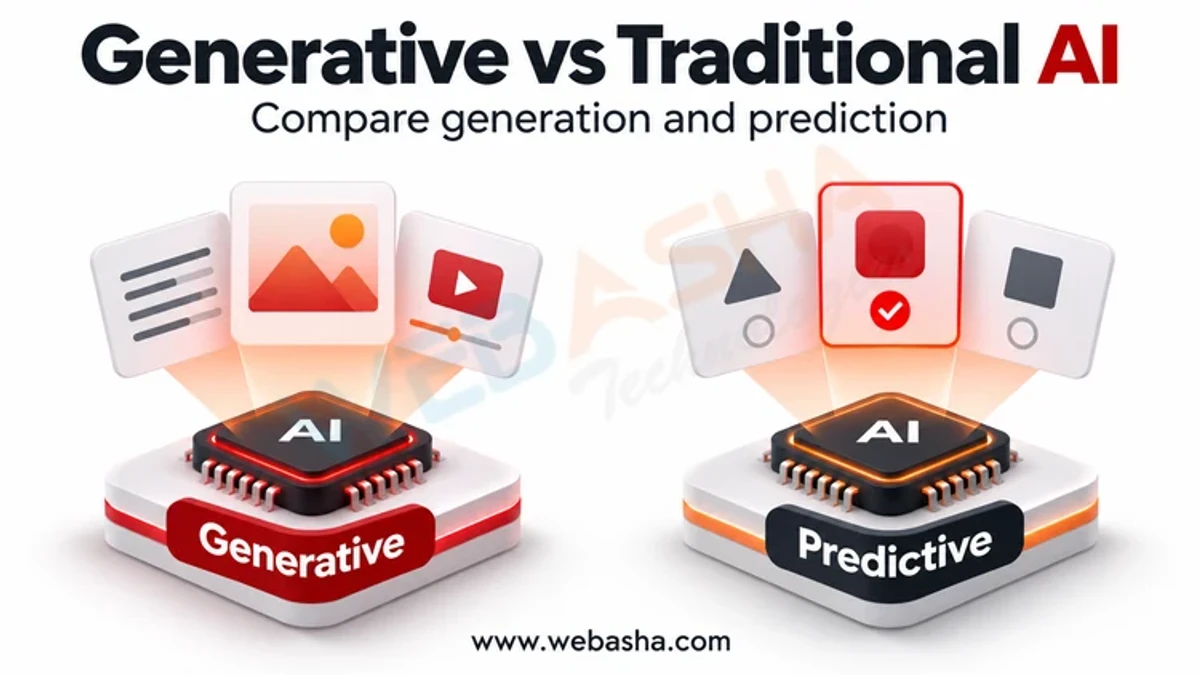
For an application-focused beginner, a suitable early output is a diagram of the data flow and a small data preparation task. For a deeper model track, ask how mathematical concepts connect to experiments you can inspect. The WebAsha comparison of generative and predictive AI can help with the terminology.
Practise prompt engineering through comparisons
Write LLM instructions that identify the task, permitted source material and expected output. Use examples when they clarify the task. Then test the instruction on cases that include missing information and ambiguous requests, keeping the input and output for review.
For a fictional product FAQ, ask for an answer supported only by the supplied description. Compare a broad instruction with a revised one that asks for a source reference and an explicit unknown result. Review whether the change helped the intended cases and whether it introduced a new failure elsewhere.
A useful assignment records the prompt version, sample inputs, review criteria and observed differences. It should not claim that one phrasing guarantees correct answers. Being able to explain why a case failed is part of the exercise.
Ask how the course teaches output validation. A response can have the requested structure and still contain an unsupported value. Review the meaning against the source as well as checking its form.
Study retrieval as a separate stage to inspect
Retrieval-augmented generation, or RAG, supplies relevant source content to support generation. Microsoft’s overview discusses content preparation, retrieval relevance, token constraints and access control as implementation concerns. A source connection alone does not resolve those concerns. [2]
In a lab, keep the retrieved passages visible before reviewing the answer. If the answer is wrong, first ask whether the right material was retrieved. Then ask whether the generated response used it accurately.
Use a few approved documents with clear identifiers. Include a question the documents answer, one they do not and one affected by conflicting versions. Require a source-linked answer or a qualified fallback. Test access boundaries using fictional users and documents with explicit permissions.
Ask whether the syllabus covers source refresh, document splitting and search evaluation. Learners should be able to explain the chosen approach without assuming a particular vector database or framework is compulsory for every project.
Make evaluation part of every build
Define what a satisfactory output must do before comparing model or prompt versions. For a support draft, criteria might include answering the supplied question, using the approved policy and avoiding an invented commitment. Keep the criteria specific enough that a reviewer can explain a disagreement.
Google Cloud documents rubric-based evaluation for response qualities such as writing, safety and instruction following. Its service is one product example; an evaluation module should also teach learners to inspect the examples and rationale behind a score. [3]
| Record | Purpose |
|---|---|
| Case and source version | Identify exactly what was assessed. |
| Expected behaviour | Describe the requirement before judging output. |
| Observed result | Preserve the response or relevant action trace. |
| Review decision and reason | Explain acceptance, failure or uncertainty. |
| Change tested | Connect a correction to the evidence. |
| Remaining limitation | State what the exercise did not establish. |
Report counts with denominators and include failed cases. A small classroom sample is useful for learning but cannot establish reliability across every future input. Ask whether feedback addresses the reasoning behind a result rather than only the final demonstration.
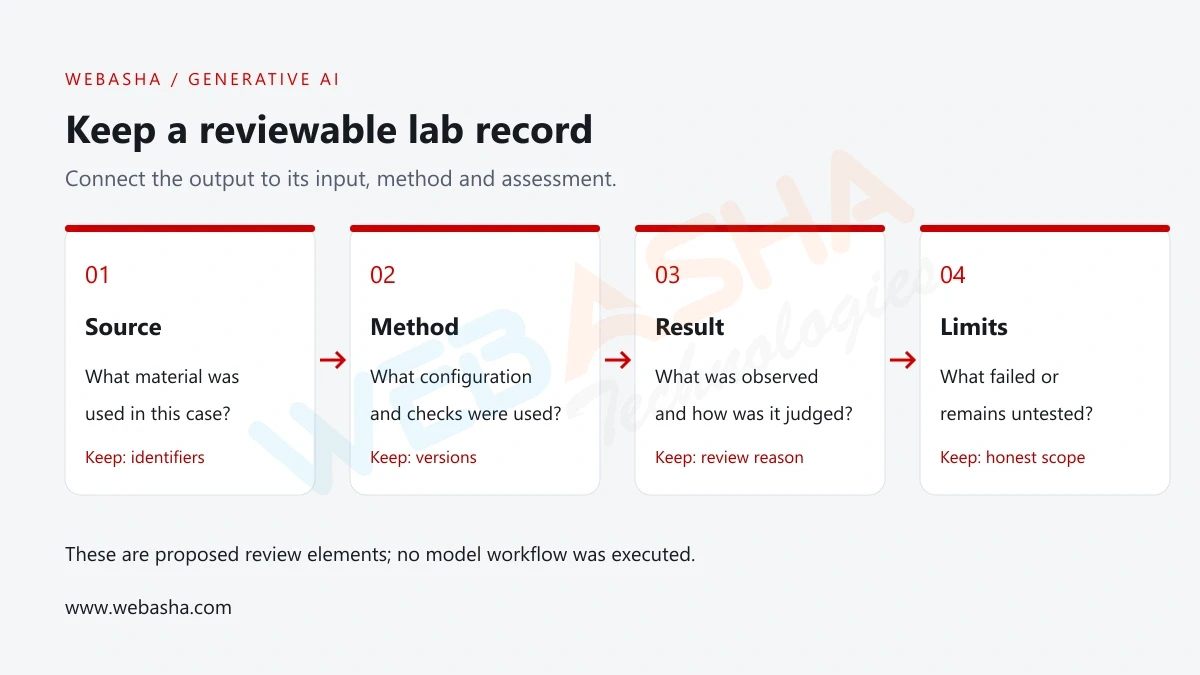
Understand tool use and application authority
A tool-using application can do more than generate text. The learner should be able to identify the proposed operation, its arguments and the component that executes it.
Anthropic’s documentation distinguishes client tools, which run in the application, from server tools, which run on its infrastructure. For a client tool, the model returns a structured call and the application runs the operation and returns a result. Check the selected provider’s own execution model. [4]
A beginner lab can use a mock catalogue lookup with no external writes. Add a missing item and an invalid argument to see how the application handles them. If the course later introduces messages or record changes, ask how it checks destinations, permissions and approval of the exact action.
Keep fine-tuning and model adaptation in a clearly scoped module. Ask which problem the exercise addresses, what data is permitted and how it compares with a baseline. A learner should not need to train a model merely to demonstrate a straightforward lookup workflow.
Include AI input security and operational failures
External text may contain instructions that try to redirect the model. OWASP describes this indirect prompt-injection problem and recommends layered defences, including separation of instructions and data, validation, least privilege and human review. A statement inside a prompt is not a complete access-control mechanism. [5]
Ask for defensive exercises using synthetic material. The application should preserve its intended task when an input contains unrelated instructions. Learners should inspect the actual output and any tool proposal, and state which controls were tested.
Operational work should cover unavailable services, malformed output, duplicate requests and private information in logs. Use a test environment to practise stopping an action, recording its status and handing the exception to an owner.
NIST describes its AI RMF Playbook as voluntary guidance for considering trustworthiness across AI design, development, deployment and use. It can support a broader discussion; completion of a course exercise does not establish legal compliance or certification. [6]
Ask for a capstone with evidence of individual work
A bounded document assistant is one possible capstone. Define a permitted document set, expected users and the questions it should answer. Keep the application read-only at first, with source references and a fallback for unsupported questions.
- Document the task, source permissions and scope.
- Preserve the preparation method and configuration needed to reproduce the work.
- Build a baseline and collect a small review set.
- Inspect retrieval, generated answers and failures separately.
- Make a correction and repeat the relevant cases.
- Submit the result with limitations and individual contributions.
These are proposed lab requirements, not results from an executed capstone. If work is shared, identify what each learner built and reviewed. A portfolio should distinguish a tutorial reproduction, an original extension and a deployed application.
The WebAsha discussion of generative AI ethical concerns offers background for reviewing data use and accountability before sharing a project.
Questions to ask before choosing training
Request the actual batch outline and prerequisites, then ask how much practical work receives individual feedback. Confirm which accounts and tools learners need, what environment is provided and whether the final project can be retained or shown publicly.
Ask to see the assessment criteria. A completion certificate, an issuer’s assessed credential and a project review have different meanings. Confirm the stated outcome directly with the provider and issuer.
Choose a level at which you can explain your work and improve it after feedback. If an advanced topic appears only as a demonstration, record that depth accurately when comparing options.
Discuss Generative AI training with WebAsha Technologies. Contact WebAsha to confirm the current syllabus, prerequisites, lab access and project-review process for your batch.
Official references
Frequently Asked Questions
What's Your Reaction?
 Like
0
 Dislike
0
 Love
0
 Funny
0
 Wow
0
 Sad
0
 Angry
0

With a passion for staying on the cutting edge of technology trends, I am dedicated to delivering content that not only informs but also inspires. Whether you need in-depth analysis pieces, informative guides, or thought-provoking opinion pieces, I craft content that resonates with tech enthusiasts and professionals alike.