Generative AI Projects for Beginners: Build Useful Applications
Start generative AI projects for beginners with a small input and an output you can check, such as a source-linked summary, study question or draft reply. Build one complete path from input to review, then test missing information and poor output. Keep the project scope and observed results clear enough for someone else to inspect.
Start generative AI projects for beginners with a small input and an output you can check, such as a source-linked summary, study question or draft reply. Build one complete path from input to review, then test missing information and poor output. Keep the project scope and observed results clear enough for someone else to inspect.
These are editorial project briefs for learners building application skills. The Python checking exercise was run locally on fictional in-memory data; no model, customer dataset or external application was used. Technical references were checked on 17 November 2026.
Finish a project you can explain
- Choose an input you have permission to use.
- Define what a satisfactory output must do.
- Preserve failed cases and the changes you assessed.
- Separate a local prototype from a deployed service.
Choose a first project by the result you can review
Pick one task that has an identifiable source and a clear stopping point. A short summary of a supplied document is easier to inspect than an assistant expected to answer anything. Keep the first version small enough that you can read every input and output.
| Project | First deliverable | A useful test |
|---|---|---|
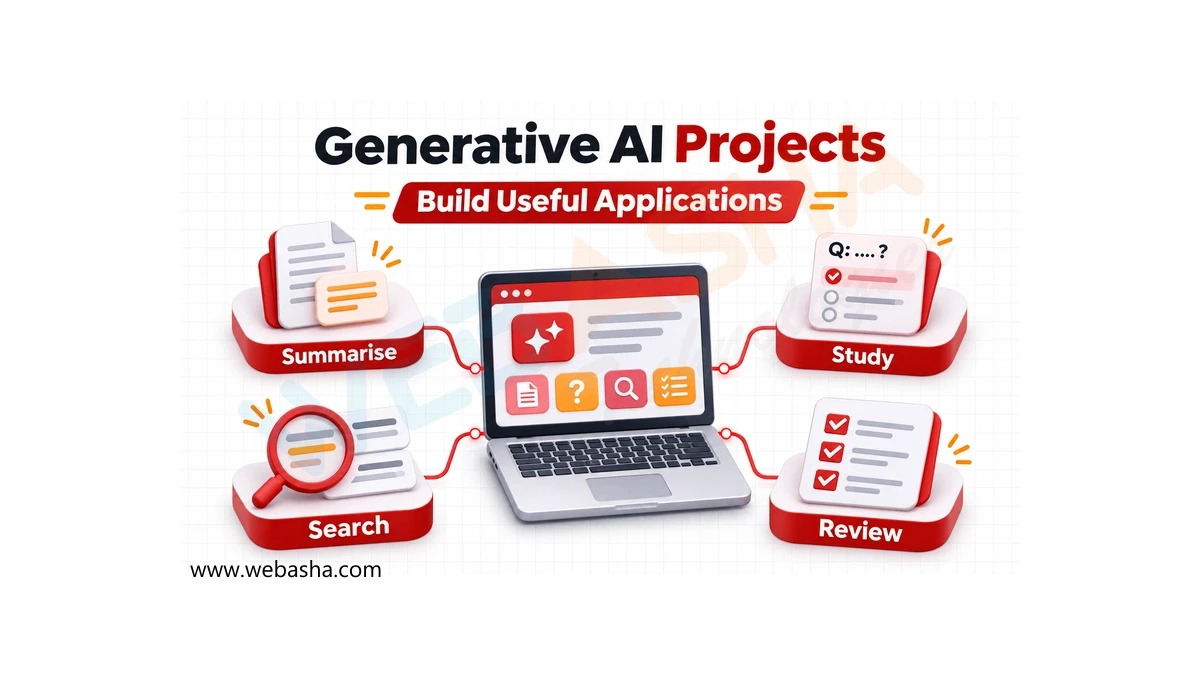
| Source-linked summariser | Summary with references to supplied passages | An important detail absent from the draft. |
| Study-question assistant | Questions and draft answers from approved notes | A question the notes cannot answer. |
| Reply-draft assistant | Editable reply based on an approved policy | A request for an unsupported exception. |
| Document question assistant | Answer with the retrieved source | Conflicting or outdated documents. |
| Content adaptation tool | Draft derived from approved source copy | An invented product claim. |
| Output review helper | Flags for missing fields and unknown source IDs | Malformed or incomplete sample output. |
The last project supports a generative application; it does not generate content itself. It is useful beginner practice because it makes one part of output handling inspectable before a model is connected.
Use the WebAsha generative AI engineering roadmap to connect the project with a broader generative AI learning path. Select the next skill from the work you need to complete.
Define the input, model step and review step
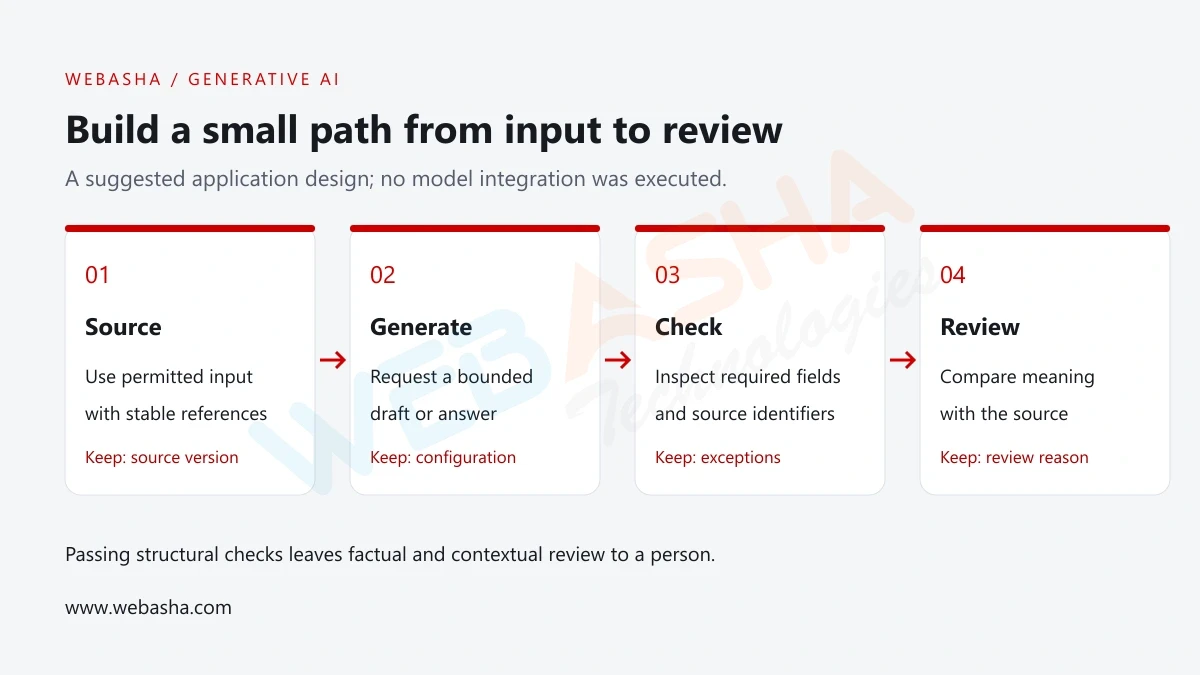
Write a brief with the intended user, permitted source material and expected output. Decide where the application will stop when information is missing. Keep sending messages, changing records and publishing outside the first draft-only prototype.
For a model integration, record the provider or local model, model identifier, configuration and documentation used. Hugging Face documents pipelines as an inference abstraction for supported tasks. A library wrapper helps organise the call; it does not establish that an output meets your project’s requirements. [1]
Begin with fictional or approved material and keep credentials out of shared code. Inspect the chosen tool’s data handling and runtime requirements before supplying a real dataset. This guide does not prescribe an installation or a model download.
Project 1: a source-linked document summariser
Use a short document you wrote yourself, such as a fictional product guide. Ask for a summary that identifies the supplied passage behind each factual point. Show the original beside the draft so a reviewer can compare them.
Define a few requirements before generating: preserve an important qualification, avoid unsupported details and acknowledge missing information. Include a version where two passages disagree. Ask the application to expose that conflict instead of quietly selecting a convenient answer.
Completion evidence: the document version, instruction, draft and review notes. Record a failed case and a revised attempt. If the summary omits a qualification, identify the exact passage before changing the prompt or model.
A useful extension is to compare two draft lengths using the same source and criteria. Report observed trade-offs without claiming that one configuration is universally more accurate.
Project 2: a study-question assistant
Provide a small set of approved learning notes. Generate draft questions, expected answers and references to the notes. Let the learner inspect the reference after attempting a question.
Review whether each answer follows from the notes and whether the question has a clear meaning. Include an unanswered topic to test the fallback. Keep the exercise separate from official exam predictions or a claim that generated questions match an issuer’s assessment.
Completion evidence: a reviewed question set, source references and a list of rejected items with reasons. An extension could vary question difficulty while preserving the underlying source facts. Keep a person responsible for checking the final learning material.
Projects 3 and 4: reviewable reply and content drafts
Reply-draft assistant
Use fictional enquiries and an approved policy excerpt. Produce an editable answer with the source reference and any unresolved question. Test a message that asks for an exception the policy does not authorise. The draft should leave that decision with its owner.
Check names, dates, promised actions and unsupported details. Completion evidence is the original enquiry, policy version, draft and reviewer correction. A send button is a separate integration with its own destination and action checks.
Content adaptation tool
Turn a supplied product description into a draft newsletter paragraph or short caption. Preserve the original factual claims and distinguish proposed creative wording from source facts. Test whether the draft invents a feature or endorsement.
Completion evidence is a source-to-draft comparison with editorial corrections. Keep automatic public publishing outside the beginner version. The WebAsha comparison of generative and predictive AI can help clarify the task you are building.
Project 5: a document question assistant with visible retrieval
Use a few approved documents with stable identifiers. Return the relevant passages with the generated answer so the reviewer can inspect both stages.
Retrieval-augmented generation (RAG) uses source content to ground generation. Microsoft’s overview identifies content preparation, retrieval relevance, token constraints and access control as implementation concerns. A connected document folder alone does not resolve them. [2]
Start with a question the documents answer and one they do not. Then introduce an old document version and a conflicting statement. If the final answer is wrong, check which passages were retrieved before changing the generation instruction.
Completion evidence: source versions, search configuration, retrieved passages, answers and review decisions. A useful extension tests fictional user access to restricted documents. Preserve the same access boundary in retrieval, output and logs.
Project 6: a small Python output-checking exercise
This exercise checks fictional JavaScript Object Notation (JSON) strings before source review. It requires an existing Python 3 interpreter and uses only the standard library. It makes no network calls, reads no files and changes no system settings. Paste it into a local scratch script or interpreter you control.
Python’s json.loads decodes a JSON string, and malformed input can raise JSONDecodeError. The additional checks below are explicit rules written for this exercise. [5]
import json

known_sources = {"guide-1"}
samples = [
    '{"answer": "See the supplied guide.", "sources": ["guide-1"]}',
    '{"answer": "A draft answer.", "sources": ["unknown"]}',
    '{"answer": "", "sources": ["guide-1"]}',
    '{broken',
]

def check(raw):
    try:
        item = json.loads(raw)
    except json.JSONDecodeError:
        return "needs_fix"
    if not isinstance(item, dict):
        return "needs_fix"
    answer = item.get("answer")
    sources = item.get("sources")
    if not isinstance(answer, str) or not answer.strip():
        return "needs_fix"
    if not isinstance(sources, list) or not sources:
        return "needs_fix"
    if not all(isinstance(s, str) and s in known_sources for s in sources):
        return "needs_fix"
    return "ready_for_review"

results = [check(raw) for raw in samples]
print(results)
print("ready_for_review:", results.count("ready_for_review"))
print("needs_fix:", results.count("needs_fix"))
Observed output from the local run:
['ready_for_review', 'needs_fix', 'needs_fix', 'needs_fix']
ready_for_review: 1
needs_fix: 3
The first item has a non-empty answer and a known source identifier, so it is ready for a person to review. The other items contain an unknown source, an empty answer or malformed JSON. The code does not inspect source text, verify a claim or decide whether an answer is safe.
For an extension, add wrong-type cases and a missing source list. Preserve expected outcomes before changing the rules. Passing this checker is a structural prerequisite in this exercise, not a claim that a generated answer is correct.
Evaluate the project with ordinary and difficult cases
Write a review set before comparing versions. Include normal inputs, absent information and examples that should be rejected or routed to a person. Keep the actual outputs so another reviewer can understand the decision.
Google Cloud documents rubric-based evaluation for response qualities such as writing, safety and instruction following. It is one product example; the project should make its own criteria and reviewed cases visible regardless of evaluation tool. [3]
| Field | What to keep |
|---|---|
| Input and source version | The exact material reviewed. |
| Expected behaviour | The requirement used to judge the result. |
| Observed output | The draft, retrieval trace or checker result. |
| Decision and reason | Acceptance, correction or unresolved issue. |
| Configuration change | What differed between compared attempts. |
| Scope and limits | Cases not covered by the reported result. |
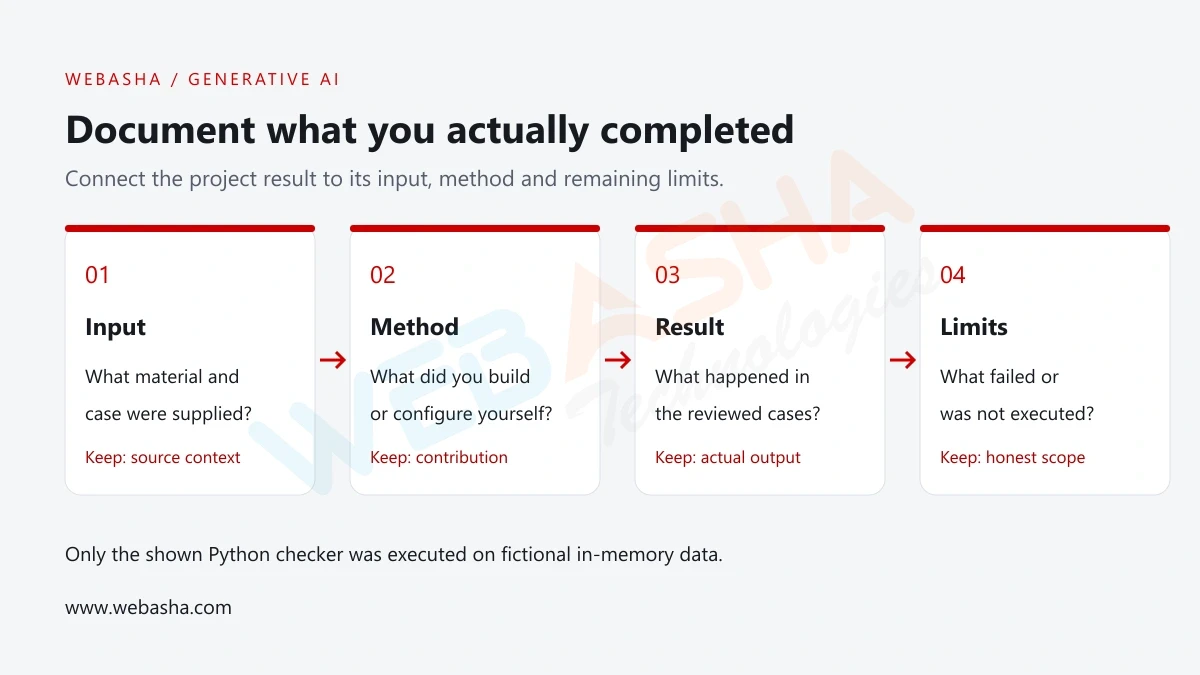
Report counts with denominators and include correction effort. A small sample can expose obvious problems, but it does not establish reliability for every future input. The local Python output above establishes only how the shown rules handled four fixed samples.
Troubleshoot failures and preserve data boundaries
If a summary invents a detail, locate the source passage and compare the instruction with the output. If a document answer cites the wrong version, inspect retrieval and source refresh. If a checker rejects valid input, reduce the case and inspect the exact rule before widening acceptance.
External documents and messages are untrusted content. OWASP describes indirect prompt injection and recommends layered controls, including separation, validation, least privilege and human review. A single instruction in a prompt is not a complete application security boundary. [4]
Test with synthetic material in an environment you control. Keep secrets out of reports, screenshots and shared repositories. The WebAsha discussion of generative AI ethical concerns provides background for data use and accountability.
When a service is unavailable, preserve the request status and show a clear exception. Route uncertain outcomes to the responsible person before retrying an external action.
Document the result and choose the next extension
Write a README with the task, prerequisites, permitted inputs, configuration, run method and limitations. Include a few reviewed cases and a failure you corrected. Credit tutorials and collaborators, and identify what you implemented yourself.
Describe the state accurately: a proposed design, an executed local exercise and a deployed application are different deliverables. For this article, only the shown Python checker was executed. The model-backed applications remain project briefs.
Develop AI engineering skills by completing the next missing part of one application. Add a review interface, improve a source trace or handle an exception before expanding to more data and actions.
Discuss Generative AI training with WebAsha Technologies. Contact WebAsha with your starting skills and the practical AI projects you want to build.
Official references
Frequently Asked Questions
What's Your Reaction?
 Like
0
 Dislike
0
 Love
0
 Funny
0
 Wow
0
 Sad
0
 Angry
0

With a passion for staying on the cutting edge of technology trends, I am dedicated to delivering content that not only informs but also inspires. Whether you need in-depth analysis pieces, informative guides, or thought-provoking opinion pieces, I craft content that resonates with tech enthusiasts and professionals alike.