What Is Enumeration in Cyber Security? Types, Commands and Defence
Enumeration is the stage of a security assessment where the tester connects to services already discovered and extracts detailed information from them: user and group names, shared folders, software versions, DNS records, network devices and configuration. Scanning tells you a door exists; enumeration tells you what is behind it.
Topic: Ethical Hacking in Cybersecurity & Ethical Hacking · Explainer
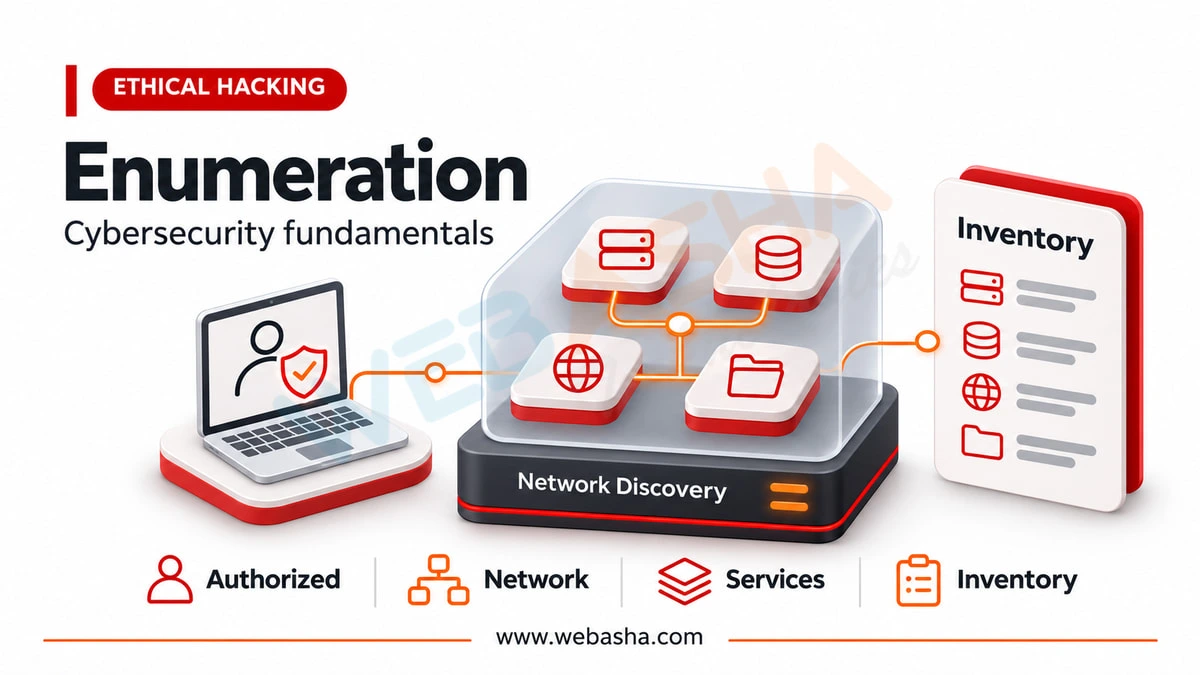
Quick answer: Enumeration is the stage of a security assessment where the tester connects to services already discovered and extracts detailed information from them: user and group names, shared folders, software versions, DNS records, network devices and configuration. Scanning tells you a door exists; enumeration tells you what is behind it. Attackers use the same techniques, which MITRE ATT&CK groups under its Discovery tactic, so defenders should know exactly what their services give away to anyone who asks.
Key takeaways
- Enumeration follows scanning and turns open ports into usable detail.
- The richest sources are usually SMB, LDAP and Active Directory, DNS, SNMP and NFS.
- Default and anonymous access settings leak far more than most administrators expect.
- It is legal only on systems you own or are authorised to test.
- Defenders can detect it: bursts of directory queries and failed anonymous binds stand out in logs.
Table of Contents
- What Is Enumeration in Cyber Security?
- How Is Enumeration Different From Scanning?
- What Are the Main Types of Enumeration?
- Which Commands Are Used, Protocol by Protocol?
- How Does Enumeration Fit Into an Assessment?
- Is Enumeration Legal?
- How Can Defenders Reduce Exposure?
- How Do Defenders Detect Enumeration?
- References
What Is Enumeration in Cyber Security?
It is active, structured information gathering against specific services. The tester asks each service questions its protocol allows, such as which shares exist, which users belong to which groups, which records a DNS server holds, and records the answers. The output is a map of accounts, systems and weak points that shapes everything that follows in the test.
In MITRE ATT&CK, these behaviours fall under the Discovery tactic, with techniques such as T1087 Account Discovery, network share discovery and system service discovery.
How Is Enumeration Different From Scanning?
Scanning finds live hosts and open ports, and often guesses service versions. Enumeration connects to those services properly and pulls structured information from them. A scan reports port 445 open; enumeration lists the shares on it, the users who can read them and the domain the machine belongs to.
What Are the Main Types of Enumeration?
| Protocol | Port | What it can reveal |
|---|---|---|
| NetBIOS and SMB | 137 to 139, 445 | Shares, users, groups, password policy, domain name |
| LDAP and Active Directory | 389, 636 | Users, groups, computers, organisational structure |
| DNS | 53 | Hostnames, mail servers, sometimes the whole zone |
| SNMP | 161 UDP | Device details, interfaces, running processes, routes |
| NFS | 2049 | Exported directories and which hosts may mount them |
| SMTP | 25 | Valid mailbox names, via VRFY or RCPT responses |
| Web services | 80, 443 | Directories, technologies, API endpoints |
Which Commands Are Used, Protocol by Protocol?
Run these only against a lab or systems you are authorised to test. Start with versions and default scripts from the Nmap reference guide:
nmap -sC -sV -p 53,139,389,445,2049 192.168.56.110
nmap -sU -p 161 --script snmp-info 192.168.56.120SMB: shares, users and domain information. enum4linux-ng wraps several tools into one report:
enum4linux-ng -A 192.168.56.110
smbclient -L //192.168.56.110 -N          # list shares with a null session
nmap --script smb-enum-shares,smb-enum-users -p 445 192.168.56.110LDAP: read the naming context, then query users if anonymous or authorised access allows:
ldapsearch -x -H ldap://192.168.56.110 -s base namingcontexts
ldapsearch -x -H ldap://192.168.56.110 -b 'DC=lab,DC=local' '(objectClass=user)' sAMAccountNameDNS: records, and a zone transfer attempt, which a correctly configured server refuses:
dig +short NS lab.example
dig axfr lab.example @ns1.lab.exampleSNMP: walk the device information tree with a community string, often a default such as public on badly configured devices:
snmpwalk -v2c -c public 192.168.56.120 1.3.6.1.2.1.1NFS: list exported directories and who may mount them:
showmount -e 192.168.56.130The Nmap Scripting Engine documentation lists many more scripts by protocol. Our dedicated guides cover NetBIOS enumeration and SNMP and LDAP enumeration in depth.
How Does Enumeration Fit Into an Assessment?
It sits after reconnaissance and scanning, and before vulnerability analysis and exploitation. Good enumeration often makes exploitation unnecessary: an exposed share containing a configuration file with a password, or a user list combined with a weak password policy, is already a finding. In Active Directory tests, enumeration of groups and permissions maps the paths from an ordinary account to domain administrator. See common penetration testing techniques for the full sequence.
Is Enumeration Legal?
Only on systems you own or have written permission to test. Querying someone else's directory, shares or devices without authorisation is unauthorised access under the Information Technology Act, 2000, even if the service answered without a password. Practise in a lab, or under a signed scope. Our article on ethical hacking laws explains authorisation.
How Can Defenders Reduce Exposure?
- Disable anonymous and null-session access to SMB, and anonymous LDAP binds.
- Restrict DNS zone transfers to authorised secondary servers only.
- Replace default SNMP community strings, or move to SNMPv3 with authentication and encryption.
- Limit NFS exports to specific hosts, never to everyone.
- Block these services at the network edge; they rarely need to be reachable from the internet.
- Run the same commands against your own network regularly, and fix what answers.
How Do Defenders Detect Enumeration?
Enumeration is noisy. Signs to alert on include a single host making many LDAP queries for users and groups in a short time, many SMB share or session listing requests across different servers, failed anonymous or null-session attempts, refused zone transfer requests in DNS logs, and SNMP requests with wrong community strings. On Windows domain controllers, directory service access auditing and endpoint detection tools capture much of this. Our guide to Active Directory attack methods covers detection for each path.
Talk to a WebAsha training advisor about ethical hacking courses, batches and current fees.
References
- Nmap reference guide
- Nmap Scripting Engine documentation
- MITRE ATT&CK, Discovery (TA0007)
- MITRE ATT&CK T1087, Account Discovery
- enum4linux-ng
Related reading
Frequently Asked Questions
What's Your Reaction?
 Like
0
 Dislike
0
 Love
0
 Funny
0
 Wow
0
 Sad
0
 Angry
0

I am passionate about technology, invention and big challenging tasks on my to- do list. In terms of the work I am doing also at Bunnyshell, I am most passionate about the technologies that we are using., I'm devoted to delivering content that not only informs but also inspires. Whether you need in- depth analysis pieces, educational attendants, or study- provoking opinion pieces, I draft content that resonates with tech suckers and professionals likewise.