CEH vs OSCP: Which Ethical Hacking Certification Is Better?
An honest comparison of CEH and OSCP - format, difficulty, cost, recognition and who each genuinely suits - without pretending one is universally better.
Topic: Ethical Hacking in Cybersecurity & Ethical Hacking · Comparison
Also covers: Penetration Testing, Cybersecurity Careers & Certifications
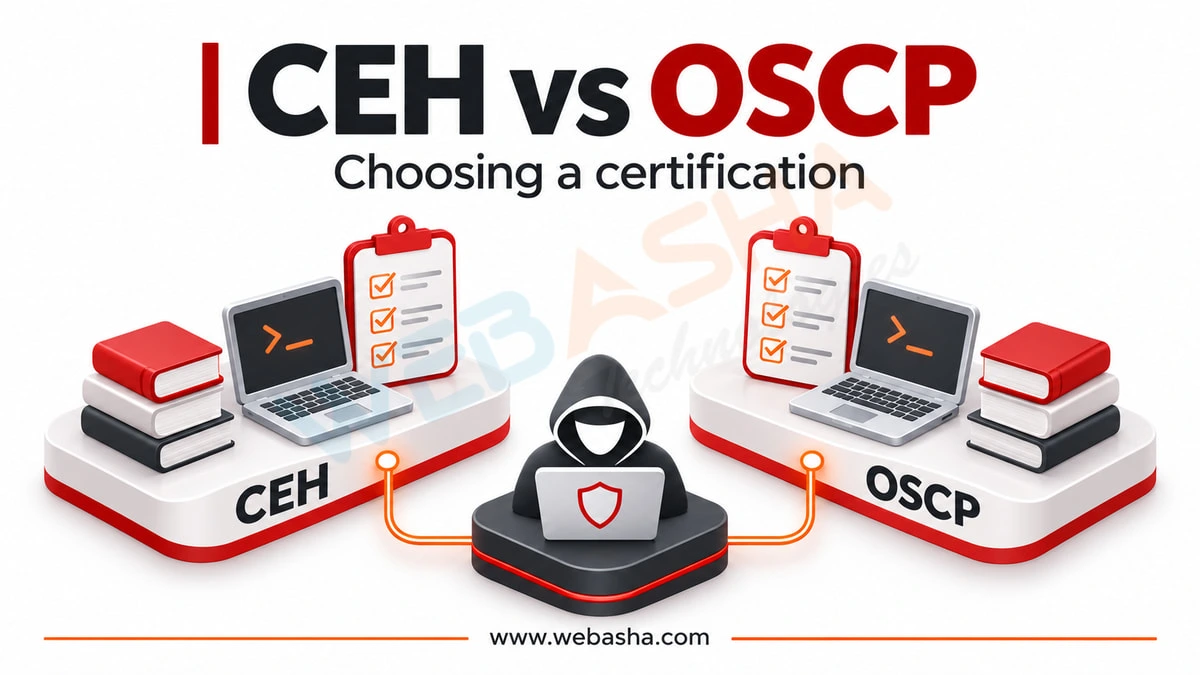
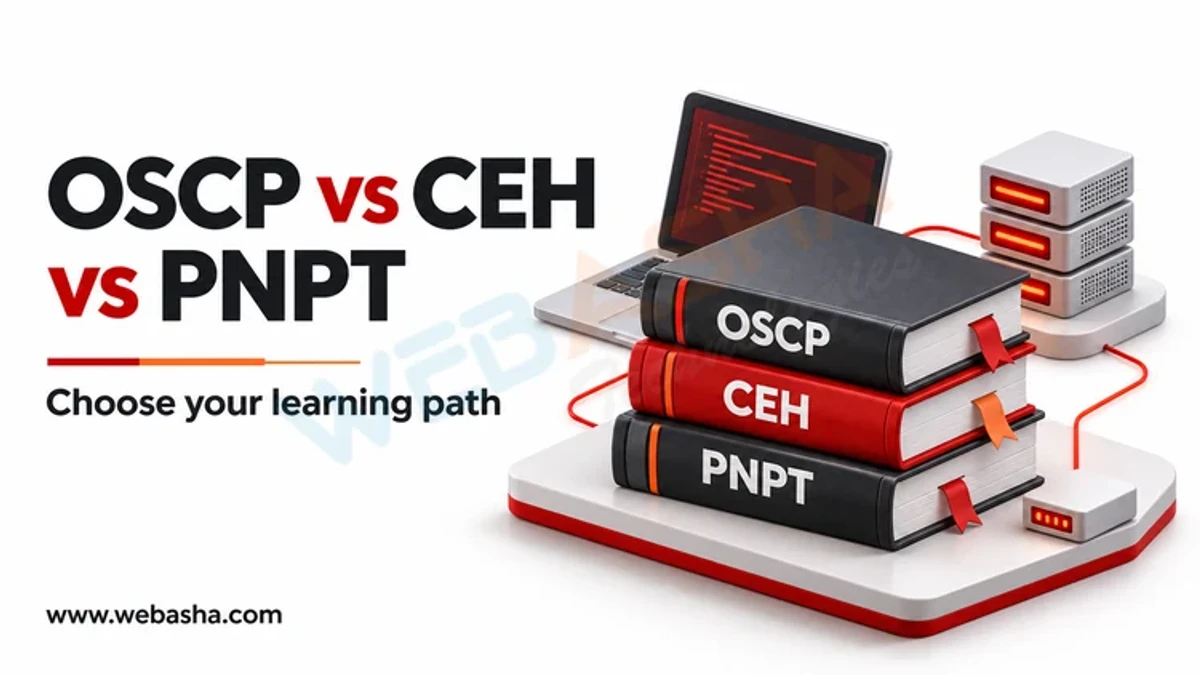
Quick answer: CEH tests broad knowledge of hacking tools and techniques, while OSCP is a hands-on exam where you must compromise machines yourself. Neither is simply better. CEH suits beginners and roles that ask for it by name, and OSCP suits people aiming at penetration testing who already have solid fundamentals. Many professionals take CEH first, then OSCP.
Key takeaways
- CEH tests broad knowledge and OSCP is a hands-on exam where you compromise machines.
- The current CEH is v13 and PEN-200 is the OSCP course.
- Take CEH for broad recognition and OSCP for a pentester path.
CEH and OSCP get compared as if one must be better, when they test fundamentally different things and serve different purposes. This guide compares them on the dimensions that actually affect your decision, and is explicit that the right answer depends on your stage and target role rather than on which has more prestige.
Topics covered in this guide: CEH vs OSCP, ethical hacking certification comparison, OSCP difficulty, CEH recognition, which certification first, penetration testing certification.
Table of Contents
- What Is the Core Difference Between CEH and OSCP?
- How Do They Compare Directly?
- Which Is More Recognised by Employers?
- Which Is Harder?
- What Does Each Cost?
- Who Should Choose CEH?
- Who Should Choose OSCP?
- Should You Take Both, and in What Order?
- Do Either Guarantee a Job?
- What Are the Alternatives Worth Considering?
- What Is the Honest Verdict?
- How Should You Prepare for Each Exam?
What Is the Core Difference Between CEH and OSCP?
CEH is a knowledge-based certification testing breadth across ethical hacking concepts, primarily through multiple-choice questions. OSCP is a hands-on practical certification requiring you to compromise machines in a live exam environment and document what you did.
That difference drives everything else. CEH asks whether you know the field; OSCP asks whether you can actually do the work under time pressure. Both are legitimate questions, but they are not the same question.
How Do They Compare Directly?
CEH is broader and less demanding, widely recognised by HR and common in job descriptions. OSCP is narrower, considerably harder, and carries more weight with technical interviewers who have taken it themselves.
| Dimension | CEH | OSCP |
|---|---|---|
| Format | Multiple choice, optional practical | Hands-on exam in a live lab |
| Tests | Breadth of knowledge | Practical capability under pressure |
| Difficulty | Moderate | High |
| Preparation time | Weeks to a few months | Several months of lab work |
| HR recognition | Very high, frequently named in postings | High in technical roles |
| Technical credibility | Moderate | Very high |
| Reporting requirement | None | Yes, a documented report |
Which Is More Recognised by Employers?
CEH appears more often in Indian job descriptions and HR filters, so it is more likely to get an application read. OSCP is more respected in technical interviews, particularly for penetration testing roles, because passing it demonstrates capability rather than recall.
This creates a practical asymmetry worth understanding: CEH helps you get the interview, OSCP helps you pass it. Which matters more depends on whether your current bottleneck is being screened out or being outperformed technically.
Which Is Harder?
OSCP by a considerable margin. It requires compromising machines you have never seen, within a fixed time window, then writing a professional report. Failure rates are high and many candidates need more than one attempt.
The difficulty is not primarily technical knowledge, it is persistence and methodology under pressure. Candidates fail more often from poor enumeration and time management than from lacking a specific exploit.
The methodology it tests is covered in our guide to penetration testing techniques.
What Does Each Cost?
Both involve meaningful expense, and pricing changes periodically, so verify current figures with the respective certification bodies before committing. OSCP bundles lab access with the exam, which is where much of its value sits.
Consider retake costs when budgeting for OSCP specifically, since needing a second attempt is common rather than exceptional. Factoring that in from the start avoids an unpleasant surprise.
Who Should Choose CEH?
CEH suits people entering security who need breadth and a recognised credential for screening, those in defensive or governance roles, and professionals whose employers or clients specifically require it for compliance reasons.
- Career changers needing a recognised entry credential
- Defensive and SOC roles where broad awareness matters more than exploitation skill
- Compliance requirements where a named certification is mandated
- Government and enterprise roles that list it explicitly
Who Should Choose OSCP?
OSCP suits people targeting penetration testing or red team roles, those who already have solid Linux and networking fundamentals, and anyone who needs to prove practical capability rather than familiarity.
- Aspiring penetration testers where hands-on proof is expected
- Candidates with existing fundamentals in Linux, networking and scripting
- People with time to commit to months of sustained lab practice
- Career changers with technical depth needing credible proof of ability
Should You Take Both, and in What Order?
Many practitioners hold both. The usual order is CEH first for breadth and screening value, then OSCP once fundamentals are solid. Attempting OSCP without Linux, networking and scripting competence generally wastes both money and months.
That said, taking CEH is not a prerequisite. Candidates who already have strong technical foundations frequently go straight to OSCP, and doing so is entirely reasonable if HR screening is not your bottleneck.
Do Either Guarantee a Job?
Neither does. Certifications open doors and pass filters; interviews are won on demonstrable understanding. Candidates who hold OSCP but cannot explain their methodology, or hold CEH with no practical work, both interview poorly.
The most effective combination is a credential appropriate to your stage plus documented practical work you can discuss in detail. The certificate gets the conversation; the work wins it.
What Are the Alternatives Worth Considering?
Other hands-on practical certifications have emerged that test similar capability, and specialist credentials exist for web, cloud and mobile testing. Evaluate them on exam format and how often they appear in the roles you actually want.
Our broader guide to cyber security certifications in India covers how these fit into a full progression.
What Is the Honest Verdict?
Neither is universally better. CEH is the better first credential for most people entering the field and for defensive or compliance-driven roles. OSCP is the better credential for anyone whose target job involves actually performing penetration tests.
The question worth asking is not which certification is superior, but which problem you currently have. If your applications are not being read, CEH addresses that. If you reach technical interviews and fall short, OSCP addresses that instead.
How Should You Prepare for Each Exam?
Prepare for CEH by working systematically through the published domains and testing yourself on breadth. Prepare for OSCP by spending months in lab environments building a repeatable methodology, because the exam rewards process far more than memorised techniques.
| Aspect | CEH Preparation | OSCP Preparation |
|---|---|---|
| Primary activity | Structured study of domains | Sustained hands-on lab practice |
| Typical duration | Weeks to a few months | Several months minimum |
| Key skill | Recall across breadth | Enumeration and methodology |
| Biggest risk | Superficial coverage | Poor time management in the exam |
| Also required | - | Professional report writing |
For OSCP specifically, the advice most repeated by people who passed is to build a written methodology and follow it rather than improvising. Candidates fail far more often from missing something obvious during enumeration than from lacking an advanced technique.
Practise the report as well as the exploitation. Documentation carries marks, and candidates who compromise machines but write the report badly have lost points that were entirely within their control.
Talk to a WebAsha training advisor about batches, syllabus and current fees.
To take this further with guided labs and an instructor, see our Penetration Testing with Kali Linux.
Related reading
- Top 7 Cyber Security Certifications in India
- Claude Certification vs AWS AI Certification: Which One Should You Choose in 2026?
- CEH Practical Real Exam Questions and Answers
Reference
For the authoritative details, see OffSec PEN-200 (OSCP).
Frequently Asked Questions
What's Your Reaction?
 Like
0
 Dislike
0
 Love
0
 Funny
0
 Wow
0
 Sad
0
 Angry
0

I am passionate about technology, invention and big challenging tasks on my to- do list. In terms of the work I am doing also at Bunnyshell, I am most passionate about the technologies that we are using., I'm devoted to delivering content that not only informs but also inspires. Whether you need in- depth analysis pieces, educational attendants, or study- provoking opinion pieces, I draft content that resonates with tech suckers and professionals likewise.