
Top Ethical Hacking Tools & Software in Kali Linux
Discover the top ethical hacking tools and software in Kali Linux, the premier penetration testing platform. Unleash the power of ethical hacking with a comprehensive toolkit that includes network scanning, vulnerability assessment, password cracking, and more. Elevate your cybersecurity skills with these essential tools.

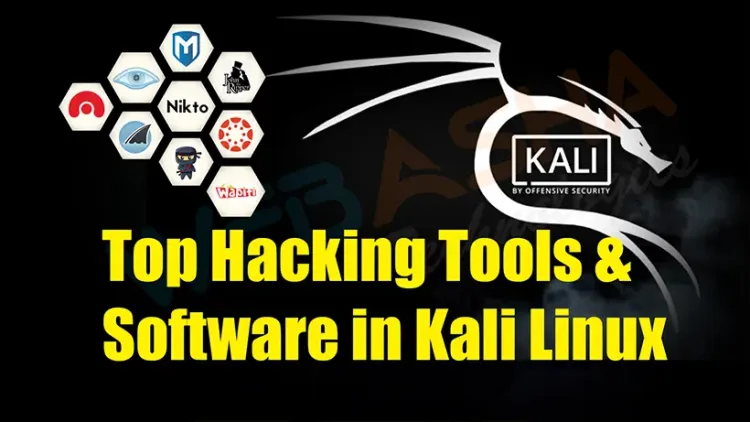
Quick answer: Kali Linux ships with hundreds of tools. The essential ethical hacking ones are Nmap for scanning, Wireshark for packet capture, Burp Suite for web testing, Metasploit for exploitation practice, Aircrack-ng for wireless audits, John the Ripper for password auditing and SQLmap for injection testing. Use them only on systems you are authorised to test.
Key takeaways
- Kali was formerly BackTrack, which is obsolete.
- Nmap, Burp Suite and Metasploit are the three most used.
- Use tools only on authorised systems.
Top Ethical Hacking Tools & Software in Kali Linux
Overview
Kali Linux is a Debian-based Linux operating system designed primarily for digital forensics and penetration testing. Kali Linux, formerly BackTrack Linux, is maintained and sponsored by Offensive Security, a significant information security training company. Cybersecurity experts, ethical hackers, and penetration testers use the distribution to assess and improve computer system security.
Kali Linux : Importance and Need
Kali Linux is a specialized operating system created specifically for ethical hacking, penetration testing, and digital forensics. Its value stems from its ability to provide cybersecurity professionals, ethical hackers, and penetration testers with a diverse and specialized arsenal of pre-installed tools for assessing and upgrading computer system security. Kali Linux makes it simple to identify vulnerabilities, assess network security, and investigate cybersecurity issues, making it a vital tool for upgrading cyber defenses. Its popularity stems from its frequent updates, flexible nature, and active community support, all of which ensure that security practitioners have access to the most recent tools and feature releases.
As the cyber world advances, Kali Linux is critical in giving professionals with the tools they need to proactively handle new security risks, resulting in a more secure digital environment through ethical and responsible behaviors.
Top Ethical Hacking Tools in Kali Linux
Nmap
Nmap, which stands for "Network Mapper" is an advanced and versatile open-source tool for network discovery and security auditing. Its targeted uses include network research and mapping, device finding, and host information collection. Nmap is widely used by network administrators, security professionals, and penetration testers for a range of tasks, including network reconnaissance and vulnerability assessment.
Key Features:-
- Helps users realize which devices are on the network.
- Monitors network responses to determine the operating system installed on a target machine, which is useful for understanding the different operating systems on a network and tailoring security measures accordingly.
- Users can write and run custom scripts to automate a wide range of operations, including as sophisticated vulnerability detection, network discovery, and host enumeration.
- Understands the target system's software stack, which helps with vulnerability assessment and identifying potential security issues associated with specific service versions.
- Identify open ports on a target system and the services that run on them; this information is useful for security assessments because open ports can be potential entry points for attackers.
Wireshark
Wireshark is a famous open-source network protocol analyzer that lets you capture and analyze data as it passes over a network. It provides detailed information on network traffic and is commonly used for troubleshooting, network analysis, and security assessments.
Key Features:-
- Real-time statistics are available for a number of network characteristics, including packet rates, data throughput, and protocol dispersion.
- Useful for assessing the content of application-layer protocols, such as extracting files, photographs, or other data transmitted across a network.
- It dissects and decodes packets, providing a hierarchical and detailed picture of the protocol stack, making it a useful tool for troubleshooting network communication issues.
- Strong filtering capabilities enable users to target specific types of traffic or separate packets of interest.
- Users can collect and analyze live network traffic as well as previously recorded capture files. It provides a detailed view of each packet, including headers, payloads, and other relevant information.
3. Fluxion
Fluxion is a security auditing and social engineering tool for wireless networks. Its primary purpose is to automate the process of collecting WPA/WPA2 handshake data and then using social engineering techniques to trick users into providing their Wi-Fi passwords. Note that using Fluxion or related technologies to obtain unauthorized access to Wi-Fi networks is both illegal and unethical.
Key Features:-
- Uses deauthentication attacks to force connected devices to disconnect from the approved Wi-Fi network.
- A captive portal is used to create a fake login page that looks like the real Wi-Fi login page.
- Automatically acquires WPA/WPA2 handshake files, which are essential when attempting to crack Wi-Fi passwords.
- Adapts its assault strategies based on the events and responses it receives during the combat.
- Creates rogue access points (Evil Twins) that imitate legitimate Wi-Fi networks.
4.Sqlmap
SQLmap is an open-source penetration testing tool for detecting and exploiting SQL injection vulnerabilities in online applications. SQL injection is a type of security issue in which an attacker can modify a web application's database by injecting malicious SQL code. SQLmap aids security professionals and ethical hackers in identifying and addressing such vulnerabilities.
Key Features:-
- SQLmap extracts important information from database schemas and data.
- Automates the process of identifying SQL injection vulnerabilities in web applications by inspecting the input fields and parameters that can be changed with SQL.
- Perform tasks like data extraction, database manipulation, or even providing a command shell on the target machine.
- Supports post-exploitation tasks such as privilege escalation and gathering operating system information.
- Examine a broad group of web applications that use different database backends.
5. Autopsy
Autopsy is an open-source digital forensics program that analyzes and investigates digital media using forensically valid methods. It is meant to assist digital detectives, law enforcement agents, and cybersecurity experts in examining and extracting data from a variety of digital sources.
Key Features:-
- Provides a chronological summary of activities and occurrences based on digital evidence.
- Ensures that the forensic analysis process is conducted in a forensically sound manner, which means that the instrument safeguards the integrity and validity of the evidence.
- Strong search features allow investigators to run keyword searches across the investigated data.
- Extracts and evaluates various artifacts, such as file metadata, registry records, internet history, and user behaviour.
- Supports data analysis from a number of sources, including hard drives, memory dumps, mobile devices, and disk images.
6. Nikto
Nikto is an open-source web server scanner that finds potential security issues and misconfigurations in web servers. It allows security specialists and system administrators to assess the security status of web servers and applications.
Key Features:-
- Assesses SSL/TLS cipher strength, detects outdated protocols, and finds potential flaws in the server's encryption settings, hence providing information on the overall security of encrypted communication.
- Users can modify scan profiles based on their individual needs.
- Conducts extensive scans of web servers to detect potential security flaws and misconfigurations.
- It supports a number of output formats, making it suitable for a wide range of reporting and analytics applications.
- In addition to server-level inspections, tests are performed to identify vulnerabilities in web applications and database systems associated with the target web server.
7. Skipfish
Skipfish is a Google-created open-source web application security scanner that finds and evaluates potential security flaws in online applications. It operates by making a range of requests to the target application and analyzing the responses for signs of vulnerability.
Key Features:-
- Provides detailed and well-structured reports summarizing the security scan results.
- Dynamically adjusts the queries sent to the program, focusing on areas where potential vulnerabilities have been discovered.
- Optimized for performance and capable of handling large-scale scanning tasks.
- Users can choose from a number of choices, including the depth and breadth of the scan, the level of aggression, and the kind of tests to be performed.
- Captures and logs all HTTP communication between the scanner and the target web application.
8. John The Ripper
John the Ripper, often known as John, is a widely used open-source password cracking tool. It finds weak passwords through a range of password cracking techniques, including dictionary attacks, brute-force attacks, and hybrid attacks.
Key Features:-
- Multi-core computers and distributed computing environments are examples of performance-optimized systems that can make use of parallel processing.
- Adapt to changing conditions and password difficulty.
- It allows security professionals and penetration testers to tailor the tool to their specific requirements, making it helpful in a wide range of password cracking scenarios.
- Users and developers build a thriving and friendly community.
- It supports a variety of password hashing algorithms, making it compatible with a wide range of operating systems and software.
9. Lynis
Lynis is an open-source security auditing tool designed specifically for Unix-based systems. It studies systems and security resources to discover potential flaws and opportunities for improvement.
Key Features:-
- Checks systems for compliance with security best practices and industry standards.
- Monitors system configurations such as firewall rules, authentication procedures, and network properties.
- Creates detailed reports outlining the results of the security audit. The reports summarize the system's security status, indicate areas of concern, and give recommendations for improvement.
- Identifies potential security issues and provides recommendations for strengthening the system's security posture.
- Administrators can discover and repair vulnerabilities before they are exploited by attackers.
Conclusion
Kali Linux, a powerful penetration testing platform, provides a variety of tools for detecting and fixing security issues in computer systems, networks, and applications. Ethical hackers and cybersecurity experts use these tools to conduct allowed security assessments, penetration tests, and vulnerability assessments on their own or other systems with explicit permission. These efforts help find and resolve vulnerabilities before they may be exploited by malicious actors.When doing security assessments, users of Kali Linux and its hacking tools must prioritize ethical considerations, professional conduct, and legal compliance.
To take this further with guided labs and an instructor, see our OffSec PEN-103 preparation.
Related reading
- What are the best open-source ethical hacking tools to use in 2026 for penetration testing and cybersecurity assessments?
- The Top Eight Kali Linux Tools For 2026
- The History of Kali Linux and Its Evolution in Cybersecurity
Reference
For the authoritative details, see Kali Linux documentation.
Frequently Asked Questions
What's Your Reaction?
 Like
0
Like
0
 Dislike
0
Dislike
0
 Love
0
Love
0
 Funny
0
Funny
0
 Wow
0
Wow
0
 Sad
0
Sad
0
 Angry
0
Angry
0

![Top 50+ Must-Know Linux Commands for Beginners [2026 Updated Cheat Sheet]](https://webasha-blog.s3.ap-south-1.amazonaws.com/uploads/images/202506/image_750x415_6856662f4638c.webp)