Welcome!

Unlock your personalized experience.
Sign Up
Tag

Cybersecurity Articles, Guides & Tutorials - Page 3

158 posts Page 3 / 10

Google Hacking Database (GHDB): How Dorks Expose Data and Defences

The Google Hacking Database (GHDB) is a public catalogue, hosted on Exploit-DB and maintained by OffSec, of search queries called Google dorks that reveal sensitive information search engines have indexed by mistake. Dorks work because servers expose files, directory listings, login pages, error messages and device panels to crawlers without authentication.


Kaspersky: About 29% of Indian Users Faced Web Threats in 2024

Kaspersky reported in early 2025 that 28.8 percent of internet users in India, nearly one in three, were targeted by web-borne threats during 2024. The data comes from the Kaspersky Security Network (KSN), so it covers people using Kaspersky products who share telemetry, not every Indian.

Real-World OSINT Successes and Failures: Documented Cases and Lessons

Open source intelligence (OSINT) has produced real successes and serious failures. A well-documented success is Bellingcat's open-source investigation into the July 2014 downing of flight MH17, whose key findings about the Buk missile system were matched by the Dutch-led Joint Investigation Team in September 2016.

Cyber Threat Intelligence Analyst: Role, Skills and Frameworks

A cyber threat intelligence (CTI) analyst collects and analyses information about attackers, their tools and their methods, then turns it into advice that helps an organisation prevent and detect attacks. Unlike a SOC analyst, who handles live alerts, a CTI analyst looks at who is likely to target the organisation, how and why.

Ethical Hacker and Penetration Tester: Role, Skills and Certifications

An ethical hacker is a security professional who looks for weaknesses in systems with the owner's permission, so they can be fixed before criminals find them. A penetration tester does this inside a formal engagement with a written scope, rules of engagement and a final report. The two titles overlap heavily.

HTTrack Website Copier: Features and Responsible Configuration

HTTrack is a free, open-source website copier released under the GNU GPL. It downloads a site’s pages, images and files to a local folder and rewrites links so the copy can be browsed offline. It runs on Windows (WinHTTrack), Linux and other Unix systems (WebHTTrack and a command line), and after a long pause it is maintained again, with version 3.51-0 dated 28 October 2026 on httrack.com.

What Is KeePassXC? An Offline, Open-Source Password Manager Explained

KeePassXC is a free, open-source password manager released under the GPLv3. It stores your passwords in a single encrypted database file in the KDBX format, kept on your own device rather than in a vendor cloud. It runs natively on Windows, macOS and Linux and is a community project that grew out of KeePassX, compatible with KeePass databases.

OSINT in Ethical Hacking: Scope, Techniques and Best Practices

In ethical hacking, open source intelligence (OSINT) is the reconnaissance phase of an authorised test: collecting publicly available information about the client organisation, such as domains, exposed services, leaked documents and staff roles, to understand its attack surface. It must stay inside the written scope agreed with the client.

Nmap Scripting Engine Guide: Categories, Safe Scripts and Usage

The Nmap Scripting Engine (NSE) lets Nmap run Lua scripts that collect extra information about hosts and services, such as TLS details, HTTP titles or SMB settings, and check for some known vulnerabilities. Scripts are grouped into categories like default, safe, discovery, version, vuln and intrusive.

Linux Networking Commands for Security: ip, ss, dig and tcpdump

A small set of Linux commands answers most network security questions on a host you manage. ip shows addresses, routes and neighbours. ss lists listening ports and open connections with the owning process. dig checks DNS answers. curl tests a web service and its TLS certificate. tcpdump captures packets for close inspection.

Networking Devices in Cybersecurity: What Each One Does, Compared

Each networking device has a different security job. Switches connect devices inside a LAN and can separate them with VLANs and 802.1X. Routers connect networks and can filter traffic with access lists. Firewalls enforce policy between zones. IDS and IPS sensors detect or block malicious traffic. Wireless access points extend the network and must use strong encryption.

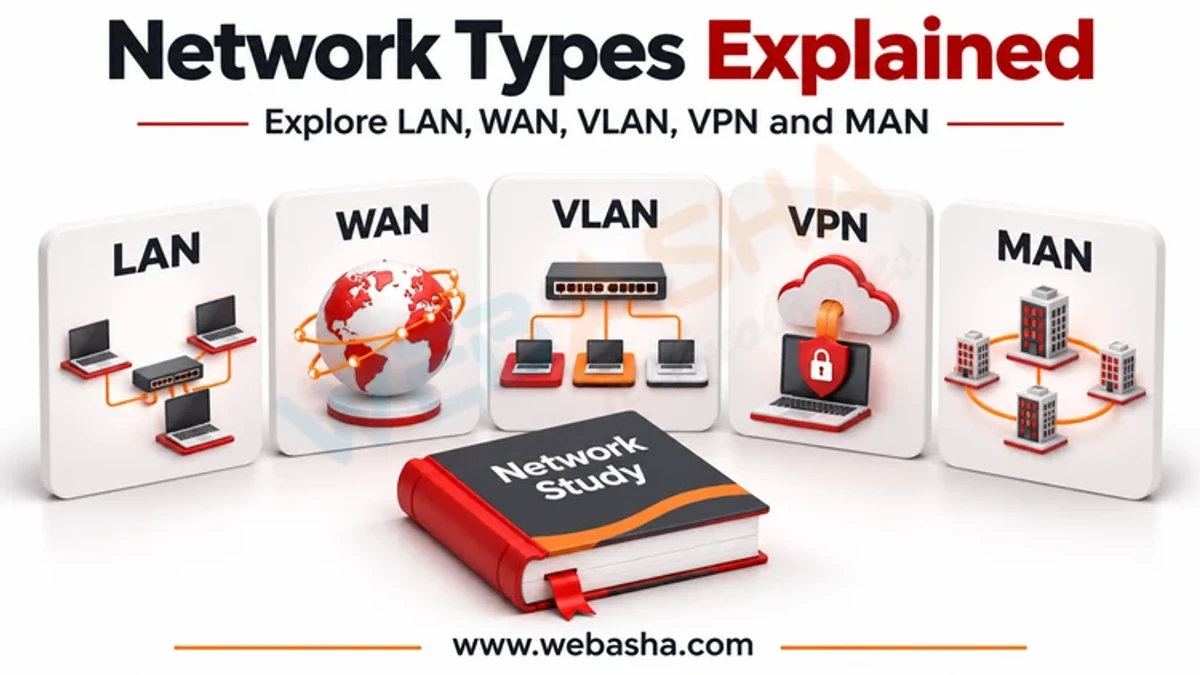
5 Types of Networks Explained: LAN, WAN, VLAN, VPN and MAN

LAN, MAN and WAN describe network size. A LAN (local area network) covers one home, office or building. A MAN (metropolitan area network) links sites across a city or campus. A WAN (wide area network) connects sites across regions or countries, and the internet is the largest WAN. VLAN and VPN are different: they are not sizes but techniques.