Classroom and Online DO370 Training at WebAsha Technologies covers cloud-native storage on OpenShift. You practise the OpenShift Data Foundation skills that the performance-based EX370 exam tests.
Training overview:
The DO370 training follows Red Hat's eight-chapter outline for enterprise Kubernetes storage with ODF. It covers ODF architecture and the Kubernetes storage APIs, an internal mode installation, file, block and object storage for applications, ODF storage for OpenShift Monitoring, Registry and Logging, backup and restore with CSI, monitoring, capacity management and troubleshooting of the Ceph components. Every chapter has lab work, which is how the hands-on EX370 exam is run.
Intended audience:
The course is meant for storage engineers, platform engineers and OpenShift administrators who provide persistent storage for cloud-native applications.
Topics covered:
-
ODF Architecture & Install: ODF features and architectures, and an internal mode deployment.
-
File & Block Storage: Storage classes for application workloads.
-
Object Storage: Object bucket claims for applications.
-
Cluster Services: ODF storage for Monitoring, Registry and Logging.
-
Backup & restore: Kubernetes CSI snapshots, clones and restore for block and file volumes.
-
Monitoring: ODF storage health metrics.
-
Storage Capacity: Quotas, volume expansion and extra disks.
-
Ceph & Troubleshooting: Ceph components, common problems and failure scenarios.
Requirements:
OpenShift administration knowledge at DO280/EX280 level is recommended, along with basic storage knowledge. Online participants need a stable internet connection and a laptop or desktop for the live ODF labs.
Prerequisites:
Before DO370/EX370, Red Hat recommends the OpenShift administration certification (EX280) and RHCSA (EX200), or equivalent knowledge, plus basic storage knowledge such as disk types, SAN and NAS.
Career benefits:
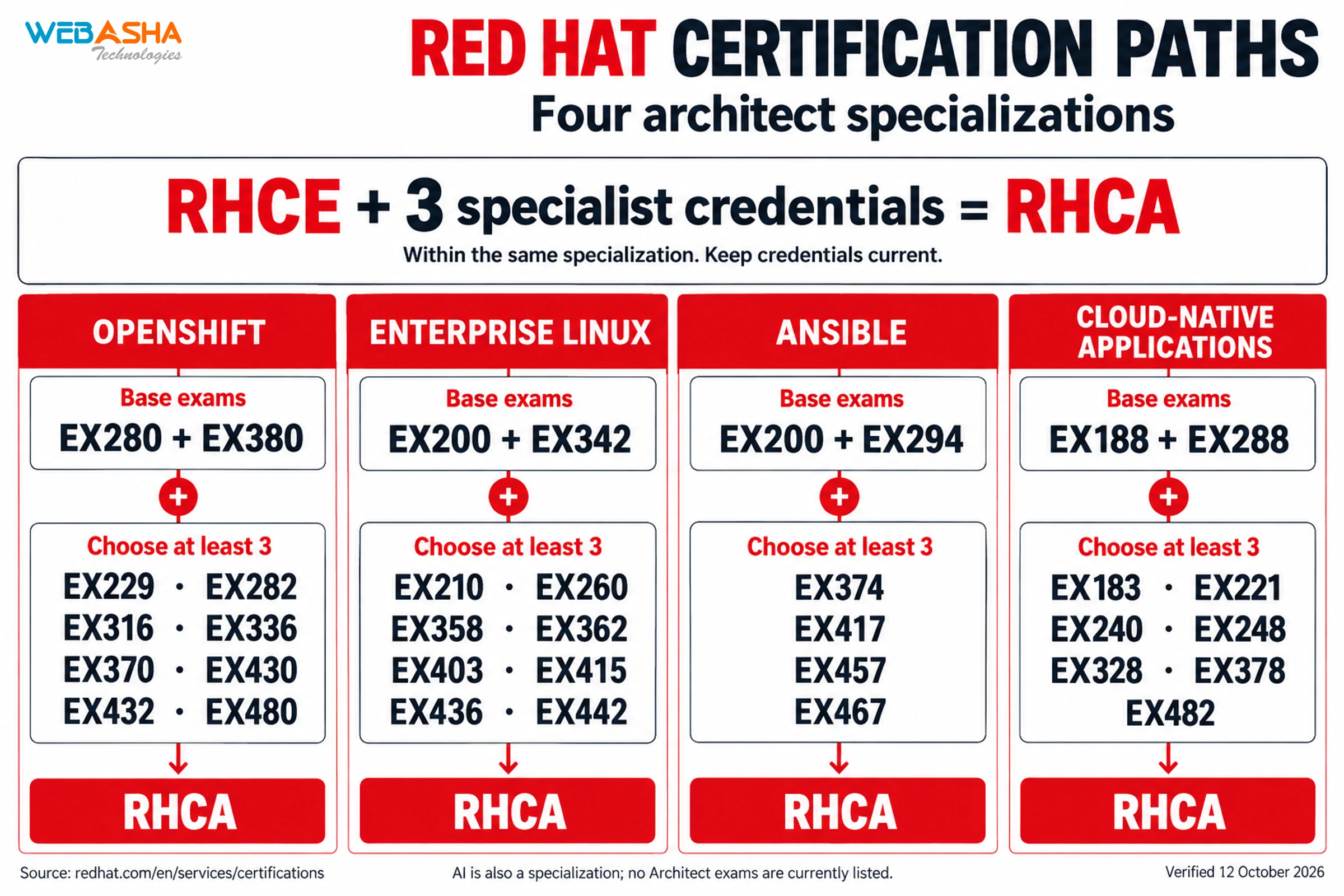
Cloud-native storage is a growing specialty as OpenShift adoption rises. In India, engineers in related roles typically earn ₹7 LPA to ₹28+ LPA. The certification also counts towards the RHCA.