Update your virtualization skills with our Classroom and Online Red Hat OpenShift Virtualization (DO316 | EX316) Training at WebAsha Technologies. This program teaches you how to run and manage virtual machines on Red Hat OpenShift using the OpenShift Virtualization Operator (KubeVirt) on Red Hat OpenShift Container Platform 4.18. In hands-on, performance-based labs you practise the skills tested by the EX316 exam and the Red Hat Certified Specialist in OpenShift Virtualization credential.
Red Hat OpenShift Virtualization training overview:
The DO316 EX316 training focuses on planning, deploying and operating production-grade VMs on OpenShift. You will install the OpenShift Virtualization Operator, provision and access VMs, and configure networking, storage, backups, live migration and VM imports on a real Kubernetes-native platform. Short concept sessions are followed by lab practice, so you are ready for the hands-on EX316 exam.
Intended audience:
This course suits site reliability engineers (SREs), cluster and platform engineers, systems administrators, cloud administrators and cloud engineers who want to run virtual machines on OpenShift and validate their skills with an official Red Hat certification. It also fits virtualization professionals migrating away from traditional hypervisors (such as VMware vSphere) toward a Kubernetes-native platform.
Topics covered:
-
Deploy OpenShift Virtualization: Install and configure the OpenShift Virtualization Operator with the HyperConverged resource using Operator Lifecycle Manager (OLM).
-
Create and access virtual machines: Provision VMs from templates and instance types, and access them through the web console, virtctl, VNC and SSH.
-
Customise VMs with cloud-init: Inject credentials, configure software repositories and run first-boot commands using cloud-init in VM templates.
-
Configure VM networking: Work with Kubernetes networking, Services, Multus CNI, NetworkAttachmentDefinitions and node networking to connect VMs to internal and external networks.
-
Manage VM storage: Configure persistent storage, attach and detach disks, and use DataVolumes and the Containerized Data Importer (CDI) to populate volumes.
-
Snapshots, clones and templates: Create and restore VM snapshots, clone VMs and disks with DataVolumes, and build custom templates for repeatable provisioning.
-
Live migration and node maintenance: Perform live migrations with affinity rules, drain nodes and manage node maintenance without downtime.
-
Backup and restore with OADP: Deploy the OADP Operator to back up and restore virtual machine workloads.
-
Import and migrate VMs: Import OVA images and migrate virtual machines from VMware vSphere and Red Hat Virtualization using the Migration Toolkit for Virtualization (MTV).
-
High availability and scheduling: Configure eviction strategies, health probes, watchdog devices, node selectors, affinity, tolerations and taints for resilient VMs.
Requirements:
Learners should be comfortable with the Linux command line and basic OpenShift/Kubernetes concepts. For online participants, a stable internet connection and a laptop or desktop are required to join live sessions and access the OpenShift cloud labs, where most of the EX316 practice happens.
Prerequisites:
Red Hat recommends RHCSA-level Linux skills (RH200 or equivalent) together with OpenShift experience such as DO180 (Introduction to OpenShift Applications) or the OpenShift Virtualization Administration path (DO156 and DO256). Prior exposure to virtualization or containers helps but is not mandatory. Our trainers fill any gaps before the advanced topics.
Career benefits:
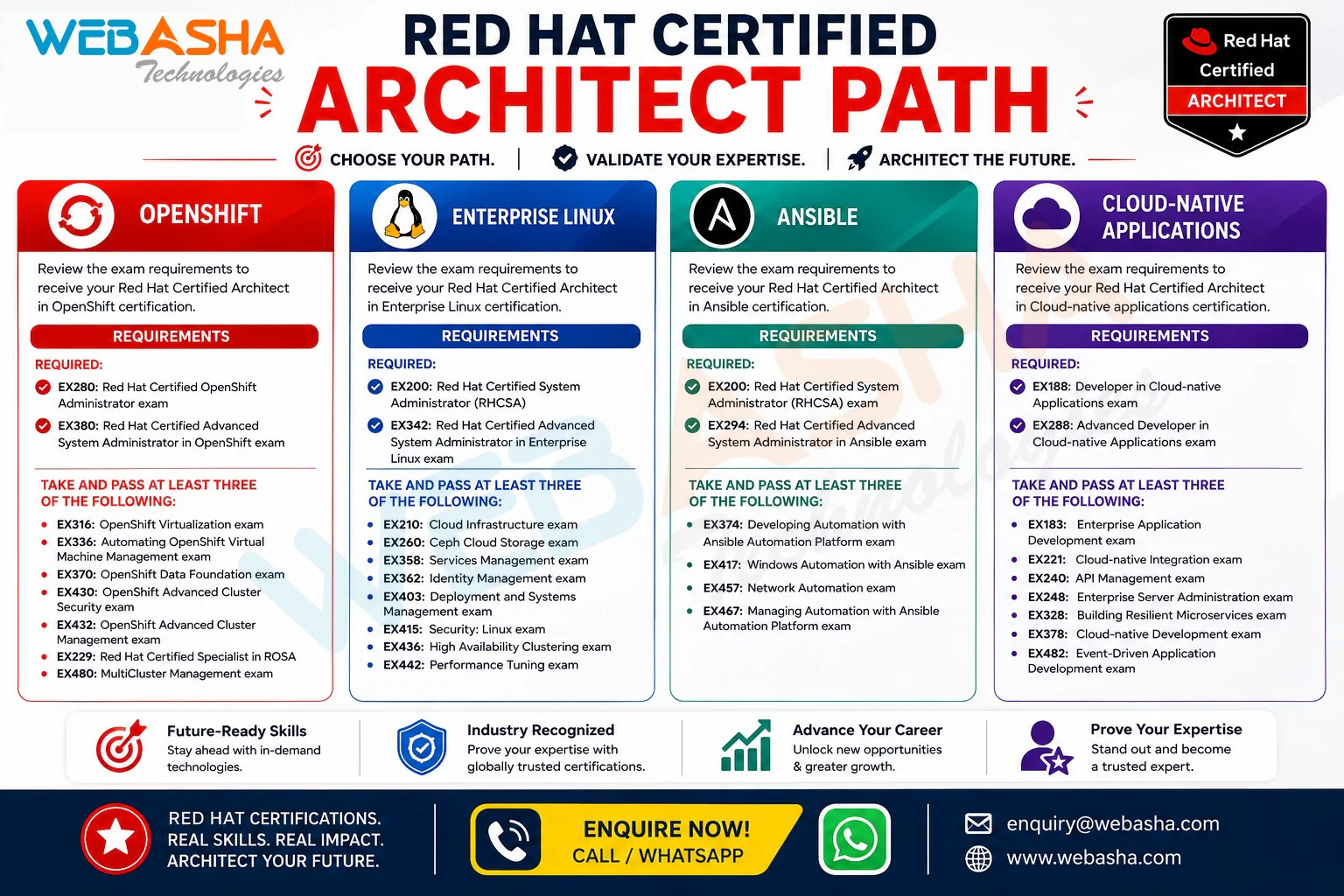
Earning the Red Hat Certified Specialist in OpenShift Virtualization (EX316) credential qualifies you for roles such as OpenShift Administrator, Virtualization Engineer, Platform Engineer, SRE and Cloud Infrastructure Specialist. As enterprises consolidate VMs and containers on Kubernetes and migrate off legacy hypervisors, certified professionals in India earn strong packages, typically ₹6 LPA to ₹30+ LPA depending on experience and role, with a clear route toward the RHCA.