
Top 50+ Cloud Migration Interview Questions and Answers (2026)
Prepare for your cloud migration interview with our top 50+ questions and answers. This comprehensive guide covers essential strategies, tools, and best practices for successful cloud migration, helping you to excel in your interviews.
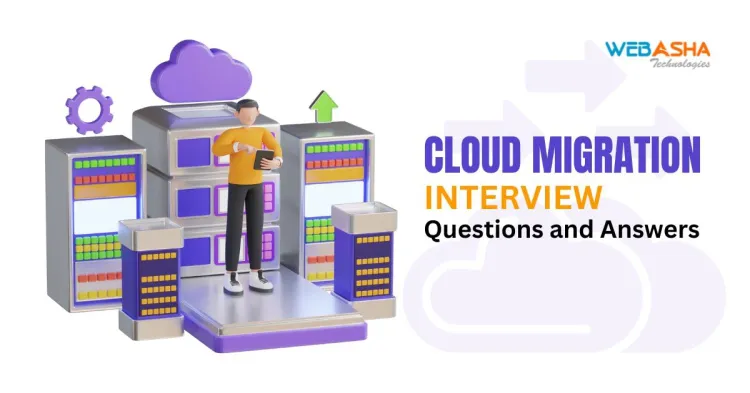
Quick answer: Cloud migration interviews test three things: whether you understand the migration strategies (the six Rs), whether you can plan and de-risk a real move, and whether you can reason about cost, security and cutover under pressure. This guide groups the questions the way interviewers think, from fundamentals to scenario questions, with short answers you can adapt in your own words. Tool names are current for 2026.
Key takeaways
- Learn the migration strategies and be able to choose between rehosting and refactoring for a given workload, with a reason tied to cost or risk.
- Expect questions on data migration, such as cutover, downtime and validation, and prepare one concrete approach you could defend.
- Revise tools that are current for 2026 rather than retired ones, and mention cost control and governance, which interviewers increasingly probe.
Below are the questions most likely to come up, organised by theme so you can revise one area at a time. Treat the answers as a starting point and bring your own examples. If you are early in your cloud journey, pair this with the broader cloud computing interview questions first.
Fundamentals
What is cloud migration?
Cloud migration is moving data, applications and workloads from on-premises or one cloud to a target cloud environment. The goal is usually some mix of scalability, resilience, speed of delivery and a shift from capital to operating expenditure, not just "being on the cloud".
What are the six Rs of migration?
They are the standard strategy options. Interviewers expect you to pick the right one per workload, not apply one everywhere.
| Strategy | What it means | When to use it |
|---|---|---|
| Rehost (lift and shift) | Move as-is, usually VM to VM | Speed, tight deadline, little appetite for change |
| Replatform | Small optimisations, e.g. managed database | Quick wins without a rewrite |
| Refactor (re-architect) | Redesign for cloud-native patterns | Long-term agility, scale, or a failing architecture |
| Repurchase | Replace with a SaaS product | Commodity software like email or CRM |
| Retire | Decommission unused workloads | Found during discovery; cuts cost and scope |
| Retain | Keep on-premises for now | Compliance, latency or recent investment |
What are the main benefits and the main risks?
Benefits: elastic scaling, pay-for-use costing, faster provisioning, managed services, and stronger disaster recovery options. Risks: cost overruns from lift-and-shift without optimisation, data security gaps during transfer, downtime at cutover, and skills shortfalls. A strong answer names a benefit and the risk that shadows it.
What is the difference between public, private and hybrid cloud?
Public cloud is shared, provider-run infrastructure (AWS, Azure, Google Cloud). Private cloud is dedicated to one organisation, on-premises or hosted. Hybrid combines both so workloads and data can move between them, often during a phased migration or for regulatory reasons.
What is the difference between IaaS, PaaS and SaaS?
IaaS gives you virtualised infrastructure to manage (EC2, Azure VMs). PaaS gives you a managed runtime so you ship code without running servers (App Engine, Azure App Service). SaaS is finished software you subscribe to (Microsoft 365, Salesforce). Migration often moves a workload up this stack, for example rehosting to IaaS then replatforming to PaaS.
What is a cloud-native application?
One designed for the cloud from the start, typically using microservices, containers, managed services and automation so it scales horizontally and tolerates failure. Refactoring aims to reach this; rehosting does not.
Planning and assessment
What is a cloud migration readiness assessment?
A structured review of your current estate, applications, data, dependencies and team skills to decide what moves, how, and in what order. It surfaces blockers early, such as hard-coded dependencies or compliance constraints, before you commit to a timeline.
How do you build a migration plan?
Discover and inventory the estate, map dependencies, assign a strategy (one of the six Rs) per application, sequence waves from low-risk to business-critical, define success metrics and a rollback plan, then run a pilot before scaling. The sequence matters more than any single tool.
What is a cloud adoption framework?
A vendor or community playbook covering strategy, governance, security, operations and skills for adopting cloud, such as the AWS or Microsoft Cloud Adoption Framework. Interviewers use it to check you think beyond the technical move to operating model and governance.
How do you handle application dependencies during migration?
Map them first with discovery tooling or dependency analysis, then migrate tightly-coupled components together in the same wave. Breaking a dependency without planning causes the outages that sink migrations.
What is a pilot or proof-of-concept migration, and why run one?
A small, low-risk workload moved first to validate your tooling, runbook, performance assumptions and rollback steps. It turns unknowns into measured facts before you move anything business-critical.
What KPIs show a migration is succeeding?
Track migration velocity (workloads per wave), downtime at cutover, post-migration performance and error rates, cost against forecast, and rework. Business KPIs such as time-to-provision or release frequency show whether the move actually delivered value.
Tools (current for 2026)
Which migration tools should you know by provider?
Name the first-party services and what they do:
- AWS: AWS Migration Hub to track progress; AWS Application Migration Service (MGN) for rehosting; AWS Database Migration Service (DMS) for databases. Note that CloudEndure Migration is end-of-life and AWS now directs users to Application Migration Service.
- Azure: Azure Migrate for discovery, assessment and server/database migration.
- Google Cloud: Migration Center, plus Migrate to Virtual Machines (formerly Velostrata) for VM rehosting.
Avoid naming retired products as if current; that is a common slip interviewers notice.
What is a database migration service and when do you need one?
A managed service such as AWS DMS or Azure Database Migration Service that moves and optionally converts databases with minimal downtime, often with ongoing replication so you can cut over cleanly. You need one when the datastore cannot tolerate a long outage or needs an engine change.
What is infrastructure as code, and why does it matter for migration?
Defining infrastructure in version-controlled files (Terraform, CloudFormation, Bicep) so environments are reproducible and reviewable. It makes target environments consistent across waves and lets you rebuild quickly if a cutover fails.
What is the role of automation in a migration?
Automation handles the repetitive, error-prone steps: provisioning, configuration, replication and validation. It speeds up waves, reduces manual mistakes and makes results consistent, which matters most when you repeat the same pattern across dozens of workloads.
Data migration
What factors matter most in data migration?
Integrity (nothing corrupted or lost), security in transit and at rest, transformation to the target schema or format, and validation that the migrated data behaves correctly. Define how you will prove integrity before you move anything.
What is data replication and why is it used in migrations?
Continuously copying changes from source to target so the two stay in sync until cutover. It shrinks downtime because most data is already present when you switch over, leaving only a small final delta.
How do you migrate very large datasets with limited bandwidth?
Options include online transfer with compression and replication, or offline bulk transfer appliances for petabyte-scale moves. Choose based on data volume, available bandwidth and how much downtime the business will accept; a strong answer weighs those three against each other.
Security and governance
What are the key security considerations during migration?
Encrypt data in transit and at rest, apply least-privilege access and identity controls, maintain compliance with the standards your sector requires, and monitor continuously for misconfiguration and threats. Security is a migration workstream, not a final step.
What is the shared responsibility model?
The provider secures the cloud (physical, host, network); you secure what you put in it (data, identities, configuration, access). Most cloud incidents come from the customer side, usually misconfiguration, so interviewers want to hear you own that half.
What are cloud governance and compliance?
Governance is the policies, guardrails and cost and access controls that keep a growing cloud estate safe and affordable. Compliance is meeting external obligations such as sector or data-residency rules. In India, data-residency and sector regulations often shape what can move and where.
What is a cloud SLA and why does it matter?
A Service Level Agreement states the availability and performance the provider commits to, and the remedies if they miss it. It sets expectations and informs your own architecture; a 99.9 percent single-region SLA may still require multi-zone design for your targets.
Cost
What is cloud cost optimisation?
Getting the value you pay for: rightsizing resources, using reserved or savings-plan commitments for steady workloads, shutting down idle resources, and monitoring spend with budgets and alerts. Lift-and-shift without optimisation is the classic cause of a surprise bill. For depth, see the cloud cost management questions.
How do you estimate migration cost?
Combine one-off migration effort (tooling, labour, parallel-running during transition) with ongoing run cost from provider pricing calculators, informed by the assessment's resource sizing. Include the cost of training and of retiring old infrastructure.
Execution, DevOps and scenarios
What is the difference between migration and cloud transformation?
Migration moves workloads to the cloud. Transformation changes how the organisation builds and operates, with new architectures, automation and ways of working. You can migrate without transforming, but the larger business benefits usually require transformation.
What is the role of DevOps in cloud migration?
DevOps practices, CI/CD, automation and infrastructure as code, turn a one-off move into a repeatable pipeline and keep the migrated estate maintainable. Many organisations adopt DevOps during migration because the cloud makes it practical. See the DevOps engineer roadmap for the skills involved.
Scenario: a lift-and-shift workload is slow and expensive after migration. What do you do?
Measure first: is it rightsizing, inefficient storage tier, chatty cross-region calls, or an architecture that needs replatforming? Fix the cheap wins (sizing, storage class, caching) before proposing a refactor. The point is a diagnostic order, not a guess.
Scenario: how do you plan a cutover with minimal downtime?
Pre-sync data with replication, prepare and test the target, choose a low-traffic window, run a final delta sync, switch DNS or traffic, validate against a checklist, and keep a tested rollback ready. Define success and failure criteria before you start.
Scenario: a business-critical app must stay available 24x7. How do you migrate it?
Favour replication-based migration with parallel running, use a blue-green or phased traffic shift, and validate on the target before moving users. If zero downtime is non-negotiable, that constraint may justify refactoring to a resilient architecture first.
How do you decide which applications to migrate first?
Start with low-risk, low-dependency workloads to build confidence and prove the process, then move toward business-critical systems as the team and runbooks mature. Retire what discovery shows is unused. Sequencing by risk is the expected answer.
What commonly causes a cloud migration to fail?
Weak discovery, missing dependency mapping, no rollback plan, lift-and-shift with no optimisation leading to cost blowouts, underestimating data migration, and neglecting skills and governance. Most failures are planning failures, not technology failures.
Next step: pick one theme above, rehearse answering out loud in your own words with a concrete example, then move to the next. If you want structured, hands-on cloud training with an authorised exam path, our AWS Cloud Practitioner training builds the foundations these questions assume.
Related reading
Frequently Asked Questions
What's Your Reaction?
 Like
0
Like
0
 Dislike
0
Dislike
0
 Love
0
Love
0
 Funny
0
Funny
0
 Wow
0
Wow
0
 Sad
0
Sad
0
 Angry
0
Angry
0

I am passionate about technology, invention and big challenging tasks on my to- do list. In terms of the work I am doing also at Bunnyshell, I am most passionate about the technologies that we are using., I'm devoted to delivering content that not only informs but also inspires. Whether you need in- depth analysis pieces, educational attendants, or study- provoking opinion pieces, I draft content that resonates with tech suckers and professionals likewise.
![[2026] Top 50+ Cloud Performance Optimization Interview Questions and Answers](https://www.webasha.com/blog/uploads/images/202408/image_750x415_66bc83e0d61e7.webp)
![[2026] Top 50+ Cloud Compliance Interview Questions and Answers](https://www.webasha.com/blog/uploads/images/202408/image_750x415_66bc84651c6e5.webp)
![[2026] Cloud Computing Interview Questions for Beginners](https://www.webasha.com/blog/uploads/images/202408/image_750x415_66cf06ad7f26c.webp)
![[2026] Cloud Engineer Interview Questions and Answers](https://www.webasha.com/blog/uploads/images/202408/image_750x415_66cef388095cd.webp)