AI in Healthcare Diagnostics: How It Works, Its Risks and the Skills Behind It
Artificial Intelligence (AI) is transforming healthcare diagnostics by enhancing accuracy, speed, and efficiency in disease detection, medical imaging, pathology, genomics, and predictive analytics. AI-powered algorithms analyze X-rays, MRIs, CT scans, genetic data, and patient records to detect diseases early and provide personalized treatment recommendations. A major breakthrough in AI-driven healthcare innovation is Pune’s first Made-in-India surgical robot, which integrates AI and cybersecurity to enhance precision surgery and reduce human error. This milestone reflects India’s growing role in AI-powered medical technology. This blog explores the key applications, benefits, challenges, and real-world examples of AI in healthcare diagnostics, emphasizing how AI is making medical diagnosis faster, more accurate, and accessible while addressing ethical concerns like data privacy, bias, and regulatory compliance.
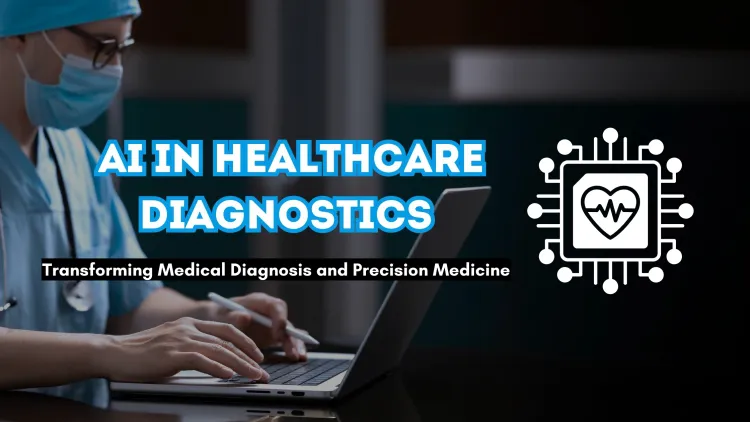
Quick answer: AI in healthcare diagnostics uses machine learning models, mostly trained on medical images, lab results and patient records, to flag possible disease or prioritise cases for clinicians. The models support doctors rather than replace them. Success depends on good data, independent validation, privacy protection and monitoring after deployment.
Key takeaways
- Most diagnostic AI is decision support: it flags or ranks, and a clinician decides.
- Common inputs are images (X-rays, scans, pathology slides), lab values and patient records.
- Quality depends on data: representative, correctly labelled and validated on patients the model has never seen.
- Health data is sensitive. Privacy, access control and audit trails are engineering requirements, not extras.
What AI diagnostics means
In this field, "AI" usually means machine learning models trained on examples. A model sees many labelled cases, for example chest X-rays marked by radiologists, and learns patterns that help it flag similar cases. The output is a probability, a highlighted region or a priority score. A clinician reviews it.
This page is written for technology readers. It explains how these systems work and what engineering they need. It is not medical advice.
Common uses
- Medical imaging: flagging suspicious regions on X-rays, CT, MRI and retinal photos, and prioritising urgent studies in a queue.
- Pathology: analysing digitised tissue slides.
- Risk prediction: estimating the likelihood of an event, such as deterioration in a hospital ward, from structured records.
- Triage and workflow: sorting cases and drafting reports for clinician review.
How a diagnostic model is built
- Define the clinical question. For example, "is there a fracture on this image?" A vague goal produces a useless model.
- Collect and label data. Experts label the cases. Disagreement between labellers is normal and must be handled.
- Split data properly. Training, validation and a final test set, ideally including data from different hospitals and devices so the model is tested on cases unlike its training set.
- Train and tune a model, commonly a convolutional neural network for images or a gradient-boosted model for tabular data.
- Validate against clinicians and prospectively in real settings, not just on a held-out file.
- Deploy and monitor. Track performance over time, because patient populations, scanners and practices change.
What can go wrong
| Risk | What it looks like | Mitigation |
|---|---|---|
| Biased data | Works worse for groups under-represented in training | Diverse data, subgroup testing |
| Data leakage | Excellent test score that fails in practice | Strict patient-level splits |
| Model drift | Performance drops after a new scanner or protocol | Continuous monitoring and re-validation |
| Over-trust | Clinicians accept the output without checking | Clear interfaces, training, human oversight |
| Privacy breach | Records exposed or re-identified | Access control, encryption, de-identification, audit logs |
| Adversarial or poisoned data | Manipulated inputs or training data | Input validation, supply-chain controls |
Privacy and law in India
Medical data is personal data. India's Digital Personal Data Protection Act, 2023 sets duties for handling it, and hospital systems also face sector rules. Medical software may be regulated as a device in some cases. Anyone building or buying such a system should get qualified legal and regulatory advice. For general security guidance, see the NIST Cybersecurity Framework.
The security side
A diagnostic system is an IT system with high-value data. Typical requirements include role-based access, encryption in transit and at rest, audit logging, secure APIs between the imaging system and the model, patch management and incident response. Hospital security is also a physical-safety concern, which is why the intersection of AI and security matters; see the post on a Pune hospital's AI and surgical robot for a local example of this theme.
Skills the field needs
- Python, data handling and machine learning basics.
- Statistics for evaluating models properly.
- Data engineering and cloud deployment.
- Security and privacy engineering.
- Domain knowledge from clinicians, who must be part of the team.
What this means for learners
Healthcare is one application area for machine learning. If the technology interests you, learn the foundations first: Python, data analysis and ML. Then choose a domain.
Next steps
For a general view of AI across sectors, read how AI is transforming industries. To build the underlying skills, see the Machine Learning course and the Data Science course.
Related reading
Frequently Asked Questions
What's Your Reaction?
 Like
0
Like
0
 Dislike
0
Dislike
0
 Love
0
Love
0
 Funny
0
Funny
0
 Wow
0
Wow
0
 Sad
0
Sad
0
 Angry
0
Angry
0

Vaishnavi is a skilled tech professional at the Ethical Hacking Training Institute in Pune, responsible for managing and optimizing the technical infrastructure that supports advanced cybersecurity education. With deep expertise in network security, backend operations, and system performance, she ensures that practical labs, online modules, and assessments run smoothly and securely. Her behind-the-scenes contributions play a vital role in delivering a seamless and secure learning experience for aspiring ethical hackers.