Getting Into Tech Without a Degree: Skills, Portfolios, Certificates
Yes, you can get into tech without a degree, but you need other proof that you can do the work. Many employers now test skills directly, and some entry roles, such as IT support, list certifications as an accepted alternative to a degree.
Topic: Ethical Hacking in Cybersecurity & Ethical Hacking · Career guidance
Also covers: Cybersecurity Careers & Certifications, Python for AI & Automation, Data Analytics & Data Science
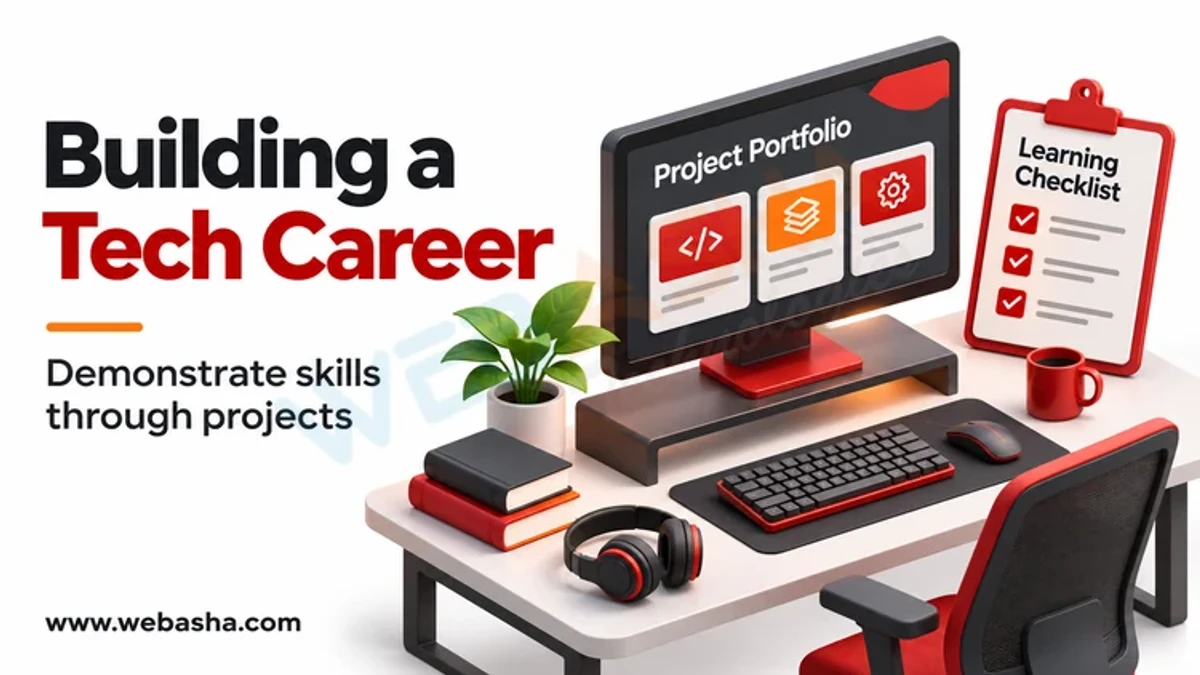
Quick answer: Yes, you can get into tech without a degree, but you need other proof that you can do the work. Many employers now test skills directly, and some entry roles, such as IT support, list certifications as an accepted alternative to a degree. Your proof is a mix of three things: a portfolio of projects, one or two recognised certifications, and real experience from an internship, apprenticeship-style role, freelance task or volunteer work. Expect some doors to stay closed, because government posts, some campus hiring and work visas often require a degree. Apply widely to roles that test skills.
Key takeaways
- Skills-based hiring is growing, but degree filters still exist.
- Support, junior cloud, SOC and junior developer roles are common entry points.
- A portfolio shows what you can do; a certificate shows you passed a test.
- Real experience, even small, makes both of those more credible.
- Plan for a steady year of learning rather than a short sprint.
Table of Contents
- Do Tech Employers Hire Without a Degree?
- Where Does a Degree Still Matter?
- Which Entry Roles Are Most Open to Skills?
- How Do You Build a Portfolio That Gets Noticed?
- Which Certifications Help Most Without a Degree?
- How Do You Get Experience Before Your First Job?
- What Does a 12-Month Plan Look Like?
- References
Do Tech Employers Hire Without a Degree?
Some do, and the trend is real but uneven. The OECD report on skills-first hiring describes employers moving towards skills tests and micro-credentials, with large firms and public bodies leading and smaller firms slower to change. For support roles, the US BLS handbook notes that candidates may qualify with a high school diploma plus relevant IT certifications.
In practice, the interview carries more weight when you have no degree. Expect practical tests such as a troubleshooting scenario, a short coding task or a log to investigate, and practise exactly those tasks in your own lab beforehand.
Where Does a Degree Still Matter?
- Government and public sector posts: recruitment rules usually name a minimum qualification.
- Campus and graduate programmes: these are built around degree holders.
- Some large employers: application systems may filter by degree.
- Work visas: many countries weigh formal qualifications.
If you may need any of these later, a distance or part-time degree alongside work keeps the option open.
Which Entry Roles Are Most Open to Skills?
| Role | What employers usually test | Proof to show |
|---|---|---|
| IT support or help desk | Troubleshooting, Windows, basic networking | Home lab notes, CompTIA A+ or Tech+ |
| Junior system administrator | Linux, users, permissions, scripting | Server build write-ups, Bash scripts |
| SOC analyst (entry) | Log reading, alert triage, networking | Lab investigations, Security+ or ISC2 CC |
| Cloud support associate | Cloud services, networking, IAM | Small deployed project, AWS Cloud Practitioner |
| Junior developer | Coding test, Git, problem solving | Public repositories with working apps |
How Do You Build a Portfolio That Gets Noticed?
- Pick three projects that match the role, not ten unrelated tutorials.
- Use Git and keep a clear commit history.
- Write a short README for each project: the problem, what you built, what broke and how you fixed it.
- Keep security projects inside your own lab. Testing systems you do not own without written permission is an offence under the IT Act 2000, Sections 43 and 66.
For a security-focused example, see building a portfolio without experience.
Which Certifications Help Most Without a Degree?
Choose certifications employers name in job postings for your target role. CompTIA's Tech+ (FC0-U71), which replaced ITF+, covers broad basics. For security, ISC2 CC is still a valid entry exam, but ISC2 ended its free programme for new candidates on 20 May 2026. For cloud, AWS certifications start at Cloud Practitioner. In India, the Skill India Digital Hub and FutureSkills Prime list recognised courses.
How Do You Get Experience Before Your First Job?
| Route | What it gives you |
|---|---|
| Internship | Supervised work and a reference |
| Freelance or small-business IT tasks | Real users and real deadlines |
| Volunteer IT for an NGO or school | Responsibility and a story for interviews |
| Open-source contributions | Public, reviewable code |
If you already hold a degree in another subject, read about switching to IT without an IT degree instead.
What Does a 12-Month Plan Look Like?
- Months 1 to 3: operating systems, networking, one scripting language.
- Months 4 to 6: choose a field, start projects, sit an entry certification.
- Months 7 to 9: gain experience through an internship, freelance or volunteer work.
- Months 10 to 12: polish the portfolio, practise interviews, apply widely.
If you want structured labs and mentoring, WebAsha can advise on skills-based IT training.
References
Frequently Asked Questions
What's Your Reaction?
 Like
0
 Dislike
0
 Love
0
 Funny
0
 Wow
0
 Sad
0
 Angry
0

Vaishnavi is a skilled tech professional at the Ethical Hacking Training Institute in Pune, responsible for managing and optimizing the technical infrastructure that supports advanced cybersecurity education. With deep expertise in network security, backend operations, and system performance, she ensures that practical labs, online modules, and assessments run smoothly and securely. Her behind-the-scenes contributions play a vital role in delivering a seamless and secure learning experience for aspiring ethical hackers.