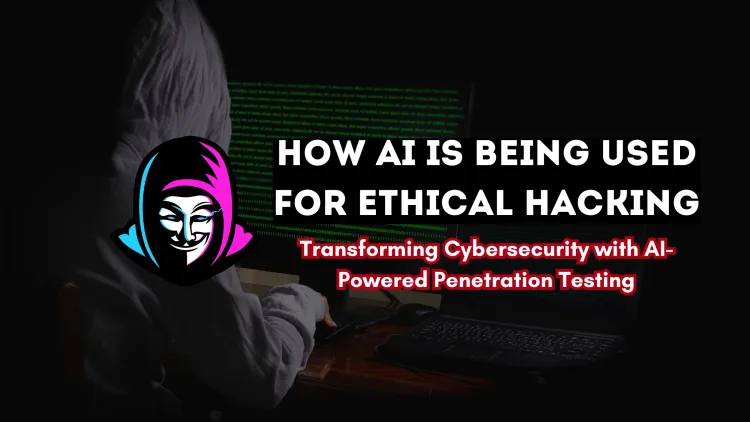
How AI is Being Used for Ethical Hacking? Transforming Cybersecurity with AI-Powered Pentesting
AI is revolutionizing ethical hacking by automating reconnaissance, vulnerability detection, and penetration testing. AI-powered tools help cybersecurity professionals identify security flaws faster and more efficiently than traditional methods. With machine learning and deep learning, AI predicts emerging threats, conducts realistic attack simulations, and enhances phishing detection. However, ethical concerns arise as AI can be misused for cyberattacks. This blog explores how AI is transforming ethical hacking, its benefits, challenges, and the future of AI-driven penetration testing.
Quick answer: Ethical hackers use AI to automate reconnaissance, scan for vulnerabilities, rank findings and draft reports, which saves time on repetitive work. It cannot replace human judgement on complex flaws and can give false results. Use AI only inside an authorised scope, and always verify its output manually before reporting a finding.
Key takeaways
- AI speeds reconnaissance, scanning and report drafting.
- Check every finding manually.
- Keep client data out of public AI tools.
Table of Contents
- Introduction
- Understanding AI in Ethical Hacking
- Key AI Techniques in Ethical Hacking
- Benefits of AI in Ethical Hacking
- Challenges and Ethical Concerns
- Future of AI in Ethical Hacking
- Conclusion
Introduction
Artificial Intelligence (AI) in cybersecurity has changed how ethical hackers identify vulnerabilities and strengthen security defences. Ethical hacking, also known as penetration testing, involves simulating cyberattacks to uncover weaknesses before malicious hackers can exploit them. AI-powered tools now help with automating reconnaissance, vulnerability assessment, and exploit detection, making ethical hacking faster and more effective.
AI in ethical hacking also raises concerns about security risks, automation reliability, and potential misuse by cybercriminals. AI is changing ethical hacking, with advantages, challenges, and a future for AI-driven penetration testing.
Understanding AI in Ethical Hacking
What is Ethical Hacking?
Ethical hacking is the practice of legally testing and securing computer systems, networks, and applications by simulating real-world cyberattacks. Ethical hackers use penetration testing (pentesting) methodologies to expose vulnerabilities before cybercriminals exploit them.
How AI Enhances Ethical Hacking
AI-driven tools assist ethical hackers by:
- Automating vulnerability detection – AI scans and identifies security flaws faster than manual testing.
- Improving penetration testing – AI predicts weak points in a system and automates attack simulations.
- Enhancing threat intelligence – AI collects and analyzes vast cybersecurity data to detect patterns.
- Simulating cyberattacks – AI mimics hacker behavior to uncover zero-day vulnerabilities.
- Reducing human error – AI enhances accuracy and efficiency in cybersecurity assessments.
Key AI Techniques in Ethical Hacking
1. AI for Automated Reconnaissance
AI-powered reconnaissance tools gather Open-Source Intelligence (OSINT) by scanning:
- Websites
- Social media platforms
- Dark web forums
- Network traffic logs
This allows ethical hackers to identify potential targets and vulnerabilities without manual effort.
2. AI-Powered Vulnerability Assessment
Traditional vulnerability scanning is time-consuming, but AI speeds up the process by:
- Detecting common misconfigurations
- Predicting which vulnerabilities are most exploitable
- Prioritizing risks based on real-world attack likelihood
| Traditional Vulnerability Scanning | AI-Powered Vulnerability Assessment |
|---|---|
| Manually scans systems for known vulnerabilities | Uses machine learning to predict emerging threats |
| Requires human validation | Automates risk prioritization |
| Takes days or weeks to complete | Completes in minutes to hours |
3. AI for Exploit Detection & Prevention
AI continuously analyzes attack patterns and can:
- Recognize zero-day exploits before they are weaponized.
- Predict attack vectors based on historical data.
- Mitigate security risks by recommending patches.
4. AI in Phishing Attack Simulation
AI generates realistic phishing emails to test employees and improve cybersecurity awareness. AI-driven phishing simulators can:
- Customize phishing emails based on user behavior.
- Analyze click rates and determine security training effectiveness.
5. AI for Penetration Testing Automation
AI enhances penetration testing by:
- Automating attack simulations to uncover weaknesses.
- Identifying real-time security flaws before hackers exploit them.
- Simulating social engineering attacks using deepfake technology.
Benefits of AI in Ethical Hacking
- Faster and More Accurate Threat Detection – AI scans thousands of systems within minutes.
- Cost-Effective Security Testing – Automates penetration testing, reducing costs.
- Continuous Security Monitoring – AI detects anomalies in real-time, preventing attacks.
- Better Risk Prioritization – AI categorizes vulnerabilities based on their real-world impact.
- Reduces Human Errors – AI improves accuracy in identifying and mitigating threats.
Challenges and Ethical Concerns
1. AI Misuse by Cybercriminals
AI can be weaponized by hackers to:
- Create AI-driven malware that evolves over time.
- Automate large-scale cyberattacks with minimal human input.
2. AI False Positives & False Negatives
AI might:
- Flag legitimate activities as threats (false positives).
- Fail to detect certain exploits (false negatives).
3. Ethical & Legal Concerns
- AI-driven pentesting must follow legal frameworks to prevent privacy violations.
- AI tools should comply with ethical hacking regulations.
Future of AI in Ethical Hacking
- AI-Powered Autonomous Red Teams – AI will fully automate red teaming exercises.
- AI vs AI Cyber Battles – Cybersecurity defenses will use AI to counter AI-driven attacks.
- Quantum AI in Cybersecurity – AI combined with quantum computing will detect even the most sophisticated cyber threats.
Conclusion
AI is redefining ethical hacking by automating penetration testing, vulnerability assessment, and threat detection. While AI enhances cybersecurity, it also presents challenges and ethical concerns if misused. Organizations must adopt AI-driven ethical hacking responsibly, ensuring that cybersecurity professionals remain in control.
The future of cybersecurity lies in AI-human collaboration, where AI speeds up detection and automation, while human experts provide strategic decision-making and ethical oversight.
To take this further with guided labs and an instructor, see our CEH v13 AI lab sessions.
Related reading
- AI and Ethical Hacking | Can CyberSecGPT Be Used for Good? Exploring AI-Powered Cybersecurity, Ethical Hacking Automation, and the Future of Cyber Defense
- Top Certifications for Ethical Hackers Interested in Machine Learning
- How AI is Transforming Security Assessments and Pentesting | Enhancing Cybersecurity with Intelligent Automation
Frequently Asked Questions
What's Your Reaction?
 Like
0
Like
0
 Dislike
0
Dislike
0
 Love
0
Love
0
 Funny
0
Funny
0
 Wow
0
Wow
0
 Sad
0
Sad
0
 Angry
0
Angry
0

Vaishnavi is a skilled tech professional at the Ethical Hacking Training Institute in Pune, responsible for managing and optimizing the technical infrastructure that supports advanced cybersecurity education. With deep expertise in network security, backend operations, and system performance, she ensures that practical labs, online modules, and assessments run smoothly and securely. Her behind-the-scenes contributions play a vital role in delivering a seamless and secure learning experience for aspiring ethical hackers.
![Top 10 Famous Ethical Hackers in India [Updated 2026]](https://www.webasha.com/blog/uploads/images/202608/image_450x280_b3317756e192c8d5e1fb674259f1a0c3.jpg)










![Top 10 Famous Ethical Hackers in India [Updated 2026]](https://www.webasha.com/blog/uploads/images/202608/image_140x98_da23f65c290cfbf1237d77aec58a2f0f.jpg)