
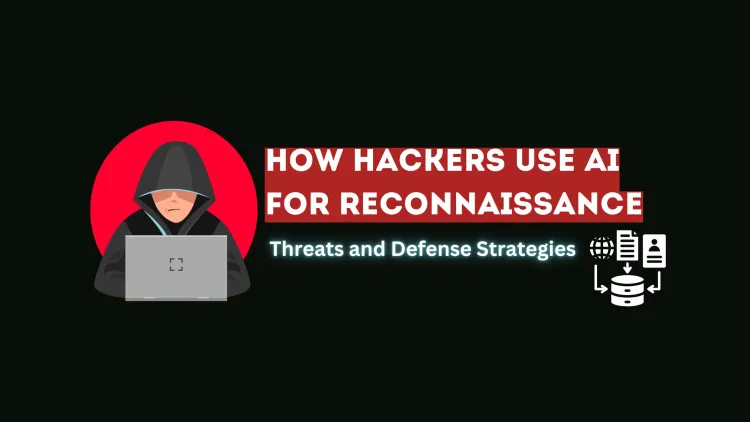
How Hackers Use AI for Passive and Active Reconnaissance | Understanding the Threats and Defensive Strategies
AI is revolutionizing cyber reconnaissance, making both passive and active reconnaissance faster, more efficient, and harder to detect. Passive reconnaissance allows attackers to gather intelligence without interacting with the target system, using AI-powered OSINT tools, web scraping, and dark web monitoring. On the other hand, active reconnaissance involves direct interaction with target networks through AI-driven scanning, vulnerability identification, and automated penetration testing. Hackers use AI to automate social engineering, deepfake impersonation, phishing attacks, and password cracking. AI also helps evade security systems by mimicking human behavior. To defend against AI-powered reconnaissance, organizations must adopt AI-driven security tools, strengthen OSINT security, improve network defenses, and train employees on AI-based phishing threats. As cyber threats evolve, AI-powered cybersecurity strategies will be crucial in countering AI-driven hacking techniques.
Quick answer: Passive reconnaissance collects public information without touching the target, while active reconnaissance probes it directly, for example by scanning. Attackers use AI to speed up both. Defend by limiting public exposure, closing unused ports, monitoring for scans and testing your own footprint with authorised assessments.
Key takeaways
- Passive recon avoids touching the target; active recon probes it and can be logged.
- Active scanning needs authorisation.
- Defenders can detect active scans in logs.
Table of Contents
- Introduction
- What is Reconnaissance in Cybersecurity?
- How Hackers Use AI for Passive Reconnaissance
- How Hackers Use AI for Active Reconnaissance
- Real-World Examples of AI in Cyber Reconnaissance
- Defending Against AI-Driven Reconnaissance
- Conclusion
Introduction
With the fast advancement of Artificial Intelligence (AI), cybercriminals increasingly use AI-driven tools for passive and active reconnaissance. These techniques let attackers gather important information about targets, making cyberattacks more effective, faster, and harder to detect. Ethical hackers and cybersecurity professionals use reconnaissance for penetration testing, while cybercriminals use AI to automate network scanning, OSINT (Open-Source Intelligence) collection, and vulnerability detection.
In this blog, we will explore how hackers use AI for reconnaissance, the difference between passive and active techniques, real-world examples, and how organizations can defend against AI-driven cyber threats.
What is Reconnaissance in Cybersecurity?
Reconnaissance is the first phase of a cyberattack, where attackers gather information about their targets before launching an attack. It helps identify vulnerabilities, misconfigurations, and weak security points. Reconnaissance is classified into two main types:
Passive Reconnaissance
- Involves collecting data without directly interacting with the target network.
- Uses OSINT, social media analysis, domain lookups, and leaked credentials.
- Harder to detect because it does not trigger security alerts.
Active Reconnaissance
- Involves direct interaction with the target system, such as scanning ports, analyzing responses, and probing security defenses.
- Uses AI-powered vulnerability scanners, automated penetration testing tools, and bot-driven reconnaissance.
- Easier to detect due to increased network traffic and suspicious behavior.
How Hackers Use AI for Passive Reconnaissance
AI enhances passive reconnaissance by automating OSINT (Open-Source Intelligence) gathering, analyzing vast datasets, and detecting security weaknesses without direct engagement. Some common AI-driven passive reconnaissance techniques include:
1. AI-Powered OSINT Collection
Hackers use AI-based OSINT tools like Maltego, SpiderFoot, and Recon-ng to analyze:
- Social media activity (LinkedIn, Twitter, Facebook).
- Company details (WHOIS records, domain information).
- Leaked databases (Dark web monitoring for credentials).
2. Automated Web Scraping
AI-driven scrapers extract sensitive information from:
- Company websites and employee directories.
- Job postings that reveal security infrastructure details.
- GitHub repositories containing exposed API keys or credentials.
3. Deep Learning for Data Analysis
- AI models correlate information from various sources.
- Helps identify employee habits, frequently used passwords, and email patterns.
- Enhances phishing and social engineering attacks.
4. AI in Social Engineering Attacks
- AI chatbots impersonate humans in phishing attacks.
- Deepfake videos and voice synthesis create realistic impersonation attacks.
- AI generates highly personalized phishing emails to target employees.
5. Dark Web Data Mining
- AI monitors hacker forums and dark web marketplaces for leaked credentials.
- Helps attackers identify breached organizations and use stolen data.
How Hackers Use AI for Active Reconnaissance
In active reconnaissance, AI interacts directly with the target system to detect vulnerabilities and weak security configurations. Some AI-driven active reconnaissance techniques include:
1. AI-Powered Network Scanning
Hackers use AI-driven tools like Nmap, Shodan, and Censys to:
- Scan open ports and services running on target systems.
- Detect outdated software versions with known vulnerabilities.
- Automate mass scanning across thousands of IP addresses.
2. AI-Based Vulnerability Identification
- Machine learning models analyze network traffic to detect security flaws.
- AI tools like Metasploit and OpenVAS find and exploit vulnerabilities automatically.
- Reduces manual effort in penetration testing and cyberattacks.
3. Automated Password Attacks
- AI predicts common passwords based on user behavior.
- Uses natural language processing (NLP) to generate password guesses.
- Accelerates brute-force and dictionary attacks.
4. AI in Web Application Attacks
- AI-driven scanners detect SQL injection, XSS (Cross-Site Scripting), and CSRF vulnerabilities in web applications.
- AI automates fuzzing techniques to exploit security gaps.
- ChatGPT-like models generate malicious payloads customized for different attack scenarios.
5. AI for Evasion Techniques
- AI mimics human behavior to avoid detection.
- Uses machine learning to bypass CAPTCHA protections.
- AI models modify attack patterns to evade security monitoring systems.
Real-World Examples of AI in Cyber Reconnaissance
1. DeepLocker – AI-Powered Malware
- Developed by IBM researchers to demonstrate AI’s power in stealthy attacks.
- Uses AI to remain dormant until specific conditions are met (e.g., detecting a target via facial recognition).
2. Shodan – AI-Driven Search Engine for IoT Devices
- Hackers use Shodan to find unsecured IoT devices, webcams, and databases.
- AI filters millions of connected devices to find high-value targets.
3. Deepfake Social Engineering
- Attackers use AI-generated deepfake videos and voices to impersonate CEOs or high-ranking officials.
- Used in fraudulent money transfers and corporate espionage.
Defending Against AI-Driven Reconnaissance
To counter AI-powered reconnaissance attacks, organizations must implement proactive cybersecurity measures:
1. AI-Based Threat Detection
- Deploy AI-driven SIEM (Security Information and Event Management) solutions.
- Use behavioral analytics to detect unusual network activity.
2. Strengthen OSINT Security
- Regularly monitor public information leaks.
- Restrict employee social media exposure to sensitive data.
3. Implement Network Security Best Practices
- Use firewalls, intrusion detection systems (IDS), and endpoint security solutions.
- Block automated bots and AI-driven reconnaissance scans.
4. Train Employees Against AI-Based Phishing
- Conduct cybersecurity awareness programs on deepfake and AI-generated phishing attacks.
- Use AI-driven email security filters to block phishing attempts.
5. Continuous Penetration Testing with AI
- Deploy AI-assisted penetration testing to simulate real-world attacks.
- Identify and fix vulnerabilities before attackers exploit them.
Conclusion
AI is quickly changing cyber reconnaissance, making both ethical hacking and cybercrime more efficient. Hackers use AI for passive OSINT gathering, social engineering, and active network scanning to exploit security weaknesses. Organisations can use AI for cybersecurity defence, and attackers also change their tactics using machine learning and automation.
To stay ahead, businesses must adopt AI-driven security solutions, enforce strong cybersecurity policies, and continuously monitor for AI-powered threats. The future of cyber warfare will be an AI vs. AI battle, where the best defense is a proactive, AI-enhanced security strategy.
To take this further with guided labs and an instructor, see our CEH v13 AI course in Pune.
Related reading
- How Hackers Use AI for Reconnaissance | The Role of Artificial Intelligence in Cybersecurity Threats and Data Gathering
- The Role of AI in Automated Reconnaissance | How Artificial Intelligence is Transforming Cyber Threat Intelligence and Security
- AI-Powered Reconnaissance Tools | Ethical Dilemma in Cybersecurity and Their Impact on Privacy
Reference
For the authoritative details, see Nmap reference guide.
Frequently Asked Questions
What's Your Reaction?
 Like
0
Like
0
 Dislike
0
Dislike
0
 Love
0
Love
0
 Funny
0
Funny
0
 Wow
0
Wow
0
 Sad
0
Sad
0
 Angry
0
Angry
0

Vaishnavi is a skilled tech professional at the Ethical Hacking Training Institute in Pune, responsible for managing and optimizing the technical infrastructure that supports advanced cybersecurity education. With deep expertise in network security, backend operations, and system performance, she ensures that practical labs, online modules, and assessments run smoothly and securely. Her behind-the-scenes contributions play a vital role in delivering a seamless and secure learning experience for aspiring ethical hackers.
![Top 10 Famous Ethical Hackers in India [Updated 2026]](https://www.webasha.com/blog/uploads/images/202608/image_450x280_b3317756e192c8d5e1fb674259f1a0c3.jpg)








![Top 10 Famous Ethical Hackers in India [Updated 2026]](https://www.webasha.com/blog/uploads/images/202608/image_140x98_da23f65c290cfbf1237d77aec58a2f0f.jpg)