AI-Enhanced Data Collection for OSINT Investigations | How Artificial Intelligence is Transforming Open-Source Intelligence and Cybersecurity
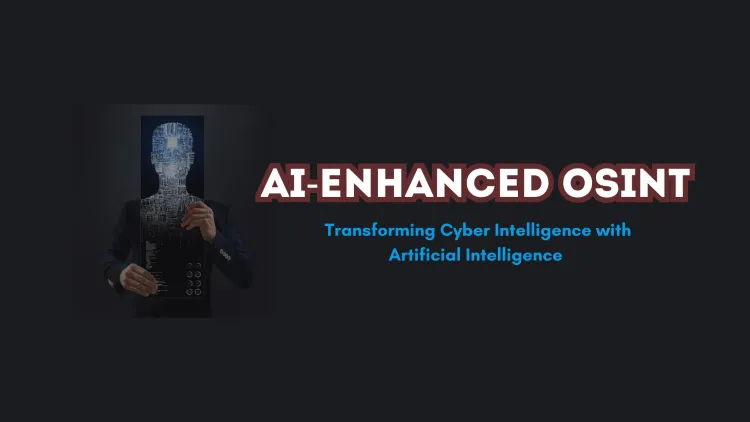
Artificial Intelligence (AI) is changing Open-Source Intelligence (OSINT) by automating data collection, analysis, and threat detection across various online sources, including social media, forums, and the dark web. AI-powered OSINT tools enable cybersecurity experts, intelligence agencies, and ethical hackers to efficiently gather and analyze publicly available data in real time. Using machine learning, natural language processing (NLP), and predictive analytics, AI enhances passive and active reconnaissance, helping to uncover security threats, monitor cybercriminal activities, and track individuals. However, while AI strengthens cybersecurity and intelligence gathering, it also presents ethical and privacy concerns, as malicious actors can exploit AI-driven OSINT for unauthorized surveillance and cyberattacks. This post covers how AI-powered OSINT tools are transforming digital investigations, the challenges they pose, and their role in the future of cybersecurity.
Quick answer: AI improves OSINT data collection by gathering and cleaning information from many public sources and highlighting relevant links between them. Passive collection uses public sources only, while active collection interacts with targets and carries more legal risk. Stay lawful, document sources and check results manually.
Key takeaways
- Clean data before analysis.
- Record sources and dates.
- Follow privacy law.
Table of Contents
- Introduction
- What is OSINT and How Does AI Enhance It?
- What Are the AI-Powered Tools for OSINT Data Collection?
- AI in Passive vs. Active OSINT Investigations
- What Are the Challenges and Ethical Concerns in AI-Enhanced OSINT?
- What Is the Future of AI in OSINT Investigations?
- Conclusion
Introduction
Artificial Intelligence (AI) is changing Open-Source Intelligence (OSINT) investigations by enhancing data collection, analysis, and automation. With AI-powered tools, security professionals, law enforcement agencies, and ethical hackers can efficiently gather publicly available information from various online sources, including social media, news websites, forums, and the dark web. AI streamlines OSINT investigations by automating data extraction, pattern recognition, and threat intelligence, making it faster, more accurate, and scalable. However, this powerful capability also raises ethical and legal concerns, as AI can be misused for cyber threats, surveillance, and privacy violations.
What is OSINT and How Does AI Enhance It?
Understanding OSINT (Open-Source Intelligence)
OSINT refers to the process of collecting, analyzing, and utilizing publicly available data to gain intelligence. It involves gathering information from:
- Websites and blogs (corporate, government, and personal sites)
- Social media platforms (Facebook, Twitter, LinkedIn, Instagram)
- Forums and dark web marketplaces
- News outlets, online databases, and archives
- Public records and government reports
How AI Enhances OSINT Investigations
AI-driven OSINT tools automate data collection, analysis, and correlation, making intelligence-gathering more efficient. Here’s how AI enhances OSINT:
- Automated Web Scraping: AI-powered bots extract and index data from websites, forums, and databases in real-time.
- Natural Language Processing (NLP): AI understands and interprets human language, helping analyze text from news articles, blogs, and social media.
- Machine Learning (ML) for Pattern Detection: AI identifies suspicious activities, trends, and anomalies in data.
- Sentiment Analysis: AI detects public sentiment and behavioral patterns by analyzing social media and online discussions.
- Facial Recognition & Image Analysis: AI helps track individuals through images, videos, and social media profiles.
- AI-Powered Dark Web Monitoring: AI scans hidden forums, marketplaces, and leaked data repositories to detect potential threats.
- Automated Translation: AI translates foreign language sources to uncover intelligence across different regions.
What Are the AI-Powered Tools for OSINT Data Collection?
Several AI-powered OSINT tools enhance data gathering and analysis:
| Tool Name | Functionality |
|---|---|
| Maltego | Graph-based link analysis for social media, domains, and networks |
| SpiderFoot | Automates reconnaissance by scanning domain, email, and network data |
| Recon-ng | Framework for gathering intelligence from online sources |
| Shodan | Identifies exposed devices and servers on the internet |
| DarkTracer | AI-driven monitoring of the dark web for leaked credentials and threats |
| OpenAI-powered NLP tools | AI-driven text analysis for extracting intelligence from articles and reports |
These AI-enhanced OSINT tools assist investigators, cybersecurity experts, and intelligence agencies in extracting actionable intelligence quickly.
AI in Passive vs. Active OSINT Investigations
Passive OSINT Investigations with AI
Passive OSINT involves collecting intelligence without interacting with the target. AI automates:
- Social media monitoring: AI scrapes Twitter, LinkedIn, and Instagram for insights.
- Data aggregation: AI-powered search tools collect structured and unstructured data.
- Metadata analysis: AI analyzes document properties to extract hidden details.
- Automated alerts: AI-driven notifications track changes in web pages and data leaks.
Active OSINT Investigations with AI
Active OSINT involves direct interaction with the target to extract data. AI helps in:
- Automated network scanning: AI identifies open ports and vulnerabilities.
- Deepfake and identity verification: AI detects fraudulent profiles and manipulated images.
- Threat actor profiling: AI maps threat actors based on their online activities.
What Are the Challenges and Ethical Concerns in AI-Enhanced OSINT?
While AI accelerates OSINT investigations, it also raises several concerns:
- Privacy Violations: AI-driven OSINT tools can intrude on personal privacy by gathering excessive data.
- Bias in AI Algorithms: AI-based intelligence gathering may be skewed due to biased training data.
- Misuse by Threat Actors: Cybercriminals can exploit AI-driven OSINT for reconnaissance and social engineering.
- Legal Implications: Unauthorized data collection using AI could violate cybersecurity laws.
- Data Authenticity Risks: AI-generated deepfake content complicates information validation.
To address these concerns, organizations must establish ethical AI usage policies, ensure compliance with data protection laws, and implement AI bias mitigation strategies.
What Is the Future of AI in OSINT Investigations?
As AI continues to evolve, its role in OSINT investigations will expand, offering advanced capabilities such as:
- Real-time threat detection with AI-driven analytics
- Integration of AI with blockchain for secure OSINT data storage
- More sophisticated AI-driven dark web monitoring
- Ethical AI models ensuring unbiased intelligence collection
Organizations must adopt AI-powered OSINT responsibly to enhance cybersecurity, threat intelligence, and forensic investigations while mitigating risks associated with data privacy and ethical concerns.
Conclusion
AI-enhanced OSINT investigations are transforming cybersecurity, intelligence gathering, and digital forensics by providing faster, automated, and more insightful intelligence. While AI improves data collection, pattern recognition, and risk analysis, organizations must balance its use with ethical considerations. The future of AI-powered OSINT lies in using automation for threat detection while maintaining privacy, security, and compliance.
To take this further with guided labs and an instructor, see our CTIA exam preparation.
Related reading
Frequently Asked Questions
What's Your Reaction?
 Like
0
 Dislike
0
 Love
0
 Funny
0
 Wow
0
 Sad
0
 Angry
0

Vaishnavi is a skilled tech professional at the Ethical Hacking Training Institute in Pune, responsible for managing and optimizing the technical infrastructure that supports advanced cybersecurity education. With deep expertise in network security, backend operations, and system performance, she ensures that practical labs, online modules, and assessments run smoothly and securely. Her behind-the-scenes contributions play a vital role in delivering a seamless and secure learning experience for aspiring ethical hackers.