How to Protect Your Personal Data: What Actually Works
Four things do most of the work: unique passwords in a password manager, phishing-resistant multi-factor authentication on the accounts that can reset everything else, software updates, and a backup you have actually restored from.
Topic: Cyber Threats, Scams & Online Safety in Cybersecurity & Ethical Hacking · Tutorial
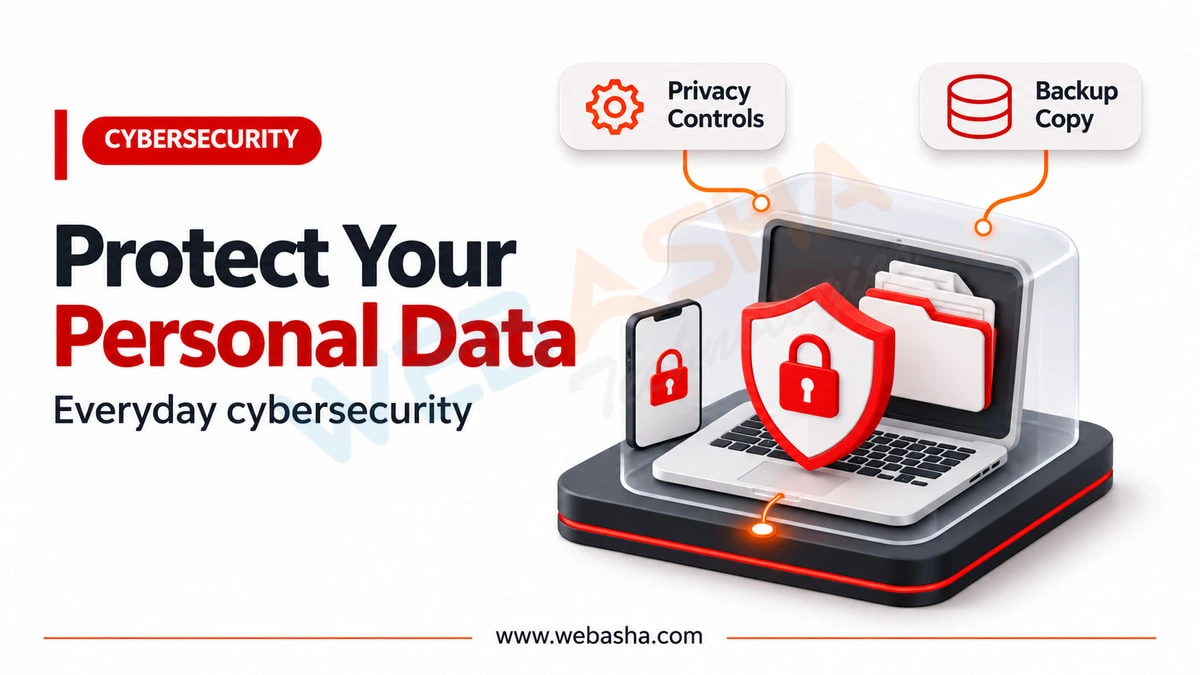
Quick answer: Four things do most of the work: unique passwords in a password manager, phishing-resistant multi-factor authentication on the accounts that can reset everything else, software updates, and a backup you have actually restored from. One piece of conventional advice is now wrong: the current NIST standard says verifiers SHALL NOT require periodic password changes, and sets a 15-character minimum rather than demanding symbols and mixed case. If your data is stolen in India, call 1930 and complete the portal complaint within 24 hours.
Key takeaways
- Stop changing passwords on a schedule. NIST's current text: "Verifiers and CSPs SHALL NOT require subscribers to change passwords periodically."
- Length beats complexity. The current minimum is 15 characters for a single-factor password, and composition rules "SHALL NOT" be imposed.
- Protect the email account first. It can reset nearly everything else you own.
- Phishing-resistant MFA matters more than any other single control, because codes can be relayed in real time.
- A backup you have never restored is not a backup.
Topics covered in this guide: what actually protects personal data, why unique passwords matter more than complex ones, what the current standard says, multi-factor authentication, which accounts to protect first, updates, recognising phishing, backups, how much to share, what to do after a breach, a realistic threat model, and phones.
Table of Contents
- What Actually Protects Personal Data?
- What Does the Current Password Standard Actually Say?
- Why Are Unique Passwords So Important?
- How Does Multi-Factor Authentication Help?
- Which Accounts Should You Protect First?
- Do Software Updates Really Matter?
- How Do You Recognise Phishing?
- What About Backups?
- What Should You Do After a Breach?
- What Is a Realistic Threat Model?
- How Do You Protect Data on Phones and Tablets?
- References
What Actually Protects Personal Data?
Four controls, in this order. Almost everything else is a refinement.
- A unique password for every account, which requires a password manager because no one can remember a hundred of them.
- Multi-factor authentication, ideally the kind that cannot be replayed.
- Updates, applied promptly rather than deferred indefinitely.
- Backups you have tested, which is what turns ransomware from a catastrophe into an inconvenience.
The ordering matters because effort is finite. Someone who does these four and nothing else is in a better position than someone who has read twenty articles and implemented a dozen minor measures.
What Does the Current Password Standard Actually Say?
This section exists because the advice most people have absorbed is now explicitly contradicted by the standard that produced it.
NIST SP 800-63B is the reference most organisations follow. The widely quoted 2017 edition was superseded by the 800-63-4 revision on 1 August 2025, and the current text says:
| Topic | Current requirement |
|---|---|
| Minimum length | "Verifiers and CSPs SHALL require passwords... to be a minimum of 15 characters in length" for single-factor use |
| Maximum length | "SHOULD permit a maximum password length of at least 64 characters" |
| Composition rules | Verifiers "SHALL NOT impose other composition rules" such as required mixtures of character types |
| Periodic change | "Verifiers and CSPs SHALL NOT require subscribers to change passwords periodically" |
| Hints | "SHALL NOT permit the subscriber to store a hint" that an unauthenticated person can see |
| Blocklists | Must be checked against a list of "known commonly used, expected, or compromised passwords" and rejected if present |
Three practical consequences for you as a user.
Stop rotating passwords on a schedule. Forced rotation makes people pick weaker passwords with predictable increments, and the standard now prohibits requiring it. Change a password when there is reason to think it was exposed, which is a different trigger entirely.
Choose length over symbols. A long passphrase beats a short password with substitutions, and the standard explicitly tells verifiers not to demand the symbols. If a site still forces them, comply and move on, but do not carry the habit to choices you control.
Check against breach lists. The standard requires verifiers to do this; you can do it yourself. A long password that has appeared in a breach is worthless.
Why Are Unique Passwords So Important?
Because the dominant attack on personal accounts is not guessing. It is credential stuffing: taking username and password pairs from one service's breach and trying them everywhere else, automatically.
Reuse is what converts someone else's security failure into your loss. A unique password per account contains the damage to the service that leaked it, which is the entire point.
This is why a password manager is the enabling control rather than a convenience. It makes the only workable strategy, a different long random password everywhere, something a person can actually do.
How Does Multi-Factor Authentication Help?
It means a stolen password is not enough on its own. That one change defeats credential stuffing entirely, because the attacker has the password and not the second factor.
The qualification that now matters: not all second factors resist phishing. A one-time code, whether by SMS or from an app, can be typed into a fake page and relayed to the real site by the attacker within seconds. That is routine rather than advanced.
| Factor | Stops credential stuffing | Stops real-time phishing |
|---|---|---|
| SMS code | Yes | No |
| Authenticator app code | Yes | No |
| Push approval | Yes | Weakly |
| Passkey or security key | Yes | Yes |
Passkeys and security keys are bound to the site's origin, so the browser will not release them to a lookalike domain. Use them where offered, especially on email. Our guide to why MFA is not always enough covers the failure modes.
Which Accounts Should You Protect First?
Not the ones with the most money. The ones that can reset the others.
- Your primary email. It can reset almost every other account you own. If you protect one thing properly, protect this.
- Your phone number and SIM, because SMS recovery runs through it. Set a PIN with your operator against SIM swap.
- Your password manager, obviously.
- Banking and payment accounts.
- Cloud storage, which usually holds documents and photographs worth more than people assume.
- Social accounts, which are used to impersonate you to others.
The ordering is about blast radius. An attacker with your email can obtain the rest at leisure.
Do Software Updates Really Matter?
Yes, and specifically because attackers use vulnerabilities after they are published, not before. A patch announcement tells everyone what the flaw is, and exploitation of unpatched systems follows quickly.
Turn on automatic updates for the operating system, browser and phone. The browser matters most for personal data, because it is the thing that handles untrusted content all day.
How Do You Recognise Phishing?
The old signals have largely stopped working. What still holds:
- An unexpected request to log in. The most reliable signal there is. Navigate to the site yourself rather than following the link.
- Urgency with a threatened consequence.
- A request to move outside the normal process, pay differently, or keep something quiet.
- A link whose host is not what the text claims. Read the domain, not the path.
The structural defence is the one from earlier: a passkey cannot be given to the wrong site even if you are completely fooled. Our guide to protecting against email phishing covers SPF, DKIM and DMARC for anyone running a domain.
What About Backups?
The useful rule is three copies, on two kinds of media, with one off-site. The part people skip is the test.
A backup you have never restored from is a hypothesis. Restore one file a month and one full restore a year. People discover a broken backup at the worst possible moment with striking regularity.
One ransomware-specific point: a backup drive permanently attached to the machine will be encrypted along with everything else. Keep at least one copy offline or in versioned cloud storage that retains previous versions.
What Should You Do After a Breach?
If a service you use is breached, or you believe an account is compromised:
- Change that password, and anywhere you reused it. This is the moment reuse costs you.
- Revoke active sessions, not just the password. A password change alone often leaves existing sessions working.
- Check for persistence: new mailbox rules, forwarding addresses, linked apps, added MFA devices and changed recovery options. Attackers add these within minutes.
- Enable MFA if it was not already on.
- Watch the accounts the email could reset.
If money has been taken, in India the clocks are specific. Call 1930, and then complete the complaint on the national portal within 24 hours: the I4C requires the formal complaint to follow "within 24 hrs using the acknowledgement number received on SMS". The call alone is not a complaint. Our step-by-step guide to filing a cyber crime complaint in India covers the process, and card fraud covers the separate bank deadline that governs your liability.
If you run an organisation rather than a personal account, CERT-In's directions of 28 April 2022 require listed incidents to be reported "within 6 hours of noticing such incidents or being brought to notice about such incidents".
What Is a Realistic Threat Model?
For an ordinary person, the realistic adversary is automated and indiscriminate: credential stuffing, mass phishing, commodity malware and SIM swap. You are not being individually targeted, and the controls that work are the ones that make you a poor return on effort.
This matters because it tells you what to ignore. Elaborate measures aimed at a determined individual attacker are a poor use of attention if you have reused a password on your email account. Do the four things in the first section before anything else.
A smaller but real category is someone who knows you, with physical access to your devices. Device encryption, a lock screen and not sharing unlock codes handle most of it.
How Do You Protect Data on Phones and Tablets?
- Screen lock and encryption on, which is the default on modern devices and worth confirming.
- Install from the official store only, and treat sideloaded applications as the risk they are.
- Review permissions periodically. An application with contacts, location and microphone access it does not need is a data leak that looks like normal operation.
- Set a SIM PIN with your operator, against SIM swap.
- Keep the device updated, and replace it when it stops receiving security updates, which is a real end-of-life rather than a marketing one.
- Do not save card details in the browser, because infostealer malware reads those profiles first.
Our guide to mobile application security covers what apps store on a device and where.
Talk to a WebAsha training advisor about batches, syllabus and current fees.
References
- NIST SP 800-63B, Digital Identity Guidelines, revision 4
- CERT-In directions under section 70B(6) of the IT Act, 28 April 2022
- Indian Cyber Crime Coordination Centre, answers to common questions
- National Cyber Crime Reporting Portal
- RFC 6797, HTTP Strict Transport Security
Related reading
Frequently Asked Questions
What's Your Reaction?
 Like
0
 Dislike
0
 Love
0
 Funny
0
 Wow
0
 Sad
0
 Angry
0

I am passionate about technology, invention and big challenging tasks on my to- do list. In terms of the work I am doing also at Bunnyshell, I am most passionate about the technologies that we are using., I'm devoted to delivering content that not only informs but also inspires. Whether you need in- depth analysis pieces, educational attendants, or study- provoking opinion pieces, I draft content that resonates with tech suckers and professionals likewise.