How to Use LLM with RAG to Chat with Databases | Complete Guide to SQL Query Generation with Natural Language Using Large Language Models
In today’s AI-driven world, businesses are increasingly adopting Large Language Models (LLMs) combined with Retrieval-Augmented Generation (RAG) to simplify natural language interactions with databases. This innovative architecture allows users to generate SQL queries automatically using natural questions like "Show me top products sold in 2024". The system intelligently extracts database schema, ranks the relevant tables, and uses prompt engineering to generate context-aware SQL statements. This guide explores how LLMs work behind the scenes, from schema extraction, ranking models, and backend APIs to LLM-generated queries, empowering both technical and non-technical users to gain instant insights without writing a single line of SQL.
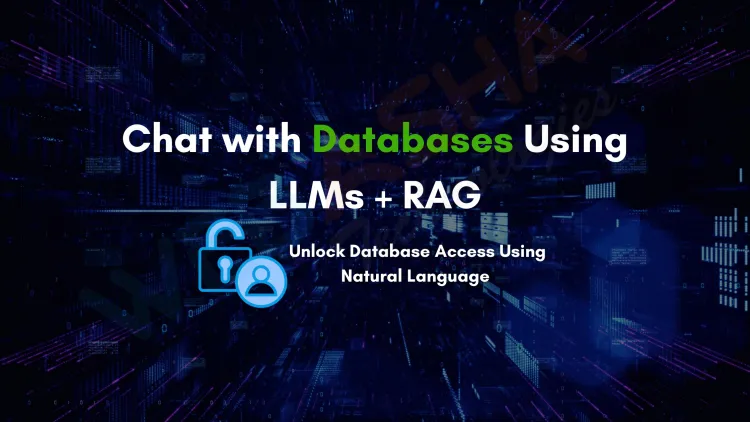
Quick answer: Retrieval-augmented generation (RAG) lets a large language model answer questions about a database by first retrieving relevant schema and context, then generating an accurate SQL query from a natural-language question. This gives non-technical users a way to query data in plain English. Security matters here: the system should restrict what tables a user's queries can touch and avoid exposing sensitive data.
Key takeaways
- RAG retrieves schema and context before the model writes the SQL query.
- Give the model read-only database access to limit damage from a bad query.
- Validate generated SQL before running it, since models can make plausible mistakes.
Table of Contents
- Introduction
- What is Retrieval-Augmented Generation (RAG)?
- Architecture: How LLMs Chat With Databases
- Real-World Example
- Security Considerations
- Future of LLM + Database Interactions
- Conclusion
Introduction
In AI and data science, one of the most revolutionary innovations is enabling Large Language Models (LLMs) to communicate with structured databases. By using a technique called Retrieval-Augmented Generation (RAG), LLMs can convert natural language queries into executable SQL statements, opening up powerful analytics for both technical and non-technical users.
LLMs use RAG architecture to understand, generate, and interact with databases, transforming natural language into real-time data insights.
What is Retrieval-Augmented Generation (RAG)?
Retrieval-Augmented Generation (RAG) is a hybrid framework that improves the accuracy of LLM outputs by incorporating relevant external information, in this case, database schemas and metadata. It allows the language model to go beyond static training data and generate dynamic, contextual responses.
When paired with databases, RAG enables LLMs to generate SQL queries by retrieving the appropriate schema and understanding the context of user questions.
Architecture: How LLMs Chat With Databases
Here’s a step-by-step breakdown of the RAG-based architecture used for enabling LLMs to interact with structured data:
User Interface (UI)
The user starts by typing a natural language query like “Show top-performing products last month.” This input is passed to the backend for processing.
Backend API
The backend API acts as a controller that links the UI, LLM, schema extractor, and ranking model. It handles schema extraction, prompt creation, LLM querying, and final result delivery.
Schema Extraction & Schema Cache
To help the LLM understand the database structure, it first performs schema extraction, retrieving table names, relationships, and data types. The extracted schema is cached to avoid redundant processing.
Ranking Model
Not every table in a database is relevant to every query. The ranking model scores and selects the most relevant tables and fields based on the user’s query, improving the accuracy of SQL generation.
Prompt Augmentation
The user’s query is combined with the relevant schema and ranking output to build an augmented prompt, which is then sent to the LLM. This prompt includes:
-
The original user query
-
Schema metadata
-
Ranked tables and relationships
Large Language Model (LLM)
The LLM (such as GPT or Claude) receives the augmented prompt and generates an SQL query tailored to the database schema.
SQL Execution & Output Delivery
The generated SQL query is executed on the database. The results are formatted and presented back to the user through the interface, typically as a table or chart.
Real-World Example
Let’s explore how this works in practice.
-
User Query: “Show sales revenue by product for Q4 2024.”
-
Extracted Schema:
-
products(product_id, name) -
sales(sale_id, product_id, sale_date, amount)
-
-
Relevant Tables Ranked:
sales,products -
Augmented Prompt Sent to LLM
Generated SQL Query
SELECT p.name, SUM(s.amount) AS total_revenue
FROM sales s
JOIN products p ON s.product_id = p.product_id
WHERE s.sale_date BETWEEN '2024-10-01' AND '2024-12-31'
GROUP BY p.name
ORDER BY total_revenue DESC;
Output:
A ranked table of products with their total sales revenue for the last quarter of 2024.
Technical Benefits
| Feature | Benefit |
|---|---|
| Natural Language Input | Enables querying by non-technical users |
| Schema Awareness | Increases accuracy of generated SQL |
| Prompt Engineering | Contextual input leads to relevant results |
| Reusable Architecture | Can be implemented with any RDBMS and LLM |
| Modular Design | Supports flexible, scalable, and customizable use cases |
Security Considerations
Integrating LLMs with databases comes with its own set of security concerns:
SQL Injection Prevention
Ensure the LLM-generated SQL queries are validated and safe from injection.
Access Control
Enforce role-based permissions to prevent unauthorized access to sensitive tables.
Auditing & Logging
Maintain logs of user queries and generated SQL statements for accountability and transparency.
Data Masking
Use data masking techniques to hide sensitive fields (PII, financials) in outputs.
Future of LLM + Database Interactions
The combination of LLMs and RAG with databases is set to transform analytics and automation. Upcoming innovations may include:
-
Voice-to-Data Queries
-
Auto Chart Generation with LLMs
-
Integration with BI Tools
-
Domain-Specific LLM Fine-Tuning
-
Enterprise Dashboard Automation
Conclusion
The ability for LLMs to chat with databases using Retrieval-Augmented Generation is redefining how organizations access and analyze data. Whether for business analysts, developers, or executives, this fusion allows anyone to extract insights using natural language, faster and smarter.
By understanding the architectural flow, from schema extraction to LLM-powered SQL generation, you’re ready to explore or build your own AI-powered data analytics interface.
To take this further with guided labs and an instructor, see our LLM engineering training.
Related reading
- Can ChatGPT Write Better SQL Than a Data Analyst? Complete Comparison with Real Examples
- [2026] Top 50+ Database Administration Interview Questions and Answers
- Kali GPT | How AI Is Transforming Penetration Testing on Kali Linux for Ethical Hackers in 2026
Reference
For the authoritative details, see OWASP.
Frequently Asked Questions
What's Your Reaction?
 Like
0
Like
0
 Dislike
0
Dislike
0
 Love
0
Love
0
 Funny
0
Funny
0
 Wow
0
Wow
0
 Sad
0
Sad
0
 Angry
0
Angry
0

Vaishnavi is a skilled tech professional at the Ethical Hacking Training Institute in Pune, responsible for managing and optimizing the technical infrastructure that supports advanced cybersecurity education. With deep expertise in network security, backend operations, and system performance, she ensures that practical labs, online modules, and assessments run smoothly and securely. Her behind-the-scenes contributions play a vital role in delivering a seamless and secure learning experience for aspiring ethical hackers.








![Top 10 Famous Ethical Hackers in India [Updated 2026]](https://www.webasha.com/blog/uploads/images/202608/image_140x98_da23f65c290cfbf1237d77aec58a2f0f.jpg)